Politics & Government
Parents Seek To Block School Budget Cap Question
Kelly Wieser of Campton and David Bates of Warner are seeking an injunction to block a school budget cap question from the November ballot.

CONCORD, NH — Two New Hampshire parents, one a school board member and the other a former school budget committee member, have sued to block the school budget cap question from appearing on the general election ballot in November.
The question would ask voters to cap school budgets to the rate of inflation plus new construction, to cap school administrative budget increases to six percent of the district’s budget, and to exclude capital costs from the calculations.
Find out what's happening in Across New Hampshirefor free with the latest updates from Patch.
The controversial House Bill 1300 passed the legislature with almost all Republican support and was signed into law by GOP Gov. Kelly Ayotte in June.
Although New Hampshire is not a referendum state, the back-door attempt at that comes after almost all school districts who had budget cap proposals on their warrants this spring and last saw them defeated. One school district voted to study a budget cap last year.
Find out what's happening in Across New Hampshirefor free with the latest updates from Patch.
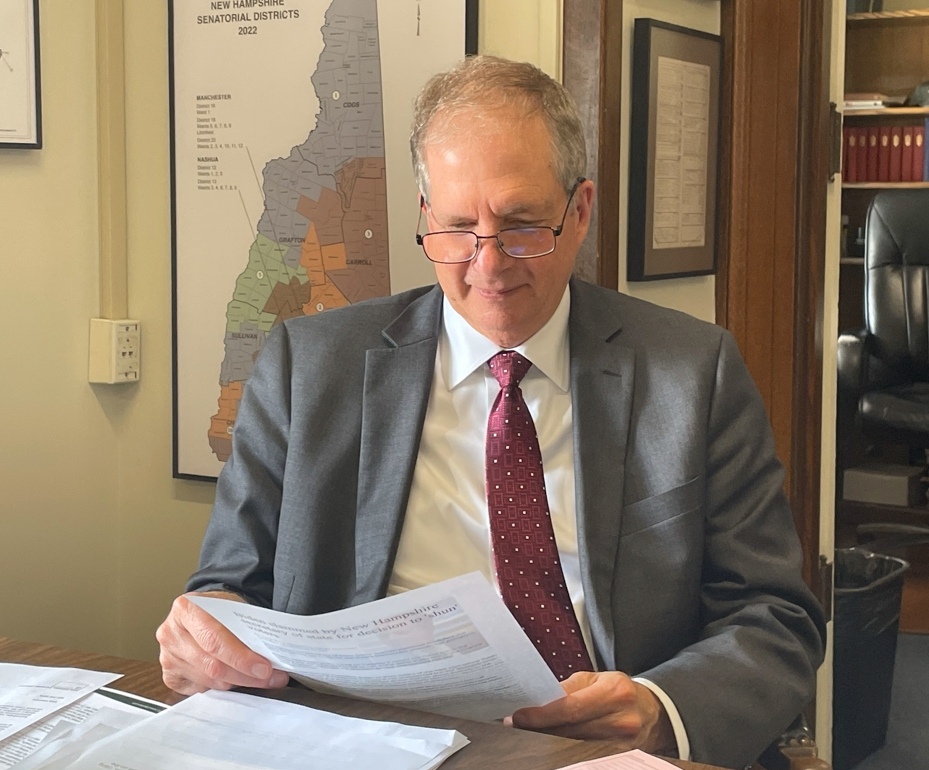
The suit was filed in Merrimack County Superior Court Monday by Kelly Wieser of Campton and David Bates of Warner, and seeks an emergency injunction to block Secretary of State David Scanlan from putting the question on general election ballots.
“I’m a former school budget committee member and a paralegal, but with all that experience the proposed ballot measure is still unclear,” said Bates. “I’m unsure what it would mean for my children, I’m unsure what it would mean for hundreds of kids in my district, and I’m unsure precisely what it would do for taxpayers.”
“As a New Hampshire native who attended the same elementary school as my children, I take pride in representing my town on our school board, where we have established processes for determining what is best for our community,” said Wieser. “I know how carefully we allocate every single dollar we budget to benefit our children’s education. It is inevitable, as laid out in this filing, that if this ballot question passed, we would have no choice but to consider budget cuts that would have the potential to impact classroom instruction and other school-based services.”
The plaintiffs are represented by two Hinckley Allen attorneys who claim the question is misleading and confusing and likely unconstitutional.
The litigants are seeking injunctive relief to remove the confusing and misleading question from ballots this November.
The lawsuit challenges the constitutionality of the ballot question on three grounds:
- The question is confusing, using structure, language, and terminology that are difficult for voters to understand and evaluate the impact.
- The question is misleading, directly claiming to not impact classroom or other school-based services, which is impossible to guarantee.
- The question impacts the right to vote, as the yes or no options do not represent the range of possible choices for voters outlined in the statute.
The language that would appear on the general election ballot is:
“Shall the [name of municipality] limit property tax growth for [name(s) of school district(s)] under RSA 32:5-i? If adopted for a two-year period: (1) the local property tax levy may not grow beyond the prior year’s amount, adjusted for inflation and new construction; (2) SAU central office spending may not exceed 6 percent of total school district appropriations; and (3) bonded capital costs are excluded from both limits. These caps apply only to administrative operations of the SAU central office and do not affect classroom instruction, school-based services, or other municipal expenditures. These limits may be overridden as provided in RSA 32:5-i. Adoption requires a three-fifths (3/5) majority vote.”
The suit claims many items in the ballot question are undefined, while many others lack details as to how they would work.
They also claim the question contains misleading statements like the cap would not apply to school instruction, school-based services or other municipal expenditures when that is not guaranteed as budget adjustments would be determined by school boards to meet the cap.
“A school district required to cut spending in order to comply with the tax cap that HB1300 would impose is limited to the smaller part of its budget containing non-fixed costs. The school board in the district would decide which costs to cut. The options available would include cutting staff positions, increasing class size, reducing course offerings, reducing co-curricular activities, reducing administrative staff or ancillary services, deferring maintenance issues and limiting purchases of equipment and supplies,” the suit notes.
The plaintiffs also contend the question would not go before voters until November when school districts are already well into their budget development process including negotiations with unions and the rate of inflation would not be known until after budgets are adopted.
The suit also contends that many school districts have already rejected proposed budget caps, and other school districts such as Dover, Franklin, Laconia, Manchester, Rochester, and Somersworth already have caps built into their budgets because of municipal budget caps, would have to vote in the next general election even though those caps are in place.
“I understand the urgency lawmakers feel when they want to pass something to prove to voters they are ‘doing something’ to solve a problem, but this particular measure was not ready for prime time when it was signed into law,” Bates said.
Property taxes cover about 70 percent of public education costs while state aid is about 17 percent. New Hampshire pays the lowest percent of education costs of any state in the country, but has failed to meaningfully increase state aid to education in a sustained fashion for some time.
The plaintiffs seek an emergency injunction noting the general election ballots will be printed soon after the primary election results are known. The state’s primary election is scheduled Sept. 8.
The plaintiffs’ attorneys assert they are likely to succeed because the question violates citizens’ right to vote guaranteed by the constitution because it is vague, confusing, misleading and contains fewer choices than the legislature intended.
Without the injunction, the plaintiffs say they face irreparable harm because a violation cannot be remedied through damages.
They argue the burden on the state is minimal as it can simply remove the question from the ballot, make the necessary corrections next year and then put the question to voters.
The plaintiffs also argue the constitutional standard is “the question submitted to the electorate” must give “the ordinary person a clear idea of what he (or she) is voting for or against,” from Fischer v. Governor from 1957. Otherwise, voters are deprived of the opportunity to “fairly express their will,” the attorneys write.
“Applying these principles, the HB1300 ballot question does not pass constitutional muster because its ambiguities and omissions will deprive voters of the opportunity to fairly express their will about the school funding caps,” the suit claims.
After voters rejected every school budget cap put before voters in 2025, Republicans tried unsuccessfully to introduce a statewide school budget cap in the legislative session.
House Majority Leader Jason Osborne, R-Auburn, said after a very lopsided Kearsarge Regional School District vote against a proposed budget cap, “Perhaps, if (local voters) are unwilling to cap themselves, the state will step in and cap local taxes for them.”
This past legislative session the Republican leadership supported HB 1300 which went through a number of changes before it was approved after a conference committee worked out differences between House and Senate versions and over the objection of educators, school officials and local budget writers.
“It is frustrating that the legislature would pose this question, which seems designed to intentionally mislead voters about the impact of their decisions,” said Wieser.
The plaintiffs ask for expedited consideration by the court, including an expedited briefing schedule and hearings.
And they ask the court to require the Secretary of State to ensure the question is not presented to voters for the Nov. 3 general election.
Under HB 1300, the question would be on the general election ballot for both the 2026 and 2028 general elections.
Supporters of the bill argued that more voters need to decide if a budget cap is necessary as a smaller number and those with “special interests” determine school district warrant articles.
Turning out voters who want to cap their property taxes is also a way of bringing out many voters who do not vote in general elections, and the Republicans who proposed HB 1300 are hopeful they will turn out and vote for Republicans if they do, as a get-out-the-vote technique.
Garry Rayno may be reached at garry.rayno@yahoo.com.
This story was originally published by InDepth NH.