Politics & Government
2012: The Nastiest Election Ever?
Former and current candidates agree that campaigns are getting unbearable.


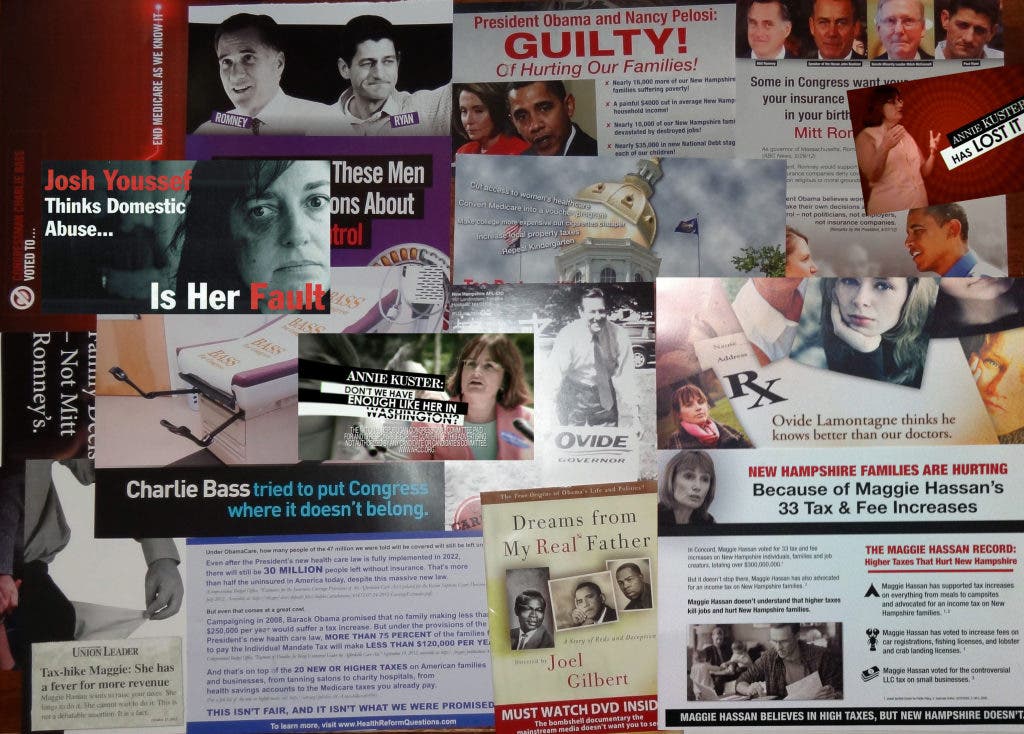
One candidate allegedly wants to strip away all of your rights while the other reportedly wants to raise taxes. This candidate voted for this thing while that one voted for that thing. He’s in the tank for special interests. Well she is uncivilized. She likes to eat children while he cooks grandma on the spit.
OK, OK, it’s not quite as bad as that last one … but it’s getting close, isn’t it?
It seems like each and every election cycle, the voters, the candidates, and even sometimes the press, complain how negative the entire process has become. While it has always been negative in some way, how did it get this way and what can be done about it?
Find out what's happening in Concordfor free with the latest updates from Patch.
Maggie Hassan, the Democratic candidate for governor, said it was important for everyone to “set a tone that acknowledges that we all have a roles to play.” She said that when working in the Senate, there seemed to be respect because everyone was sitting next to someone else of another party who was sent there by other voters. She said, if elected, she would build relationships with people and “have open and civil discussions” because “the people of New Hampshire want this to work.” Hassan said if everyone can honor each other, a lot of work can be done.
“It’s up to all of us as we engage in these campaigns to try to remember that,” she said, “and it’s particularly important to a governor to set the tone and that’s something I intend to do.”
Find out what's happening in Concordfor free with the latest updates from Patch.
Her Republican opponent, Ovide Lamontagne, said the way he was conducting his campaign was they way he would elevate the tenor “to a higher level of discourse” with the state races staying “very focused and honorable.” He chastised “the bombardment of third party advertisements,” especially on the presidential level.
“I get along with Maggie Hassan, on a personal level,” he said. “I like her very much. We disagree on policy. But when we’re together, we’re not disagreeable to one another and I want to make sure that it stays that way.”
In his 2010 Senate race, Lamontagne said things also stayed relatively professional with Kelly Ayotte, the woman who eventually won the seat by a sliver.
Lamontagne said as more voters turn to the Internet and social media to gather all their information, campaigns will have other ways of communicating with voters beyond just television ads.
U.S. Rep. Charles Bass, R-CD-2, said the negativity problem was a “long-term trend” by the Supreme Court to allow individuals and groups to do what they wanted to do with their own money.
“I don’t see any way you can turn that process around,” he said, adding that he has continually supported and voted for “meaningful campaign finance reform.”
Bass said anything new to rein in the advertising would need to be done during a non-election year, in order to make sure that no one had an unfair advantage during an election. He added that the only advertisements in his campaign have been used to contrast his record on the economy and taxes with his opponent’s, Ann McLane Kuster.
“Now admittedly, we bring an element of humor to a very serious subject,” he said, speaking about his Kuster tap dance ad.
At the same time, Kuster’s ads made fun of his name and mentioned things that had nothing to do with his record, he stated.
Former U.S. Rep. Paul Hodes, D-Concord, said the negative advertising had become a problem but he said that a lot of it could be curbed by the candidates themselves, agreeing with others that “showing respect to the other side and making sure that the focus is on contrast on issues, contrast on policies, because that’s what people care about.” He said it was easy to say that the contrasts could become negative.
Hodes also agreed that the big problem seemed to be the third party groups that weren’t coordinating with the campaigns due to laws restricting communication between the two entities. He said the lack of coordination meant that candidates cannot stop the negative advertising even if they wanted to. Hodes said there was a very fine line between the two but there was still a line.
“Because of Citizen United, there’s a huge amount of money being thrown around,” he said.
Hodes called on supporting legislation to “control” Citizens United as the first and most important thing that could be done in order to get the groups out of politics.
“Controlling the money going into the Super PAC world is probably one of the best things that can be done,” he said.
U.S. Rep. Frank Guinta, R-CD-1, said it was important for candidates to focus on “policy and substance.” He said voters do reward candidates with positivity. He said in his race, Carol Shea-Porter shot the first volley of negativity into the race during a debate in August when he alleged that the host of the debate had to step in and tell the former representative to focus on her issues not mudslinging.
“The next day, my opponent went up on TV with a negative attack,” he said.
Guinta said he has always tried to have an agreement with opponents to stay positive but if that doesn’t work, he has to go negative too, “because you can’t allow another candidate or organization to distort your record.” Shea-Porter later took the ad down.
Another issue Guinta had been seeing was the Democratic Congressional Campaign Committee stating that he had voted for lower taxes on millionaires and higher taxes on the middle-class when no such vote had taken place.
“The electorate is very frustrated with negative campaigning,” he said, “but more so, they are frustrated by distortions and lies. I think the people around New Hampshire and the country want to hear facts, substance and policy, and make decisions based on facts, substance, and policy.”
Congressional candidates Kuster and Shea-Porter did not return requests for comment.
Get more local news delivered straight to your inbox. Sign up for free Patch newsletters and alerts.