Politics & Government
City Official Says Employment Security Project Financials Add Up
Special projects director: Splitting $7M viability gap will bring 125 market rate apartments to Downtown Concord; Council to decide Monday.


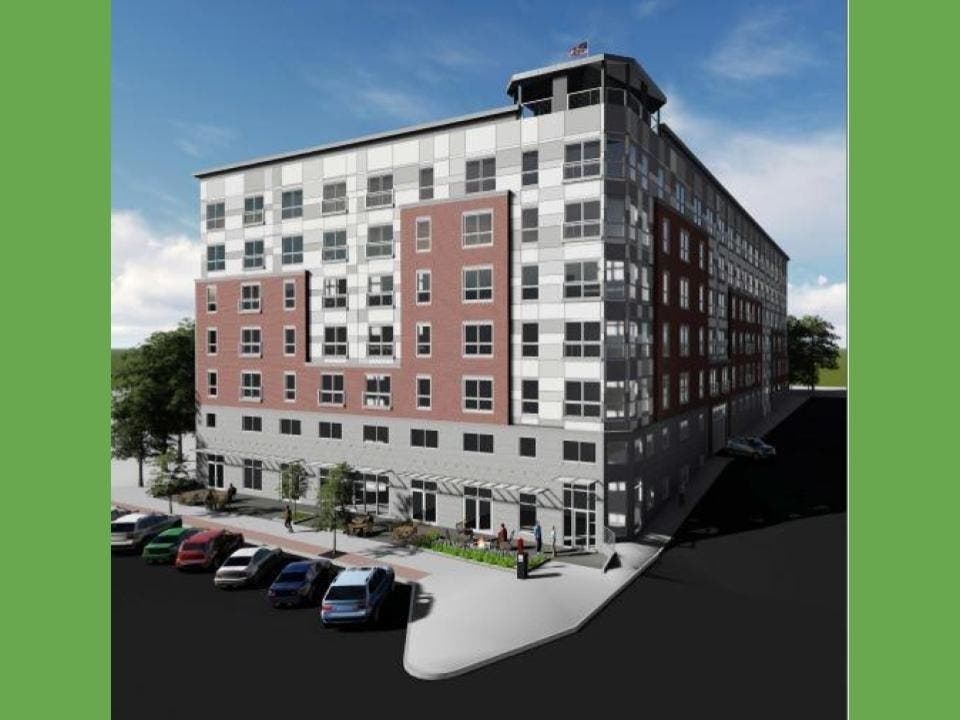
CONCORD, NH — The Concord City Council will consider whether or not to revise – and sweeten – a purchase and sale agreement with an out-of-state developer to construct market rate apartments at the location of the former New Hampshire Employment Security building on South Main Street. After holding a public hearing in July, the council will decide Monday whether to proceed with the project – with millions more in incentives requested by Dol-Soul Properties of Woburn, Massachusetts, the potential developer of the parcel.
Originally, the city – which borrowed and spent $2 million to buy and mothball the building – had entered into an agreement with Dol-Soul for 109 market rate apartments and a restaurant on the parcel for $1.075 million. Parking spaces and capped fees were also part of the deal.
Nearly two years later, Dol-Soul, which has two other complexes in Concord, is looking to build 125 market rate apartments with a restaurant but projects that revenues would fall about $7 million short after construction. In order to move forward with the deal, Dol-Soul wants the city to agree to a new purchase and sale agreement with $4.63 million more in incentives.
Find out what's happening in Concordfor free with the latest updates from Patch.
The city would use tax increment financing – TIF – from the Sears Block District to essentially borrow against current and future tax revenue on properties downtown to pay the incentives. The Sears Block TIF includes all of the properties between Depot Street, Storrs Street, Theatre Street, and South State Street, sans the Kennedy Apartments and Capital Center for the Arts to the South and Bicentennial Square properties to the north. Tax revenues from those properties are currently paying for the city's share of the Storrs Street Garage and Capitol Commons redevelopment project (which used to be where Sears was located, hence the name).
ALSO READ:
Find out what's happening in Concordfor free with the latest updates from Patch.
- Russell: $3.5M In Corporate Welfare In Concord?
- Washburn: I find it incredulous the the Concord city council would hold a public hearing of contributing $3.5 M on a proposed development for the former Employment Security building.
- Former NH ES Building Developer Wants $3.5M More From Concord
- Concord Could Lose $1.3 Million On Former ES Building Sale
- Council Rejects Employment Security Building Proposals
- City Extends Employment Security Building RFP Deadline
- City to Charge for Parking in Former NH ES Lot
- What Should Be Built at the Employment Security Building?
- City Acquires Department of Employment Security Building
- City to Get Employment Security Building
- Should the Concord City Council Buy the ES Building?
- City of Concord Wants NH Employment Security Building
In a timeline of financials presented to the council and the public, Matt Walsh, director of Redevelopment, Downtown Services, & Special Projects for the city of Concord, predicted that if everything goes as planned, the Sears Block TIF would be fully paid by 2032, due partially to the city's high bond rating and the project's value.
"It's a snapshot in time," Walsh said, about having the TIF district paid off by 2032. "Another project could come in and say, 'We also need assistance through the TIF,' which could change the numbers there. It changes all of this."
What Increased The Cost Of The Project?
During the past two years though, some of the developer's costs – and the financials – have changed.
At first, the city was looking at preliminary numbers of assessed value of the completed project to be around $12.5 million versus development costs of the project which has jumped to around $21 million. Construction costs have gone up at least 20 percent since 2017, as seen with other projects the city has worked on, including the community center on the Heights and the new Skate House at White Park.
"That's a real problem," Walsh said. "And the thing that is driving the construction numbers is that there are not enough subcontractors for most of the trades out there. There is no workforce and no skilled workforce to draw from the trades … which is really tough."
This requires more workers to be brought to the area from other locations to come to Concord to work on the project, raising labor costs.
The building is also slightly larger than originally conceptualized, with more apartments.
These combined factors have raised the initial costs to construct a new building at the site to more than $30 million, according to the developer's data. The project's revenues, however, only support a development cost of around $23.4 million, leaving a gap of about $7 million.
While the project doesn't have a parking requirement – no housing built in the central business district has the requirement, Walsh noted – the developer needs to have a certain amount of parking to make the project rentable. Lenders will also be more secure knowing they will be paid back if the apartments are rented and renters have parking spaces, he said.
All real estate development involves some amount of risk and while many projects are profitable, many aren't, which makes the profitability portion of this project – and hedging about the $7 million – questionable. But Walsh said other projects had come along wanting more money and incentives. The TIF, he added, has the financial capacity to hold off on working with Dol-Soul. But decisionmakers have to look at the analogy of whether or not a buyer would spend $400,000 for a house that was only worth $200,000.
"Would you as a developer say, 'OK, I need to spend $30 million on a project that is only going to valued at $23 million' or would you take your capital somewhere else and spend it on another project that you would make the return on investment?," Walsh asked when questioned about the need for more incentives. "Because, right there, you're upside down."
Splitting the gap down the middle, after eyeing the financials, is the best proposal to move forward, Walsh said.
"We are comfortable that their numbers are real," he added.
A History Of TIFs In Concord
TIF districts have been around since the late 1970s and Concord has used them for a number of projects including the Capitol Commons project, the Horseshoe Pond development, and other smaller projects in the city. Officials are currently holding open the North End TIF district to potentially pay for a northern section of Storrs Street. That is being held up though while I-93 expansion and potential rail projects get settled. For now, two-thirds of the North End TIF is being returned to the general fund coffers, Walsh said.
"These projects do work," he stated. "It's almost saving your retirement account. You put away your money, for 40 years of work, and you don't get to see it; it grows in an account and it is there on the backend, when you need it. TIF is kind of the same thing."
Got a news tip? Send it to Tony Schinella at tony.schinella@patch.com.
View videos at https://www.youtube.com/user/tonyschinella.
Get more local news delivered straight to your inbox. Sign up for free Patch newsletters and alerts.