Politics & Government
Concord City Councilors Haggle For Hours; Only Cut 1% In Taxes; Golf Clubhouse Approved
Faced with a proposed 3.96% property tax increase, councilors reject a revenue-neutral budget, spend hours finding only $281K in savings.


CONCORD, NH — Anyone who has eaten sausage with eggs at their favorite greasy spoon diner or in a roll with mustard at a ballgame or some other event knows while they taste great, you don’t want to know how they are made.
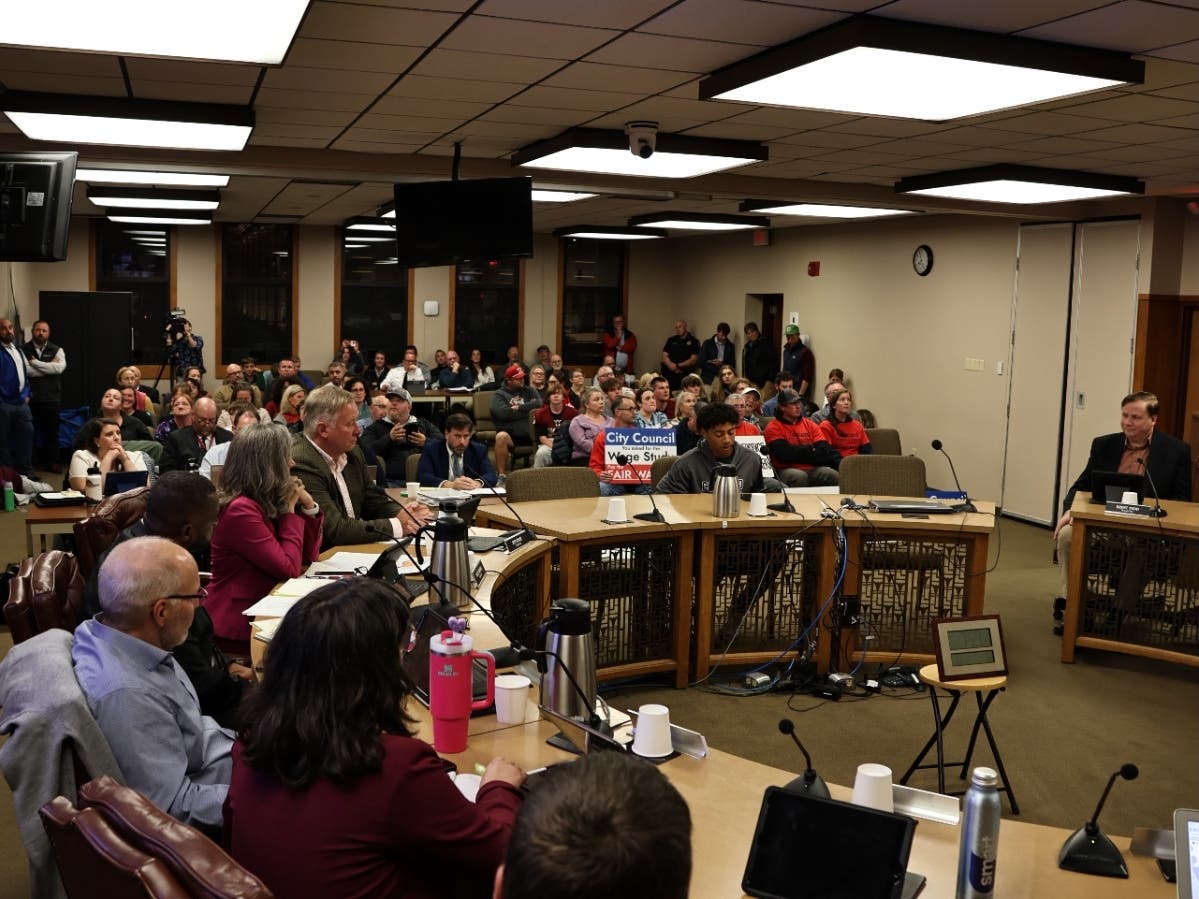
The same could be said for the Concord City Council meeting about the fiscal year 2026 budget Thursday night, a nearly six-and-a-half-hour ordeal of micromanagement, minutia, and disorganization which failed to lead to the one thing property taxpayers and renters in New Hampshire’s capital city have been clamoring for: A significant decrease in the tax rate increase and property taxes, something many of the councilors acknowledged but failed to produce despite the lack of trying.
In fairness to the councilors and the mayor, some arrived with lists of things that should be cut or curbed. Others had ideas but also wanted to hear proposals from their colleagues. But there was not much transparency to the process. No handouts were available for the press or the dozens of people attending the hearings. It was not until around two-and-a-half hours into the finance committee hearing Mayor Byron Champlin’s recommendations were posted onto a projector screen and via Concord TV from a computer in the meeting room.
Find out what's happening in Concordfor free with the latest updates from Patch.
Also Read
- Last Chance To Comment On Concord’s $155M Budget, New Golf Clubhouse Proposal
- See What’s Inside The Concord City Manager’s $155 Million Fiscal Year 2026 City Budget
Many of the comments on Friday morning by several politicos across the city were not surprising: A calamity, a clown show, and a cluster.
View the entire meeting on YouTube.com, linked here.
Find out what's happening in Concordfor free with the latest updates from Patch.
After approving the minutes of the previous finance committee meeting, councilors held a work session to propose changes to City Manager Tom Aspell’s $155 million FY26 budget.
Champlin proposed lowering the tax rate from 3.96 percent to 3.46 percent by making some cuts or delaying some hires, and eliminating equipment and training, about $280,000. Champlin also suggested adding $150,000 from the economic development trust for event promotion, essentially an event promotion slush fund, and transferring $205,000 to clean up — and clear out, Healy Memorial Park.
At-Large Councilor Amanda Grady Sexton proposed a revenue-neutral budget, essentially making about $2 million in cuts to the city manager’s proposed budget, with Aspell coming back to the council with proposed reductions. She said everyone worked hard to preserve the vibrant city and essential services.
“However,” she added, “the one consistent message that I have heard from residents is that their income is not increasing at the same rate that their taxes are and that rents and property taxes are no longer affordable.”
Grady Sexton said this was the 15th budget she had worked on and was one of the toughest, requiring “some very tough choices.” While she commended the small cuts approach, she said, ultimately, it would not be enough to reduce the tax rate substantially. Grady Sexton said she previously opposed the $10 million golf course clubhouse plan. The new plan, though, was cut in half. And, if approved, the latest proposal had no tax rate impact for the first two years. She believed, too, the city manager could find the efficiencies to keep the tax rate hike to zero.
Another at-large councilor, Fred Keach, said he came down between Champlin and Grady Sexton and proposed a 1 percent tax rate reduction. He also suggested Aspell make recommendations.
“(We need) to respect his discretion and his proximity to department heads and each department to find that savings,” he said. “So, I’d like to give him the discretion to do that.”
Keach recognized, too, public safety was a priority. But allowing Aspell and department heads to make the cuts was “the fairest way to approach this.” Keach also suggested delaying the Garrison Park Pool renovations, about $575,000, spread out between three fiscal years of bonding in 2028, 2029, and 2033. He said the city sustaining seven pools seemed “unrealistic.”
Ward 3 Councilor Jennifer Kretovic also agreed having Aspell consider the budget changes was appropriate. She also proposed a $50 annual capital fee on every non-resident who uses the Beaver Meadow Golf Course, a proposal approved later in the evening. Kretovic said juvenile golfers who live outside Concord, though, would not pay the fee.
Ward 5 Councilor Stacey Brown proposed removing $50,000 from the economic reserve fund to use for workforce development for people with language barriers and childcare issues. She also proposed removing funds being spent on irrigation at the golf course and from the Northeast Corridor TIF for an expanded Storrs Street, which was several years out. Brown also wanted $500,000 of the recreation reserve to go toward a new skateboard park and restoration of two truck drivers and laborers for the sign crew working for general services for about $181,000, for crosswalks and pedestrians.
“I think having clear, crisp, white lines is really important,” Brown said.
Brown also proposed tabling the golf clubhouse, saying there had not been a public hearing about the revised plan, and hundreds of residents had opposed prior plans.
Ward 10 Councilor Jeff Foote said he appreciated everyone’s proposals to lower the tax rate. He proposed converting all mail from color copying to black and white, which officials said would save about $15,000. In previous years, councilors requested the change to color since the bills were easier to read. Foote also wanted to “jumpstart the effort” to fund the skateboard park, maybe about $50,000 from the $750,000 committed to a new Memorial Field plan.
“It’s a thought,” he said.
Foote also proposed splitting the $1.2 million in new streetlights into a two-year plan, $600,000 yearly, instead of one year. That idea was later withdrawn. Later on in the evening, he also expressed dismay over the low impact fees the city was charging for development. He claimed the city could see about $1 million more in revenue with a different fee structure.
After hearing the proposals, Champlin suggested taking up Grady Sexton’s first, due to its “magnitude,” and since if it were approved, everything else would “probably fall by the wayside.”
Grady Sexton made the motion and Ward 2 Councilor Michele Horne asked if Aspell would have to come back with cuts to the council or make them on his own. Champlin said he would be directed to make them on his own.
That did not sit well with Brown, who liked the idea but said Aspell should come back and they should hear from the public about what he proposed. Grady Sexton said Aspell heard all the comments by councilors on what they wanted cut and things could be added back, if needed, later.
Ward 9 Councilor Kris Schultz, too, said cuts across the board without feedback were not a good idea.
Keach said the most realistic way to consider cuts was to have Aspell do them. But, he added, it was not stagnant. Money could be added back. Keach was also critical of councilors getting “down into the weeds” on things like golf course greens fees and other minutia, “all this nonsense,” which was not the role of a councilor.
“We should set policy, and we, presumably, hire professionals that know what they’re doing,” he said. “And let them go; let them go and do their job.”
At-Large Councilor Nathan Fennessey spoke against the proposal and said there were tough decisions councilors needed to make. He pointed to new employment contracts for nearly every union in the city, which all received raises of 4 percent to 5 percent. Fennessey proposed having “good conversations,” as members, to lower the rate by around half a percent or 1 percent.
“We’ve already made choices that, you know, apply to 75, 80 percent of the budget,” he said. “So what you’re saying to the city manager is, for the last 20 percent, I want you to cut 4 percent. That’s what you’re saying. I don’t support that.”
At-Large Councilor Judith Kurtz stood by the new union contracts and admitted a large part of the tax increase was going toward those pay raises. She called it “a heavy lift,” but was also concerned about daily city services a 4 percent tax rate cut might harm.
“If we did this,” she asked, “if we (approved the amendment), are there things that we would immediately feel or that our constituents would immediately experience and feel?”
“Yes,” Champlin said.
Aspell said he would have to go back through everything, but many unfilled positions would not be filled, and current employees would no longer have jobs.
“Yeah,” he said. “I can’t tell you where. I can’t tell you now. But as of July 1, that would be the situation.”
Ward 4 Councilor Karen McNamara said she was uncomfortable with a 3.95 percent tax increase yearly. The community, she said, was uncomfortable with the current taxes, never mind the future taxes with capital projects and other expenses.
“Nothing is going down,” she said, “it’s all going up.”
Grady Sexton said things needed to be cut if the council lowered the tax rate. She said there were smaller items that could be cut. But Grady Sexton said those items would not be significant enough. At the same time, residents “have consistently told us they cannot absorb these tax increases that we are handing down to them, year after year.”
Keach agreed, since more than 80 percent of the city budget is spent on employees, jobs would be lost. But he also suggested starting with the vacant positions and a hiring freeze, to see what kind of money could be saved. Keach also raised the issue of a tax cap, which he did not support, but was bandied about in Concord about 15 years ago. The cap locked the council into a set rate regardless of what may happen in the future. Part of the budget problem, he added, was outside forces around the council, including the school districts.
Much of the burden on property taxpayers and renters is the two school district budgets, which are autonomous, something very few communities in the Northeast have to deal with. The SAU 8 budget, which represents about 85 percent of students in the city, was settled earlier in the year. The SAU 8 district has a nearly quarter-of-a-billion-dollar (including interest) middle school project looming on the horizon, for which many don’t want to pay. The city and school district are also eyeing a $30 million plan to update and renovate the Memorial Field athletic complex (the Merrimack Valley School District has its own fields in Penacook).
Some councilors also expressed frustration about the Legislature passing on costs to cities and towns.
“The dynamics,” Keach said, “are just really complicated.”
Brown said the tax increases were not sustainable. But as elected representatives, they should make the spending decisions, and Aspell should manage employees.
Brent Todd of Ward 1 said zero tax increases have been done before, including in June 2020 for FY21, during the coronavirus pandemic. He said positions were not cut back then. But Todd asked Aspell about the cuts made then.
Aspell said some cuts could be made permanently, but he was not prepared to discuss a $2 million budget cut. The issue, he said, was employee contracts, which were three to four years. The council, he said, was going to need to make cuts for this budget and future budgets. Health care, too, would increase annually, and so would dental insurance, too. The retirement system decreased slightly, but the new employee contracts wiped out those savings due to the increased wages of the new contracts.
“If you want to (have a revenue-neutral budget),” he said, “you need to make those cuts now.”
After about 90 minutes of discussion, Grady Sexton’s motion failed by a 2-12 vote.
A motion by Keach to have the city manager prepare a 1 percent reduction also failed, 2-12.
A motion by Fennessey to have a 1 percent reduction put together by Aspell and the councilors also failed.
Councilors then discussed Champlin’s proposals. Most were approved.
Fennessy added $65,000 in police department attrition to Champlin’s $35,000, which was approved. The council approved not hiring a third social worker for the police department until midway through the fiscal year. They also eliminated training programs, about a $10,000 funding cut to the CAT bus, and other items, which reached about $280,000.
Fennessey then motioned to have Aspell find 0.5 percent more in cuts, which was approved by a 12-2 vote.
At the time of this post, it is unknown exactly how much those cuts will be and what they will entail.
During a discussion about the Healy Memorial Park clean up, Foote returned to a question he had two weeks ago about whether price estimates to clean up the homeless camp under the Water Street bridge, where there have been several fires and explosions. Aspell expected that location, too, to be cleaned with the $205,000, based on new pricing from vendors.
The event slush fund was also approved by a 13-1 vote to be returned to the budget.
Brown made several requests to modify the budget, including the abovementioned items. Most were either not approved or failed to get a second motion from her colleagues.
Brown proposed eliminating $3,500 in fees for golf employees to attend tournaments at other courses as part of their professional development, but it failed by a 5-9 vote. Another member did not second a proposal to increase non-resident fees at the golf course. A request to divert $500,000 to the skateboard park from the recreation reserve fund was also rejected by a 2-12 vote.
Brown and Horne were the only councilors to vote for a motion to table the golf course, which failed 2-12.
Foote’s proposal to go back to black and white printing to save $15,000 was approved 14-0. He withdrew the proposal to stretch out the lighting to two years instead of one. Foote also withdrew a motion to move some of the Memorial Field planning money to the skateboard park.
A 13-1 vote approved Keach’s proposal to delay rebuilding the Garrison Park Pool.
The finance committee closed its work session and reconvened as the city council just before 11:30 p.m.
They held four public hearings to discuss the budget, approve capital projects, borrow money, and set water and sewer rates.
During the public hearing about the capital projects, several spoke in favor of the new golf clubhouse. Brown asked a few people where they resided, for the record.
One speaker, Keith Duclos, owns the Broken Tee, the business that serves food and drinks at the facility. He said the new plan would help him with his business and serving customers at the course.
Mark Stevens, a former resident who graduated from Concord High School and worked at the course, said it helped him through those complicated years, and he became so good at the game, he won a golf scholarship to URI. Champlin noted he also attended URI.
Former city councilors Allan Herschlag, Mark Coen, and Robert Washburn also all spoke.
Herschlag said the city had wasted hundreds of thousands of dollars on zoning that it threw away, as well as the study of a deck park over Interstate 93, a ridiculous proposal. On Healy Park, he said, “Thank you … it’s about time,” and called for the clearing out to be “aggressively maintained.”
Coen commended councilors and Herschlag and Washburn for attending the hearing and for supporting the revamped clubhouse proposal. He called it a solid business plan by Aspell.
Washburn said the Northeast Corridor TIF district, about $3 million with $400,000 in outstanding debt, should be closed. He said I-93 expansion won’t be completed, “maybe,” by 2038. That money, he said, could be used entirely this year. It could also be used to offset interest payments on capital projects, saving taxpayers millions of dollars in the future.
Washburn, too, spoke in favor of the clubhouse, but was critical of the six-hour-plus meeting.
“By the way,” he said, “I’m having flashbacks from budget hearings, having sat through 10 of them. I’ve never seen such an elongated process like tonight to accomplish a 1 percent reduction. I don’t get it.”
In a second opportunity to speak, Herschlag thanked Coen for his polite remarks, saying they were more than he had ever said to him, even when they sat at the council table together for six years.
The council then voted on the four items.
The first item, a resolution appropriating money for the fiscal year 2026 budget, including the general fund, special revenue funds, and other items, was approved.
Brown, whose husband is a police detective, did not vocally recuse herself from the vote. At publication, it is unknown if her lack of a vocal recusal violated the conflict rule or if she did not vote on the budget, since it was approved by voice vote.
A resolution to repurpose funds from capital projects was approved.
Kretovic also recused herself for the fee line item for the municipal association, of which she is a board member.
The capital budget was approved with Brown and Horne audibly voting No.
Water and sewer fees were also approved by voice vote.
Ward 8 City Councilor Ali Sekou was the only councilor not in attendance.
Do you have a news tip? Please email it to tony.schinella@patch.com. View videos on Tony Schinella's YouTube or Rumble channels. Patch in New Hampshire is now in 190 communities. Also, follow Patch on Google Discover.
Get more local news delivered straight to your inbox. Sign up for free Patch newsletters and alerts.