Schools
Concord Residents, Others Eye Design, Equity Of A New Middle School
Dozens of residents, school employees, board members discuss educational outcomes, costs, safety, and sustainability of a new $176M school.


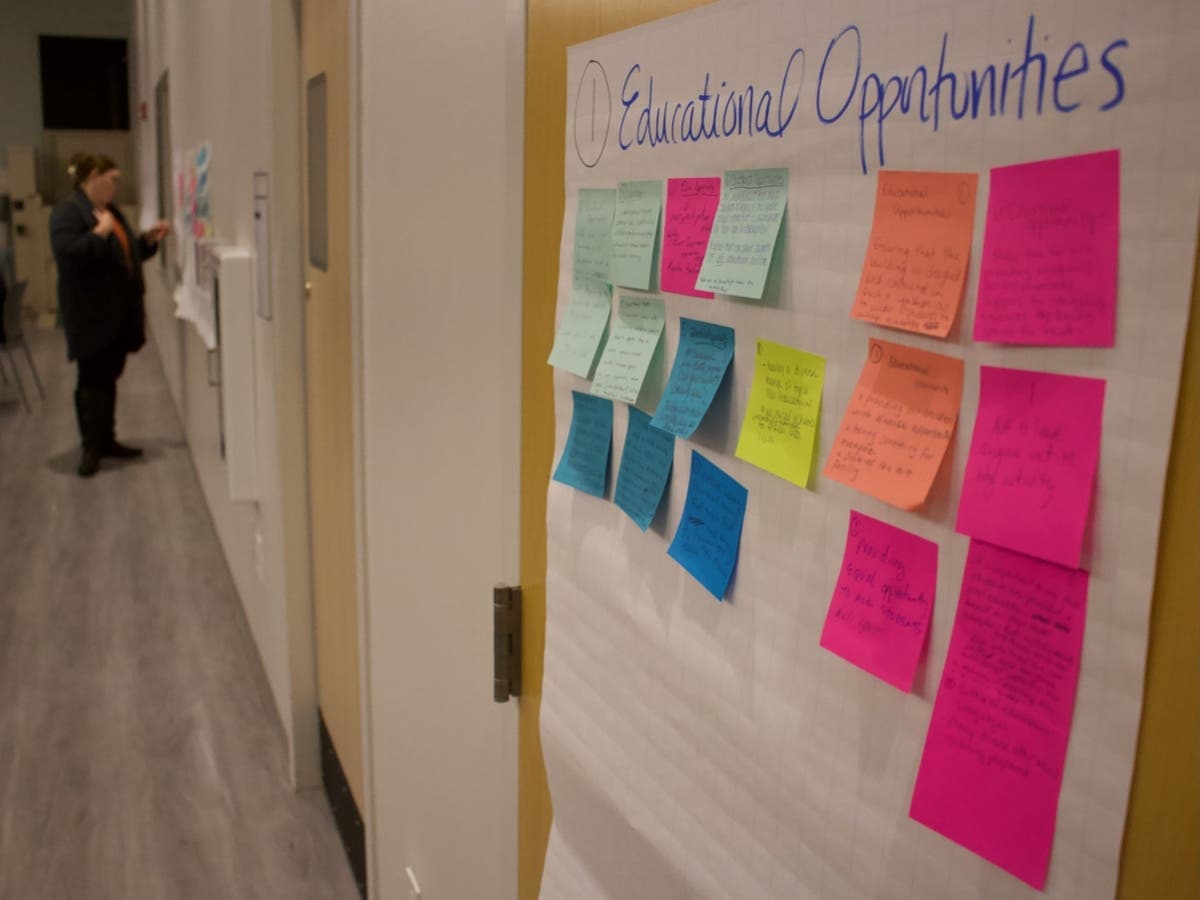


CONCORD, NH — Sustainability, equity, cost, walkability, safety, and educational outcomes connected to a new middle school were all analyzed at a workshop on Wednesday by about three dozen attendees.
The Concord Greenspace Coalition hosted the “middle school location and design workshop” at the citywide community center. The attendees, a mix of residents and parents, SAU 8 school employees, and board of education members, offered thoughts about what they expected or hoped from a new middle school.
The workshop was moderated by Carisa Corrow of Educating for Good, a Penacook educator. She told attendees that, for the workshop process to succeed, everyone had to “trust the process.”
Find out what's happening in Concordfor free with the latest updates from Patch.
While sharing their thoughts, they also needed to take time to step up, step back and listen to others, get comfortable with discomfort, and share ideas with love and kindness while also absorbing all the ideas without presuming the intentions of the people offering thoughts and concepts.
Also Read
- Concord’s Rundlett Middle School 4th On NH School Building Aid List
- CenterPoint Church Says No To Concord School District Land Sale
- Land Sale Negotiations For New Concord Middle School Reach An Impasse
- New Concord Middle School Costs? Around $176 Million, SAU 8 Docs Say
- Concord School District To Buy Land For New Middle School
- Concord's Middle School Could Be Sold After New Facility Built
- A Lot Of Unknowns With New Concord Middle School Project
Across two hours, attendees thought and spoke about the education opportunities a new school would bring, what it would cost, and whether it would be safe, walkable, or sustainable.
Find out what's happening in Concordfor free with the latest updates from Patch.
While billed as a “location” workshop, little time was spent discussing location.
Location was brought up under the equity category, with some mentioning a new middle school should be constructed on the east side of the city, while a couple also mentioned the need for more than one middle school.
While there were some constants, as one would expect, there were also differentials, too.
Walkability, an important component of the Concord Greenspace Coalition effort to stop the middle school from being moved to Clinton Street on the athletic field owned by CenterPoint Church, was quickly deemed “the lowest priority” and was “unattainable,” even though it was considered important. So many middle school students, about 850, have no way of reaching school other than being driven or bussed to Rundlett Middle School. A new school on the same site will not change this reality.
Even with a second middle school on the east side or even a third via a hypothetical SAU merge between the Concord and Merrimack Valley school districts, many students would still require transportation.
However, it should be considered when as part of the safety component of getting to school and location, too, some said.
Dozens of ideas also focused on the project's possibly most important aspect: educational opportunities.
Comments mostly mentioned activities and learning inside the physical building — state-of-the-art facilities for arts, science labs, and nature-based learning. Attendees wanted a diverse range of courses, topics, and labs offered, including AP classes. They said the school must also serve students of all educational abilities and inclusion. Ensuring space was available for physical activities, too, was mentioned.
Sustainability received a lot of focus, with most of the attendees saying they wanted the building to be LEED (Leadership in Energy and Environmental Design) certified, with a low carbon footprint or “net-zero,” with appropriate materials used and have the environmentalism of the building being “a model of learning.” Electric and public transportation and having the district not choose the lowest bidder, to some laughter in the room. However, another attendee simply wrote, “I don’t care.”
Equity, in one note, was stated to be “the priority,” with access to transportation, a sense of belonging in the school, and placement of the school all raised as issues and concerns.
Safety and security focused on “thoughtful design,” more technology, eliminating doors, and increasing visibility. Concerns were also raised by several attendees about the concept of the Concord YMCA having access to the building or being a component of the project. Safety and security, too, should not be traumatizing. The district should also hire “trauma counselors” for the students.
Corrow said, as an aside, there were some interesting issues raised with security even though it was close to impossible to ensure student safety.
“The thing that we have to focus on is to (make sure) kids feel safe and secure, valued and belonging,” she said.
Attendees also eyed costs — which offered a myriad of opinions. Some suggested waiting a couple of years due to inflationary costs or until costs decreased, while others said it did not matter since it was for the children and was a community investment. Sustainability in materials was also mentioned, focusing on the long-term. Having the school built quickly was also mentioned.
School Superintendent Kathleen Murphy thanked everyone for submitting all their ideas.
She said the district was placed fourth on the state aid list and was also the most expensive project to be considered of the 17 that made the next round of funding. SAU 8 is approved for $70.5 million toward the $176 million price tag. About $49 million is available during the next two years, which will probably go to the first three requests. If the district does not get the money during the next two years, it will be first on the list in 2025, assuming funding was available.
“We’re not stopping,” Murphy said. “We’re moving forward.”
Murphy said the future middle school students of Concord deserved a 21st Century learning environment. To this end, she said the district would be requesting qualifications for an architect. Later, a proposal request will also be sent out for a construction firm.
Murphy urged everyone to contact their state legislators and Senators and request they put some surplus funds into the school building aid account so there would be more money for Concord sooner.
Jim Richards, the school board president, said the process was like one performed five years ago and this was a good update. Right now, he said, while not getting into specifics, the department is eyeing a dozen locations for a new school. It was never just two, Richards said.
“Some of the things we just can’t talk about,” he said. “That’s just the way it is.”
Richards, who serves in the District A Wards 1, 2, 3, and 4 seat, said while it was great to have dozens of people in attendance, he was disappointed more residents from his wards did not attend.
While Corrow considered the event constructive and fruitful and said it was manageable for her to moderate, many more people needed to be involved in the process of a project of this magnitude.
“There needs to be other people in the space,” she said.
Corrow said the district could also go out into the community and go “where people are,” visiting more groups or organizations or even meeting people in places like a laundromat to ask questions “in those spaces.” Those are the people who are affected, she said, but are not participating or coming to events such as the workshop.
When asked what the ideal number of people who should be participating for a project like the middle school, Corrow said, “10 percent, something like that,” or for the Concord School District, about 4,000 people.
“It’s a lot,” she said.
But, returning to the idea of meeting people where they were, Corrow said the information could be collected via surveys and other ways, too.
New financials were not available as to what the project will cost the taxpayers.
But even with the state aid, as much as $104 million could need to be borrowed and paid for by property taxpayers on top of the 20 years of debt still being paid for the elementary school consolidation project, which had a final cost of $90.8 million, and already historically high property taxes.
Concord School District taxpayers are also still paying inflated property taxes since the bonding for the high school repairs was never lowered in 2009 when it ended. This is one of the many downsides of having an autonomous school district — they can do what they want, whereas every other community in New Hampshire must lower the tax rate after bonds are paid.
At 5 percent interest, the total cost of a new middle school could be around $201 million, not including the $70.5 million in state aid. At 6 percent, it could be as high as $224 million final cost, also not including the state aid.
Bonding for the elementary school consolidation project, around $55 million, was budgeted at about $100 annually for a $250,000 home, with a $10 increase annually through 2041 for a cost of about $400 in the last year. The Concord High School bonding has increased annually, too, costing property taxpayers hundreds of dollars a year for something that was paid for 13 years ago.
The average single-family home assessment in Concord is now around $325,000.
One could easily presume a new middle school will raise property taxes somewhere between $350 and $600 annually, with annual increases across the bonding, like the ones for the elementary schools and CHS bonding.
Got a news tip? Send it to tony.schinella@patch.com. View videos on Tony Schinella's YouTube.com channel or Rumble.com channel.
Get more local news delivered straight to your inbox. Sign up for free Patch newsletters and alerts.