Health & Fitness
Herschlag: Is There A Better Way To Address the Opioid Epidemic?
Let's have a conversartion that may reduce the harm and costs for both the community and the drug user.

Four years ago when I was first elected to the city council I requested that substance abuse be included in the city council’s priorities. Two years later as the substance abuse crisis in New Hampshire and Concord continued to worsen it was added as a priority. Since then I have become aware of a number of strategies that appear to be able to reduce costs associated with substance abuse, both for the community and the user.
It is unrealistic to believe we can eradicate all drug use. Think how well that worked during prohibition. The same as it is for those who abuse alcohol there is a percentage of the population that will become involved with drugs and will develop significant problems from using them, no matter how severe the punishment is.
Enforcement of drug laws and prosecutions, treatment and education are all important, but that will not get us to zero users, no matter how much money we spend. No war on drugs can be won. If you look at all the money and resources that have been spent and are being spent to eradicate illegal drug use from our society it is clear it is not working. Not only isn’t it working, it is getting worse.
Find out what's happening in Concordfor free with the latest updates from Patch.
So what should we do. We should look at models and strategies that have had successes in dealing with substance abuse. We should realistically look at what success looks like. I don’t have all the answers or even most of them. But unless we are willing to change the conversation we are not going to change the outcome.
Below is some information that I hope will start a more expansive conversation regarding how we design policies that focus on this issue.
Find out what's happening in Concordfor free with the latest updates from Patch.
The city council recently received this report from our Police and Fire Chiefs on drug overdoses and other statistics. This shows that the substance abuse crisis is not abating. While there was one less death in Concord due to opiod overdoses - that in all likelihood was because of the availability of Narcan, a drug that reverses the effects of an overdose.
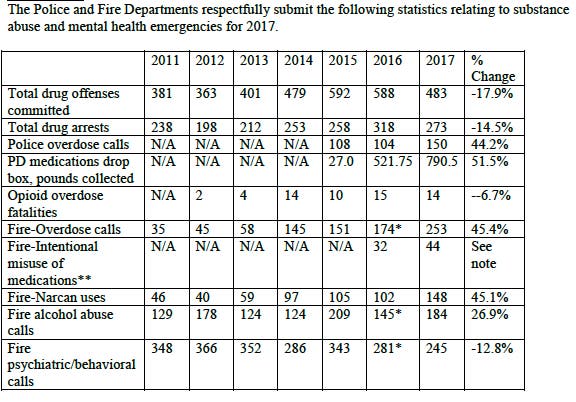
While overdose deaths are down in Manchester and Nashua, use was up there also. Here is a link to Union Leader articles on some of their statistics.
We continue to spend more money on this crisis, but we are not significantly changing our approach. While it may not be popular and it can appear counter intuitive there are strategies used in other countries that have reduced costs. Reducing the costs associated with the use of drugs for both the drug user and the community. In reduced crime, reduced costs for calls to fire and police departments, and reduced health care costs.
Is this something that makes sense for us. That is open for discussion. But what we are doing now doesn’t appear to be working. This is a problem that has been going on for a very long time. It is worth taking a look at programs that have reduced costs and harm, whether these strategies are from other countries or our county jails.
It doesn’t matter what you think about those using the drugs, it is the outcome that should concern you. If both the community and those who are addicted can benefit, than perhaps it is worth a discussion.
Here are two views that are worth a look.One is a link to a Cato report that was recently quoted in a NY Times editorial by Nicholas Kristof.
https://www.cato.org/blog/10-years-drug-decriminalization-portugal
The other is a book by Johan Hari “Chasing the Scream”. While there are sections of the book that I do not agree with (and you may not either), it provides an overview of what doesn’t work and what holds potential for reducing this crisis. I should offer full disclosure here as the author does not have a pristine history. Even with these concerns I believe it is worth reading.
This is an issue that effects everyone in our city. Let’s work to find strategies that reduce the harm from this epidemic, for everyone in our community.