Neighbor News
Rep. Aylward, Wow! What a Day in Concord and Beyond. . .
Taxes, taxes, taxes??; Danbury school debacle; Surgeon scorecard;Primary Sept.8; Some NRA ratings released;

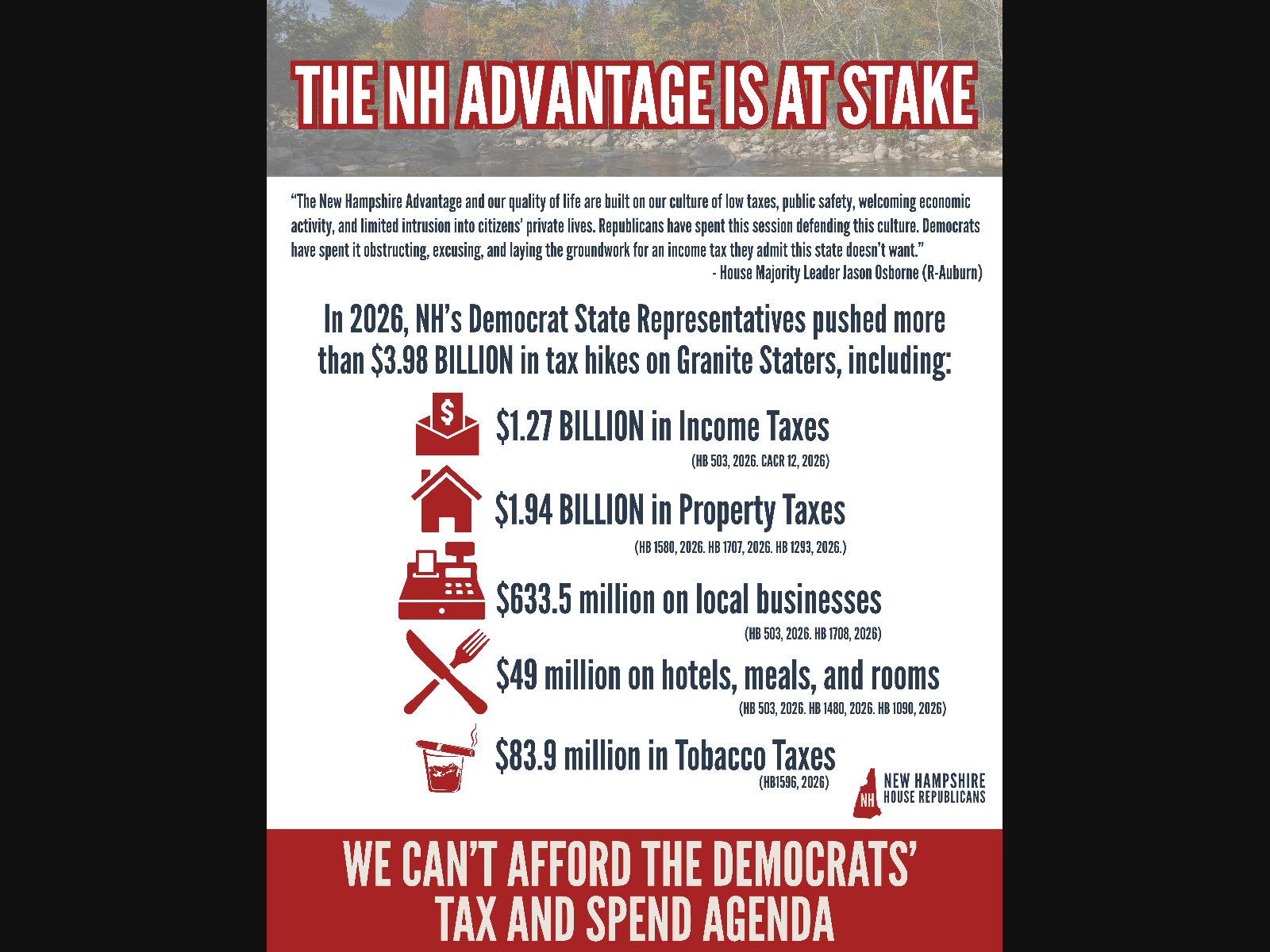
Protecting the New Hampshire Advantage (Vote “RED” down the ballot!)
New Hampshire’s identity has long been built around a simple principle: state government should live within its means while allowing residents and businesses to keep more of what they earn.
During the 2026 legislative session, House Republicans identified a series of Democratic-sponsored tax proposals which, taken together, they estimate would have resulted in billions of dollars in new or increased taxes affecting income, property, businesses, meals and rooms, and tobacco products.
Find out what's happening in Concordfor free with the latest updates from Patch.
These were proposals — not $3.98 billion in taxes ultimately imposed on Granite Staters. But proposed legislation matters, because it tells voters what competing approaches to taxation and state spending look like.
Among the measures considered this session were proposals to impose additional taxes on certain non-primary residences and unoccupied properties, tax portions of property owned by some charitable organizations, increase business taxes, and raise New Hampshire’s meals-and-rooms tax rate.
The debate is fundamentally about what kind of state New Hampshire wants to remain: one that relies on broad new sources of revenue, or one that continues emphasizing low taxes, restrained spending and a competitive environment for families and businesses.
Find out what's happening in Concordfor free with the latest updates from Patch.
Voters should pay attention not only to the bills that become law, but also to the bills their representatives sponsor and support.
Votes and legislative proposals provide a public record of where elected officials stand — and elections give citizens the opportunity to decide which direction they want New Hampshire to take.
Income Tax Debate on the House Floor
One of the clearest tax-policy debates of the 2026 session came during consideration of CACR 12 which was primarily a Republican measure, all 14 original sponsors were Republican Senators.
The proposal, as amended by the House, would have placed a constitutional prohibition on a state tax on individual wages, earned income and personal income. If it had received the required legislative support, New Hampshire voters would have had the final say on putting that prohibition into the State Constitution.
The House voted 193–148 in favor, but because constitutional amendments require a three-fifths vote, the measure fell short and died. Only four Democrats voted with Republicans.
During the same debate, a separate amendment was offered that would have expressly permitted a progressive state income tax, with proceeds dedicated to public education as a means of reducing local property taxes. That amendment was rejected overwhelmingly, 322–17.
Supporters of the constitutional ban argued that New Hampshire’s lack of a personal income tax is a central part of the “New Hampshire Advantage” and should be permanently protected.
Bottom line: New Hampshire did not enact an income tax. In fact, the proposal to authorize a progressive income tax was crushed. What narrowly failed was the effort to give voters a chance to constitutionally prohibit one for the future.
CACR 12 should not be counted as $1.27 billion in proposed income taxes. It was principally an effort to restrict future income taxation, while the Oppel floor amendment was the actual proposal to permit a progressive income tax.
Voters, beware!! The writing is on the wall, there is a push for a state income tax by the ‘other side’, which, predictably, could become law if Republicans lose their majority in the House and/or the Senate. Vote Republican!!
Danbury Elementary School Building Debacle — Hope this helps?
Below is Newfound School District Mike Limanni’s response to my August 19th clarification question of whether or not the school facility had been reported as ‘unused’ by the July 1st deadline?
Subsequently, the school board’s meeting minutes for Aug. 24th, under “Danbury Building Updates’ reads that there was a meeting with the board’s attorneys, that will be discussed at next meeting (to be held Sept. 14).
“Ms. Aylward, there have been a significant number of confusing and contradictory statements made recently in both the press and our public meetings which have not been entirely accurate. There appears to be some confusion regarding the closure of the Danbury Elementary School (DES) and the act of declaring the school to be an “unused district facility” per RSA 194.61.
It is my understanding that the school board officially closed DES on March 16, 2026, with a unanimous vote (reference the published meeting minutes below):
The board did not declare/report the building as an “unused facility” to the department of education by July 1st, 2026, because it was still fully occupied by the District’s tech hardware, security devices, and classroom furniture. I think this is what you are referencing in your question below.
A local reporter has concluded that because the building was not reported as unused by July 1st, it was not officially closed; additionally, he and others believe that because the building wasn’t declared as unused, it is subject to HB 1374’s requirement that no school can be closed without a “majority vote from voters in all municipalities served.” Please note that HB 1374 was signed by Governor Kelly Ayotte on July 10, 2026, and will not become effective until October 8, 2026.
In my financial report, Appendix C, in the meeting materials that were sent to you in the prior email, it references the need for the school board to determine if the building/property could be used in any other capacity by the District since the school was officially closed on March 16th. If the board does not have a school-board-approved plan to use it within two years, then I recommended that they declare it unused to the DOE and begin the sale or lease of the property in a way that would most benefit the financial health of the District and all of the towns served by it.
Out of concern for transparency with our community, and the desire to only report on the facts, we have sought additional clarification on the closure of Danbury Elementary School from our attorney so that we are all working with the most accurate information available. Thank you for your interest, and we will provide more information as we receive it.”
Thank you, Mike Limanni
CITIZEN COMMENTARY by Deborah Aylward
So the continuing saga of Danbury Elementary School has become a case study in why precise language matters when public property is involved.
On August 19, I asked Newfound Business Administrator Mike Limanni whether the Danbury Elementary School facility had been reported to the New Hampshire Department of Education as an “unused facility” by the July 1 statutory reporting date. His answer was no.
Limanni explained that the School Board had unanimously voted to close Danbury Elementary on March 16, 2026, but that the building was not reported as unused by July 1 because it remained “fully occupied by the District’s tech hardware, security devices, and classroom furniture.”That explanation deserves a closer look.
RSA 194:61 does not define an unused school facility according to whether the building is vacant or whether furniture and equipment remain inside.
Instead, the statute defines an “unused facility” as a district-owned school building that is not being used for academic purposes, extracurricular activities, administrative school functions or sports, and for which there is no School Board-approved written plan for one of those uses within two years. The superintendent is required to report each such facility to the Department of Education on July 1 of every year.
That leaves a straightforward question: What statutory use was Danbury Elementary serving on July 1? If the technology, security equipment and classroom furniture were merely being stored there following the school's closure, does storage constitute an “administrative school function” under RSA 194:61?
Perhaps it does. Perhaps there are additional facts that have not yet been made public. But the presence of equipment in a building is not one of the criteria expressly listed in the statute.
There is another important distinction.The statute itself defines what constitutes an unused facility and directs the superintendent to report qualifying facilities.
On its face, RSA 194:61 does not appear to say that a building only becomes “unused” after the School Board formally votes to declare it so. That makes the sequence particularly important.The District says the school was officially closed March 16.
The building was not reported as unused July 1. The District is now considering whether the building can be used for another district purpose and, if not, whether it should be declared unused and offered for sale or lease.
Those are three different actions, governed by different questions. And they matter because RSA 194:61 gives approved charter schools significant rights concerning unused district facilities, including rights involving purchase or lease.
And Now the Lawyers Are Involved
Limanni also wrote that, because of what he characterized as confusing and contradictory public statements concerning the closure, the District had sought additional clarification from its attorney.
The August 24 School Board minutes subsequently reported under “Danbury Building Updates” that a meeting had occurred with the Board's attorneys and that the matter would be discussed at the Board's next meeting, scheduled for September 14.
That may finally provide some answers. But the fact that legal clarification is now being sought reinforces rather than eliminates the central concern.
If the legal status and future disposition of a publicly owned school building are sufficiently complicated that the Board itself needs counsel to clarify them, taxpayers are justified in asking how these issues were handled before and immediately after the March closure vote.
What HB 1374 Does — And Does Not Do
There is also considerable confusion surrounding HB 1374. The District is correct about one important point: HB 1374 was approved July 10 and does not become effective until October 8, 2026. Accordingly, I am not arguing that HB 1374 retroactively invalidates the School Board's March 16 vote.
The new law does, however, make an important policy change. Beginning October 8, an elementary or high school generally may not be discontinued or its location changed without a majority vote of voters residing in all municipalities served by the school or district. If voters reject discontinuance, the statute says the school shall continue operating.
That leads to a more nuanced question than “Was the March closure legal?” The question is: What exactly occurred legally on March 16 — closure, discontinuance, or both — and what remains to be done with the school and its building?
That question is especially relevant while the building's status and disposition remain unresolved and the District itself is seeking legal advice.
The Public Deserves a Straight Timeline
This should not be complicated for taxpayers to understand.
Did the Board close the school? Yes, according to the District.
Was the building reported to DOE as an unused facility by July 1? No.
Why not? According to Limanni, because District equipment, security devices and classroom furniture remained there.
Did the Board have a written, approved plan on July 1 to use the building within two years for academics, extracurricular activities, administrative school functions or sports? That is the question that still needs a clear answer.
And if the building did not meet the statutory definition of “unused” on July 1, what specific District use prevented it from meeting that definition?
Those answers matter because this is not simply an empty building in Danbury.
It is public property, and its disposition can have consequences for taxpayers, the Newfound Area School District, the Town of Danbury and the proposed Danbury Chartered Public School.
That is why precision matters, and it is why the public should not have to decode the difference between “closed,” “discontinued,” “unused,” and “surplus” after decisions have already been made.
The September 14 school board discussion should provide those answers — clearly, publicly and on the record. Stay tuned!
Just FYI -- Check Your Surgeon: ProPublica’s Surgeon Scorecard
Patients considering surgery may want to take a look at ProPublica’s Surgeon Scorecard, a searchable database comparing complication rates for surgeons performing several common elective procedures, including hip and knee replacements, spinal fusion, gallbladder surgery and prostate procedures.
ProPublica analyzed Medicare records and calculated an adjusted complication rate, taking factors such as patient health, age and hospital performance into consideration. The project also demonstrates an important point: surgeons practicing at the same hospital can have very different complication rates.
There is one important limitation. The Scorecard was last updated in 2015 and analyzes Medicare procedures performed from 2009 through 2013, so it should be viewed as a historical resource rather than a current rating of a physician. It can nevertheless provide useful background and may help patients know what questions to ask when choosing a surgeon.
ProPublica Surgeon Scorecard: projects.propublica.org/surgeons/
Don’t Skip the Primary — Your Vote Matters
New Hampshire’s State Primary Election is Tuesday, September 8, 2026. In Merrimack District 4 (Andover, Danbury, Hill, Salisbury and Webster) there is no primary challenge for the two (2) positions for State Representatives, with Deborah Aylward and Louise Andrus, (Republican Incumbents) appearing on both the Sept. 8 Primary, and the Nov. 3, General Election ballots.
Vote for both!
In so far as primary elections often receive less attention than November elections, they are every bit as important. The primary determines which challenged candidates will represent their political parties on the General Election ballot.
In some races, especially where one party is dominant, the primary can effectively determine who will ultimately hold office. Local and legislative races can also be decided by surprisingly small numbers of votes.
Voting is more than choosing between candidates. It is an opportunity to have a voice in who represents you, how your tax dollars are spent, and what priorities are brought to Concord and Washington.
Before heading to the polls, take a few minutes to look at your sample ballot, learn about the candidates and decide who best represents your priorities.
Democracy works best when people participate — and every election begins with voters who show up.
WILL YOU SHOW UP? MARK YOUR CALENDARS!
New Hampshire State Primary:
- Tuesday, September 8, 2026
- General Election: Tuesday, November 3, 2026
Review Sample Ballots: sos.nh.gov/elections/sample-ballots
NATIONAL RIFLE ASSOCIATION (NRA-PVF) GRADES/ENDORSEMENTS
Candidates for office receive a bevy of surveys from various organizations, and fill them out seeking ratings and endorsements. Among them are the coveted NRA grades, and especially, endorsements. Though not yet complete, some primary candidate ratings have been released.
Check Ratings:
nrapvf.org/grades/New-Hampshire/?utm_source=chatgpt.com
What Does an NRA Endorsement Mean?
An endorsement from the National Rifle Association’s Political Victory Fund (NRA-PVF) is significant because it reflects an independent evaluation of a candidate’s record and positions on Second Amendment and firearms-related issues.
NRA-PVF says its grades and endorsements are issued without regard to party affiliation and are based on a candidate’s voting record, public statements and responses to its candidate questionnaire.
The organization evaluates candidates solely on gun-related issues. Deborah Aylward received the NRA Political Victory Fund endorsement in both 2022 and 2024.
For voters who consider Second Amendment rights an important issue, an NRA endorsement can therefore provide a recognizable indication of where a candidate stands and, for incumbents, how that candidate has actually voted while in office.
It is also important to distinguish between an NRA grade and an endorsement. A grade evaluates the candidate’s record or questionnaire responses; an endorsement means NRA-PVF has gone a step further and formally selected that candidate for support in the race.
Deborah Aylward is a resident of Danbury, NH, serves as an Incumbent State Representative for Merr. District 5, and as a citizen activist. She can be reached at 603-217-7842, or Deborah.Aylward@gc.nh.gov