Neighbor News
Rep. Aylward, Wow! What a Day in Concord, and Beyond. . .
Don't take "NO" for an answer; My pirate ancestor; Danbury 'Welcome Sign' problem; Letter to Selectmen; Bow Data Center?? Danbury PD stats

Meet My 500-Year-Old Relative

Every family tree seems to contain a surprise.
Mine apparently contains a pirate.
Find out what's happening in Concordfor free with the latest updates from Patch.
Or perhaps a privateer.
Or a naval hero.
Find out what's happening in Concordfor free with the latest updates from Patch.
Five hundred years later, that depends somewhat upon which side of the ship you were standing on.
My ancestor is Davy Falconer, a Scottish sea captain who lived during the reigns of Kings James IV and James V in the early 1500s.
Falconer appears in an old history of the Scottish port of Leith among the legendary “sea-dogs” who sailed out of that harbor during an era when Scotland and England were frequently less than neighborly.
At one point, Falconer and fellow sea captain Robert Barton attempted to sail through waters controlled by the English fleet. Barton escaped. Falconer did not. His ship was captured and sunk, and Falconer was hauled off to London, where Henry VIII reportedly intended to have him put to death for what the English king called his “manifold piracies.” King James IV intervened, and Falconer was eventually released. After his release, Falconer went right back to sea.
So, was my ancestor really a pirate? That is where history gets interesting.
The sailors operating in these waters lived in an age in which governments sometimes authorized private vessels to attack or seize enemy shipping. The same seaman might therefore be regarded as a patriotic defender by one country and a pirate by another. And judging by the surviving account, the English were certainly not members of the Davy Falconer Fan Club.
The historical account later describes him as “bold and intrepid” and says he was “passionately loyal to king and country.” He eventually left the sea long enough to serve as Captain of Artillery during King James V's campaign against Tantallon Castle.
That would prove to be his last adventure.
When Scottish forces were attacked during their withdrawal, Falconer was killed while covering the retreat. An English ambassador — apparently paying his adversary a considerable compliment — described Falconer as the Scots' principal captain and their best fighting man at sea. The history remembers him as one of the gallant Leith captains who helped build Scotland's reputation on the water.
The Pirate Hunter & Sea Dog: Around 1489–1490, Sir David Falconer was commissioned by King James IV of Scotland to hunt down Dutch and Danish pirates—most notably a notorious pirate named Lutkyn Mere—who were raiding Scottish merchant shipping in the Firth of Forth near Leith.
The Fighting Bartons Connection: He was closely allied with Andrew and Robert Barton, Scotland's most famous "privateers" (often referred to as the "Sea-Dogs of Leith"). They commanded heavily armed merchant vessels that patrolled the North Sea.
Scottish Royal Navy Master: In local Scottish histories (The Story of Leith and Leith and its Antiquities), "Davy Falconer" is praised for his fierce loyalty to the Scottish Crown. In the 1520s, David and his brother Robert Falconer commanded task forces out of Leith and were recognized by King James V for defending Scottish merchants against English raiders. David Falconer (Davy Falconer) was killed in action in late 1528 during King James V’s siege of Tantallon Castle.
The Circumstances of His Death
The Siege of Tantallon (1528): King James V led a massive royal army to seize Tantallon Castle, the strong fortress of the rebellious Earl of Angus (Archibald Douglas). Because of Davy Falconer’s reputation as an expert naval captain and master artillerist, the King placed him in charge of the royal siege guns and the transportation of the heavy artillery.
Killed in the Line of Duty: Davy Falconer stood his ground in command of the royal artillery guard. He was slain during the fighting, along with several of his men.
The King's Reaction
Davy Falconer was so highly regarded by King James V that his death deeply enraged the Scottish monarch. Contemporary Scottish chroniclers (such as Robert Lindsay of Pitscottie) noted that his loss was heavily mourned by the Crown and the people of Leith. The King swore an oath that no member of the Douglas family would ever be allowed to return to Scotland so long as he lived.
I confess that all of this produced a certain amount of amusement in our household. Most of us hope genealogy will uncover a statesman, an inventor, perhaps a distinguished grandmother who crossed the Atlantic with three children and twelve dollars.
I got Davy. A sea captain pursued by Henry VIII.
Davy Falconer isn't important because I am descended from him. He is interesting because every family has stories like this waiting somewhere in its past.
Here in New Hampshire, where so many families have roots stretching back generations — while others arrived only recently and brought their histories with them — genealogy offers a reminder that history isn't confined to textbooks.
- Sometimes it is depicted in an old photograph.
- Sometimes it is written on the back of a Bible.
- Sometimes it is hidden in an immigration record.
And occasionally, it comes sailing out of the North Sea with the English navy in hot pursuit.
So if you've never explored your own family history, you might want to give it a try.
Just be prepared for what you find.
Mine had a pirate.
If there is such a thing as a swashbuckler gene, I'd like to think I inherited it. Adventure has always found me—or perhaps I've found it—from exposing housing fraud at great personal risk, to an exciting, and sometimes dangerous career as a private investigator, specializing in technical surveillance countermeasures, serology, chemical and DNA sample collection and testing, to founding a nationwide volunteer missing persons organization, championing two House Bills passed into law in Virginia, to serving as a New Hampshire state representative and tackling and resolving issues, that others, including the FBI — preferred to avoid.
###
A possible Hyper-Scale Data Center in Bow as reported by the New Hampshire Bulletin: Ayotte wants moratoriums, but can Merrimack District 5 (Andover, Danbury, Hill, Salisbury and Webster) citizens rest easy at night, or would they welcome the benefits?
Food for thought.
Danbury’s “Welcome” Sign Is in Decrepit Shape.
Why Is It Allowed to Remain?
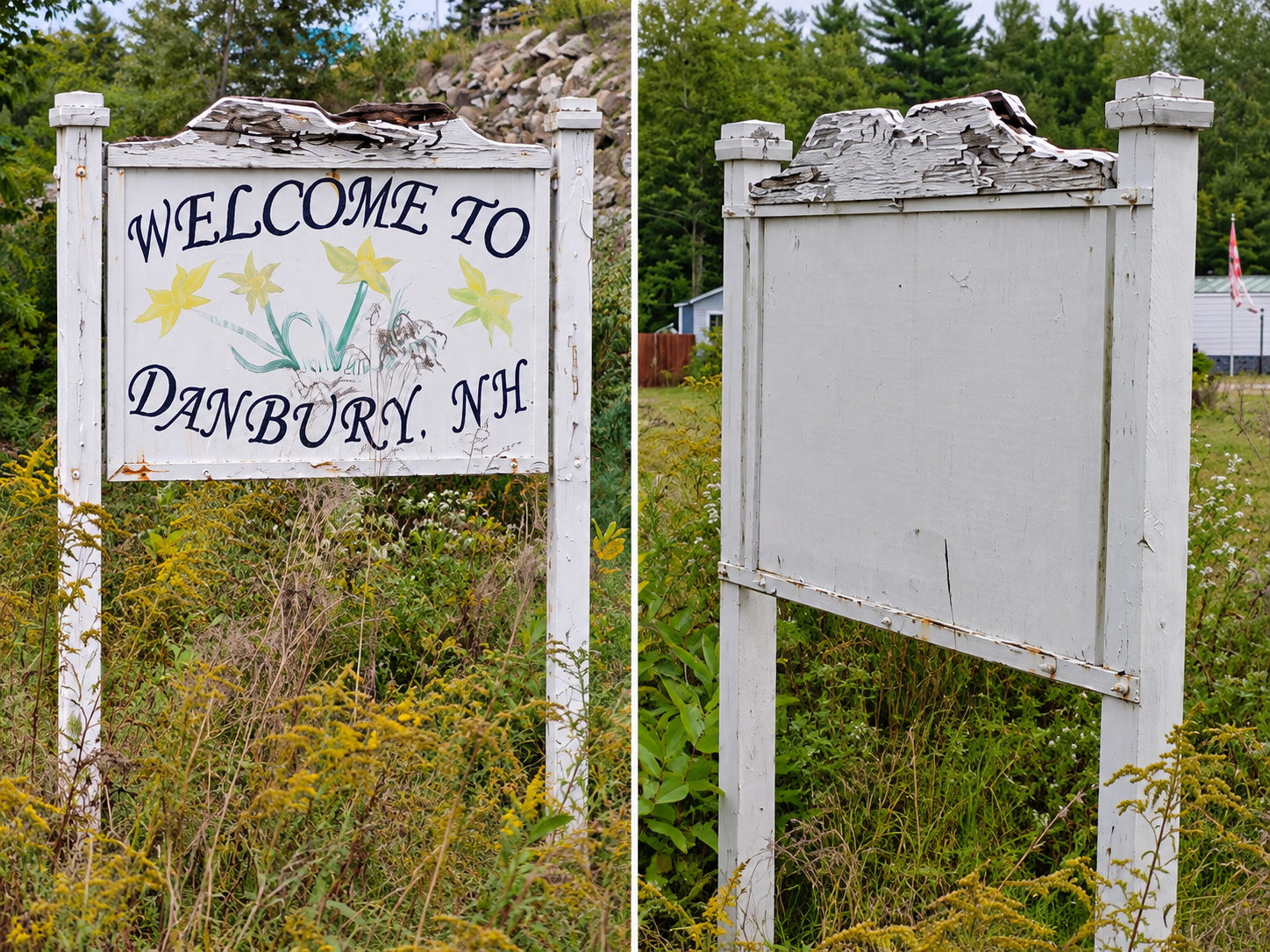
Located near the Danbury town line on Route 4 is a lovely, hand-painted wooden sign that reads, “Welcome to the Town of Danbury” featuring daffodils. Unfortunately, at this point, it is not particularly welcoming.
Those faded yellow flowers may be more than decoration. Daffodils have long appeared in Danbury's landscape and civic identity—from the flowers painted on the town's welcome sign to Daffodil Lane, home of Danbury Elementary School. They appear to be the town’s ‘motif’.
The top of the sign has deteriorated badly, it used to read: EST 1795 and is now in visibly crumbling condition. An identical sign is located on Route 104, although I have not traveled that route recently enough to comment on its present condition.
There are only so many ways to travel in and out of Danbury, and Route 4 is one of the town’s primary routes. That raises a very simple question: Has no town official noticed the condition of the sign? And if town officials have noticed it, what has been done about it? I have personally watched the Route 4 sign slowly deteriorate for well over a year. From its present appearance, the answer would seem to be: apparently, nothing.
I have written before about the economic challenges facing a small community such as Danbury, and I certainly understand that municipal budgets are limited and priorities must be made. But this need not be an expensive undertaking.
It is my understanding that a local woodworker crafted the sign many years ago, and perhaps it was originally donated to the town. If so, it has served Danbury well. But there comes a point when an aging landmark has simply reached the end of its useful life, and after that, may be worth preserving for its historical value. That time appears to have arrived.
I do not know what municipal body has jurisdiction over the sign, but leaving a badly deteriorated “Welcome to Danbury” sign standing along one of the principal entrances to town reflects poorly on the community it is supposed to represent. First impressions matter. Residents take pride in where they live, and even something as simple as a town welcome sign sends a message to visitors about how a community views itself.
I believe it is time to respectfully retire the Route 4 sign, or, in the alternative, remove the crumbling (apparently separately-attached) portion of the sign, that would then make the sign look ‘quaint’, and perhaps adding a few more years of useful life, while a new sign is contemplated.
Whether the town has the sign repaired, commissions a replacement, seeks donations, asks a local craftsman to create one, or chooses simply to remove the damaged portion or the existing sign altogether is a matter for discussion.
There may even be residents or local businesses willing to contribute materials, labor, or funding toward a replacement. But allowing the present sign to continue deteriorating should not be the default option. The Select Board should address the matter and decide what comes next.
Danbury deserves a welcome sign that actually says, in appearance as well as words: Welcome to Danbury.
###
LETTER TO DANBURY SELECTMEN
Re: Condition of Town Sign on Rt. 4
Dear Members of the Danbury Select Board,
I am writing regarding the deteriorated condition of the wooden “Welcome to the Town of Danbury” sign located near the town line on Route 4.
I have observed the sign’s gradual deterioration of the crown that used to read: EST 1795 for years, and its condition has now reached the point where I believe it warrants the Board’s attention. The wood appears badly weathered and deteriorated (photos attached) and the sign no longer presents the welcoming appearance that was presumably intended when it was originally placed there.
Route 4 is one of the primary entrances into Danbury, and a town welcome sign is often one of the first impressions residents, visitors, and travelers receive of a community. Unfortunately, in its present condition, this particular sign reflects poorly on the town.
I recognize that Danbury has limited financial resources and that replacement of a welcome sign is certainly not among the most pressing municipal expenditures. However, leaving the existing sign to continue deteriorating indefinitely does not seem to be an appropriate solution either.
I understand that the sign may originally have been made or donated by a local woodworker many years ago. If that is the case, it has certainly served the town well and deserves appreciation for doing so. But for apparent lack of preservation, it may simply have reached the end of its useful life.
Though it is unclear as to what municipal body has jurisdiction over the sign, I respectfully ask that the Select Board address the condition of the Route 4 sign and determine an appropriate course of action. Options might include removing/replacing just the deteriorated piece, to retiring the existing sign and preserving it as a historical landmark.
There is also reportedly a similar town welcome sign on Route 104, and it may be worthwhile to inspect that sign at the same time to determine its present condition.
Whatever solution the Board ultimately chooses, I believe the matter deserves attention rather than allowing the Route 4 sign to deteriorate further.
I would appreciate a written response to my request.
Thank you for your consideration.
Sincerely,
Deborah Aylward
###
When Not to Take “NO” for an Answer
I remember standing toe-to-toe with a rabid sheriff’s deputy from a western state who wanted to commandeer one of our volunteer missing-child cases by sending a S.W.A.T. to the suspected location of a parentally abducted child. He demanded that I give him the address.
Well, that’s NOT how our private investigation cases worked. We would check in with the law enforcement agency having jurisdiction over the location before proceeding to conduct covert surveillance to confirm or eliminate a location as fruitful. Only IF and WHEN the subject child was actually observed by a volunteer would we then call law enforcement to come and conduct a safe recovery.
After all, it wasn’t the deputy’s investigation. I was running the show.
I was threatened and screamed at, forbidden to conduct the investigation — all the while remaining in control because I knew my stuff — I knew the law, rules and regulations. Confronted with reality that he had no authority, he reluctantly backed down. The volunteer subsequently confirmed the child was not at the location — the deputy never given the address.
But what if I believed him and acquiesced under pressure? What if I had told the volunteer to leave? Or, worse yet, what if I had revealed the address of the child’s grandmother, only to find that the child was not there? Having a S.W.A.T. swarm the neighborhood would have certainly tipped off the familial abductor, placing the child in further danger.
Instead, I refused to take the deputy’s bluster, bravado and empty threats to heart. I told him, he was not going to interfere with our operation.
So the point is: I’ve had two eye-opening “NO, you can’t do that” experiences with New Hampshire election law in the space of just a few days.
Both started the same way: I was erroneously told that something was prohibited.
Both ended the same way: Having first carefully researched the applicable laws, rules and regulations, I refused to take “NO, you can't do that” for an answer, confidently asserted my position, cited the law, and was proved right by the appropriate authorities or official documents. You could have heard a pin drop.. .
So What Is the Lesson?
My concern isn’t that more than one person misunderstood a law. Election law can be confusing. People make mistakes. I make mistakes.
What concerns me is how quickly“I think that’s the rule” can become “You’re not allowed to do that.” Someone tells someone else. That person repeats it. Pretty soon, nobody knows where the rule came from, but everyone is certain it exists.
And an ordinary citizen confronted by a police officer, an investigator or even another elected official may simply assume: “They must know the law.” But sometimes they don’t, and are just ‘making it up as they go’.
What is rather scary is that these incidents involved:
1) A lawmaker (i.e. state representative), 2) a candidate for lawmaker 3) a town employee, and 4) a ‘top cop’ enforcer of the law. How could they get it so wrong???
The solution can be one very simple credo, followed by one very simple question:
Always question authority, always, always ask:“Can you show me where it says that -- in writing?”
###
Why Danbury Residents
Deserve More Than a Number
Each year, the Danbury Police Department reports the total number of calls for service in the Town’s Annual Report. What residents are not told, however, is what kinds of calls make up that number.
There is an important difference.
A yearly total does not tell taxpayers whether police activity involved traffic stops, motor vehicle complaints, property crimes, assaults, domestic incidents, welfare checks, alarms, suspicious activity, felonies, misdemeanors, or other categories of police activity.
That information matters.
Residents should be able to understand what types of public-safety issues are occurring in their community, whether particular problems are increasing or decreasing, and where police time and taxpayer-funded resources are being spent.
I am not requesting a police log, names of individuals, addresses, sensitive investigative information, or details identifying anyone involved in a police matter. I am simply seeking the 2025 calls-for-service data broken down by type or category.
Because that information has not otherwise been made available, I have submitted the following request under New Hampshire’s Right-to-Know Law, RSA 91-A.
Transparency should not stop with telling taxpayers how many times the police responded. Residents should also have a reasonable opportunity to understand what their police department is responding to, the state of crime in town, and especially, how to gauge budgetary increase requests.
RIGHT-TO-KNOW REQUEST — RSA 91-A
Chief of Police
Danbury Police Department
Danbury, New Hampshire
Dear Chief:
Pursuant to RSA 91-A, New Hampshire’s Right-to-Know Law, I am requesting existing governmental records showing the types or categories of calls for service and other police activity handled by the Danbury Police Department during calendar year 2025, January 1 through December 31, 2025.
The Town’s Annual Report provides only a total number of calls for service. I am seeking the categorical breakdown underlying or associated with that total, to the extent such information is maintained by the Department.
Specifically, please provide any existing report, statistical summary, spreadsheet, CAD/RMS report, activity report, annual summary, or other existing record showing the number of calls, incidents, or enforcement activities by type or category.
This should include all categories actually maintained or utilized by the Department. By way of example only, categories may include:
- felony offenses;
- misdemeanor offenses;
- violations;
- arrests;
- motor vehicle/traffic stops;
- motor vehicle accidents;
- domestic disturbances;
- thefts;
- assaults;
- drug-related incidents;
- alarms;
- welfare checks;
- suspicious persons or vehicles;
- animal complaints;
- trespassing;
- noise/disturbance complaints;
- civil matters;
- citizen assists;
- agency assists; and
- any other call-for-service or incident classifications used by the Department.
The above examples are not intended to limit the request. I am requesting the Department’s actual categories and the 2025 numerical total for each category, to the extent those figures are maintained in existing records.
To be clear, I am not requesting the police log, nor am I requesting names, addresses, dates of birth, narrative reports, identities of complainants, victims or suspects, or other personally identifying information relating to individual incidents.
I am seeking statistical/categorical information only.
I recognize that RSA 91-A:4, VII does not require a public agency to compile, cross-reference, or assemble information into a form in which it is not already kept or reported. Accordingly, if the Department does not maintain one document containing the requested breakdown, please provide the existing record or records that contain or reflect the Department’s 2025 call-for-service or activity classifications and corresponding totals.
If the requested records are maintained electronically, I request that they be provided electronically in their existing format, SUBJECT LINE: RECORDS REQUEST RESULTS
If any portion of this request is denied, please identify the specific record or information being withheld and cite the specific statutory basis for withholding it.
Thank you for your attention to this request.
Sincerely,
Deborah Aylward
###
Deborah Aylward is a resident of Danbury, NH, a citizen activist and serves as State Representative (Merr.5), serving the citizens of Andover, Danbury, Hill, Salisbury and Webster. She can be reached at: Deborah.Aylward@gc.nh.gov or 603-217-7842