Politics & Government
Simon: Republican Race for NH Governor Offers Stark Contrasts on Marijuana Policy
Two major candidates want to decriminalize marijuana, while others cling to propaganda — and the primary election is Tuesday, Sept. 13!

Yesterday, I wrote that Steve Marchand is the only candidate for governor who is calling for the legalization, regulation, and taxation of marijuana in New Hampshire, and that he has been endorsed by the Marijuana Policy Project in its voter guide for the Sept. 13 Democratic primary election. However, not all supporters of marijuana policy reform will be voting in the Democratic primary. Sensible marijuana policy enjoys majority support among Republican voters as well, and even stronger support among undeclared voters, many of whom will vote in the GOP primary.
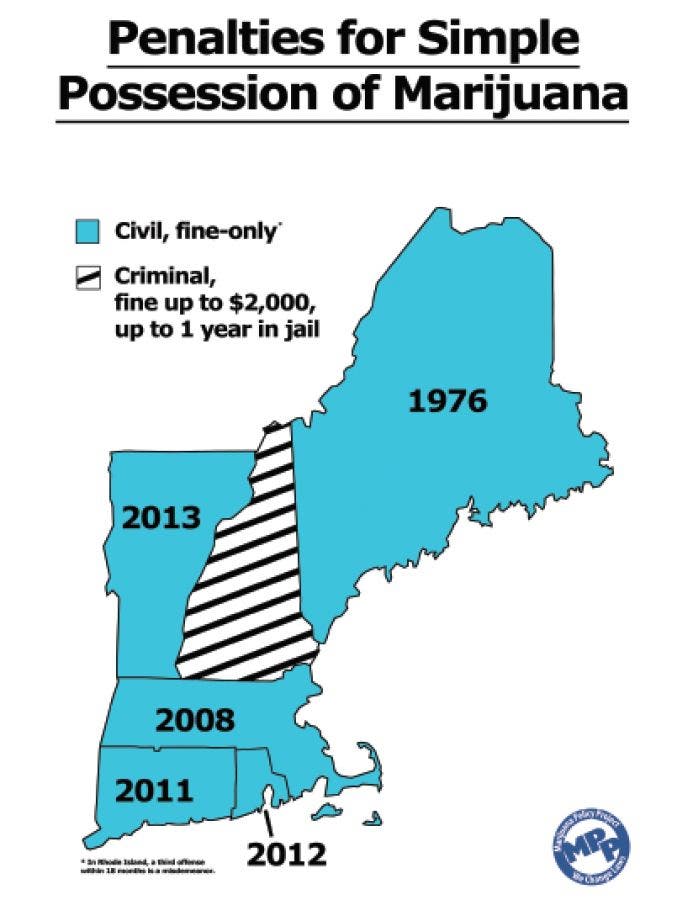
A July Granite State Poll, sponsored by WMUR and conducted by the University of New Hampshire Survey Center, found that Republicans, by a 50% to 47% margin, support legalizing marijuana (page 35). Previous polls — such as this one from last summer — have found that an even stronger majority of Republicans favor making New Hampshire the final state in New England to pass a simple decriminalization law (under which criminal penalties for possession would be replaced with civil fines).
Despite the fact that most NH Republicans support legalization, the party's candidates remain deeply divided over more modest reforms. On the prohibitionist side, State Senator Jeanie Forrester and Manchester Mayor Ted Gatsas have opposed decriminalization and even medical marijuana bills. On the pro-reform side, State Rep. Frank Edelblut and Executive Councilor Chris Sununu have strongly expressed support for decriminalization, and Edelblut has gone farther, taking an open-minded position on legalization.
Find out what's happening in Concordfor free with the latest updates from Patch.
The candidates who are advocating for the continuation of New Hampshire’s counterproductive war on marijuana users both have long records on the issue. In 2012, Forrester said she opposed a Republican-sponsored medical cannabis bill because she didn’t “like the idea of people growing their own marijuana.” Then, as was reported in the Marijuana Policy Project’s voter guide, “in 2013, after the home cultivation provision was removed from the bill, Forrester voted against it anyway.”
More recently, during a debate broadcast by NH1 on Aug. 31, Forrester scolded two of her opponents for supporting decriminalization.
Find out what's happening in Concordfor free with the latest updates from Patch.
“Why in the world would you even think about discussing this issue?,” she asked.
Gatsas has made it clear that he is no more reasonable on marijuana policy issues than Forrester. In 2009, as a state senator, he cast one of the deciding votes against a medical cannabis bill. That bill passed the House and Senate, but was then vetoed by the governor. Gatsas also voted against the veto override effort, which fell short by only two votes. Appallingly, patients who were desperately ill ended up having to wait another seven years before they were granted safe, legal access to cannabis as an alternative to opioids and other pharmaceutical drugs.
This year, when asked during the NH1 debate on Aug. 31 if he would support decriminalizing marijuana possession, Gatsas replied with a non sequitur: “We have a fentanyl epidemic. Absolutely no I would not!”
Throughout the debates, Frank Edelblut has clearly established himself as the most reasonable major Republican candidate on marijuana policy. As a state representative, Edelblut voted in favor of decriminalization bills in 2015 and 2016, and he has shown that his mind is open on the subject of legalization. Edelblut has also been outspoken on the importance of making cannabis more broadly available for patients who need it, and he has publicly criticized Forrester and Gatsas for their opposition to medical cannabis.
Sununu has also expressed support for decriminalization, and both Forrester and Gatsas have criticized him for holding this position. However, Sununu asserted during the NH1 debate that he is not open to considering legalization, despite the fact that three consecutive polls have found it to be supported by 60% or more of Granite Staters. “I am vehemently opposed to broad-based legalization of marijuana,” Sununu said.
Based on these quotes and comments, it’s probably easy to see why the Marijuana Policy Project has endorsed Edelblut for the Republican primary. Edelblut’s thoughtful leadership on marijuana policy will make a very significant impact if Republicans select him to be their standard-bearer on Sept. 13.
If you care about ending marijuana prohibition in New Hampshire, please take time to read the Marijuana Policy Project’s voter guide, and share it with your friends and family!
Check back tomorrow for analysis of how marijuana policy may impact other New Hampshire primary races, including a few key races for the state Senate.