Neighbor News
Aylward: Wow! What a Day in Concord, and Beyond ...
Kilts, cannabis, stolen election prevention, and more. . .

On April 11th, the House voted 239-132 OTP/A on proposed cannabis regulations. I voted ‘Aye’ as part of the 18.64% of other Republicans voting in the affirmative for HB1633 sponsored by a Republican with five others as co-sponsors. It was a bit of a ‘walk on the wild side’ due to concerns about adults potentially behaving badly while at the same time wanting to give so-inclined NH inhabitants the benefit of the doubt. So off it goes to the Senate, which has never before passed marijuana legislation.
House members were also honored to have the Consul General of the Republic of Korea, Mr. Kim Jaehui address members relative to the importance of maintaining good relationships with global allies and who introduced leaders of the NH Korean-American community (around 5,500 strong) who were present in the gallery. Many thanks go to District 5 voters who made it possible for me to attend these joyous, solemn, and other wonderful occasions!
###
Garnering much publicity was SB 539 — a bill that establishes a tax relief program for office conversion to residences; enables municipalities to allow its governing body to adopt certain zoning ordinance changes; and adds additional authority in zoning powers for parking requirements and lot size requirements related to sewer infrastructure, otherwise known as “The HOMEnibus” a controversial act that was voted ITL (188-173) at the May 2nd full House Session, and after a unanimous vote in favor by the Senate, but being voted ITL by a majority of the members of the Municipal and County Government Committee on April 23rd cross-over, myself also voting in favor of ITL.
Find out what's happening in Concordfor free with the latest updates from Patch.
I believe almost everyone is interested in creating incentives that would increase much-needed housing in NH, however, the bill would have undermined local control by allowing arbitrary changes to zoning codes or ordinances made by local governing boards or councils, thus bypassing the Legislative Body (i.e. voters) who are currently the ultimate decision-makers of zoning changes presented as warrant articles at annual meetings or on official ballots.
###
Find out what's happening in Concordfor free with the latest updates from Patch.
Bonnie Lads and Lasses also celebrated Tartan Day on April 11th, an occasion that honors Representatives lost, with many Reps sporting full Highland dress regalia to celebrate their Scottish heritage. Members and guests were entertained by bagpipers, fiddlers, and singers, and for this first-generation Scot, seeing all the kilts was a heartwarming spectacle that reminded me of my childhood German Shepherd named Rob Roy McGregor, III; attending the Royal Edinburgh Military Tattoo at Edinburgh Castle; fresh-baked scones, and the Haggis Toss at the Scottish Games, of course!
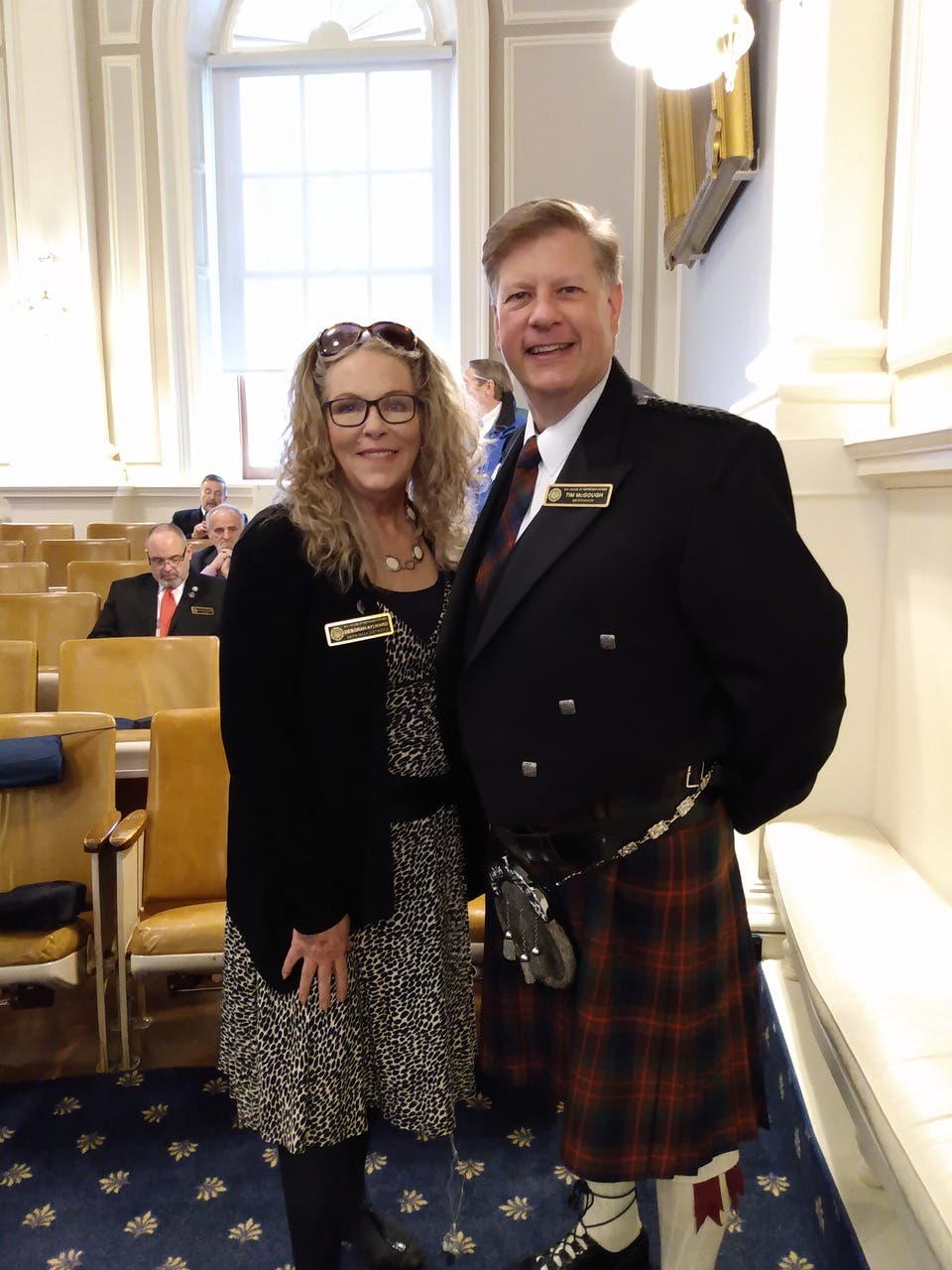
Representatives Deborah Aylward and Tim McGough
Message from Scott Maltzie, Merrimack County GOP Committee Chairman
The election was STOLEN!
Good Evening,
That headline was echoed throughout November and December of 2020 and has been a theme of many Republicans for the past four years.
In New Hampshire, we've taken some important steps to improve our election integrity through various pieces of legislation. However, it's not enough. We need boots on the ground to ensure our elections are secure.
So if you are one of the many who believe that the 2020 election was stolen, HAVE I GOT A JOB FOR YOU!
You can volunteer to be a Poll Watcher, Poll Challenger, or Inspector of the Election. We can use at least 5 people at every voting location. Can I count on you to help? Use the link to sign up.
Role Descriptions
Inspector of Election (as defined by RSA 658)
658:3 Qualifications. – The inspectors of election shall be registered to vote at the polling place where they serve.
658:4 Oath; Term. – Each inspector of election shall be sworn to the faithful performance of his or her duties and shall hold office for 2 years from August 1 in the year in which he or she is appointed or until a successor is appointed and qualified.
658:25 - Designation of Ballot Clerks. – Two of the inspectors, one from each of the 2 political parties, shall be designated by the moderator at the opening of the polls to act as ballot clerks. They shall have charge of the ballots and shall furnish them to the voters. They shall be given a duplicate copy of the checklist by the town or ward clerk. The other inspectors shall be assigned such duties in the polling place as the moderator may determine including, but not limited to, the relief of the ballot clerks and the assistance of voters marking their ballots as provided in RSA 659:20.
Poll Challenger (as defined by RSA 666)
Challengers Appointed by Party Committee. – The state committee of a political party may appoint a person to act as challenger of voters at any polling place in the state at a state election. A city or town committee of such a party may appoint a person to act as such challenger at any polling place in such city or town at a town election, business meeting, or city election. A statement signed by the chairman of the committee appointing him shall be sufficient evidence of the authority of any such challenger. He may be reasonably compensated for his services by the political party whose committee appointed him. He shall be assigned by the moderator or other election officer presiding at the polling place to such position within the polling place as will enable him to see and hear each voter as he offers to vote. Nothing herein contained shall deprive any other person of the right to challenge a voter as provided by law.
Poll Watcher
Any member of the public has a right to observe the conduct of an election from outside the rail. These individuals are colloquially known as “Poll Observers” or “Poll Watchers.” These observers do not have any special legal status. Anyone present, who has not been officially designated a “challenger” (see above) in writing by the state chair of a political party, but is present on behalf of a political party or candidate may be called a poll watcher or observer. Such an individual has the same status as any other member of the public, even if they are present at the request of a political party and performing poll-watching functions. Poll watching functions include, but are not limited to, tracking who has voted and reporting this back to get-out-the-vote efforts or monitoring the conduct of the election and reporting concerns back to a political party election day legal operation. Well-conducted political party election-day legal operations often help moderators quickly identify concerns with election procedures or election official performance.
If interested, please contact Scott.
Scott Maltzie
Chairman
Merrimack County Republican Committee
smaltzie@comcast.net
###
How Education Freedom Accounts are Administered
NH Journal: DEMERS: EFA Program Is Transparent and Responsible to Taxpayers
Consistent with our New Hampshire values, Children’s Scholarship Fund (CSF) operates the state’s Education Freedom Account (EFA) program with extreme transparency, accountability, and attention to detail so Granite State families can be empowered to choose the education that best meets their children’s needs, while taxpayer dollars are used as efficiently and effectively as possible.
We have been utterly confounded by recent discussions in the New Hampshire legislature in which one legislator referred to the EFA program as a “black box.” In fact, the opposite is true. Far from lacking oversight, the EFA program has received accolades for its integrity, and CSF recently underwent an annual independent risk-based program audit that confirms our error-free effectiveness.I would love to share in detail how we report on the EFA program to the state so you can see for yourself.
First, all students participating in the EFA program must have a State Assigned Student Identifier (SASID) for student enrollment tracking and grant payment purposes. Each September, CSF must provide data to the NH Education Department (NHED) for each student using an EFA through a Beginning of Year (BOY) Report. NHED also requires CSF to submit an Anytime of Year (AOY) Report four times during the school year to keep student enrollment data current.
At the end of each school year, CSF must recap enrollment data for the NHED through yet another report called, you guessed it, the End of Year (EOY) Report. Students who graduate or withdraw from the program are reconciled in the EOY, and CSF returns the unused EFA funds to the NHED. Funds are reconciled to the penny so that not even one cent of taxpayer money is misused.
Once a family receives an EFA grant, it is deposited into a restricted-use account, or digital wallet, called ClassWallet. ClassWallet is an approval-based system, which prevents the need for parents to make out-of-pocket expenditures and provides for maximum program integrity. Every time an EFA parent or guardian initiates a transaction, such as uploading a tuition invoice or putting an item in a cart through the online marketplace, the transaction is inspected and either approved or denied by a member of CSF’s compliance team, according to the allowable use of funds categories outlined in the EFA law. Additionally, our Director of Compliance performs a second internal review of 100 transactions or more monthly. EFA Educational Expense Reports are provided by CSF to the NHED annually in extensive detail, organized by vendor and by allowable use categories. You can see an example on the NHED’s website here.
In addition to the reporting detailed above, CSF is required by law to report cases of suspected fraud to the NHED and Attorney General’s Office. CSF also aggregates EFA recipient test scores annually and reports them to NHED, and surveys EFA families to measure their satisfaction.
Recently, you may have heard some debate about whether or not the Legislative Budget Assistant (LBA), a state agency separate from the NHED, can audit the tax returns that families provide to qualify to participate in the EFA program. While we appreciate a good debate, this one is not necessary, because both EFA law and the state-approved contract already require CSF to undergo a risk-based program audit annually.
This year’s audit, performed by Grant Thornton, a respected independent public accounting firm, found no concerns, misuse, or misstatements. The audit can be viewed on CSF’s website here, and our 990 federal tax return documents are also available on our website.
CSF has a 4-star Charity Navigator rating – the highest possible rating – and also the highest possible score that a nonprofit can attain for accountability and transparency. And this January, the EFA program was cited by EdChoice, a national education nonprofit, for the “most effective implementation” of an educational choice program in the country. In its praise, EdChoice noted that the program has grown rapidly “while preserving the highest level of program accountability and integrity.” EdChoice highlighted the level of detail involved in overseeing EFAs as unusual, adding, “While reviewing every single transaction may be more challenging in larger states, it’s clear that New Hampshire’s success in implementing the Education Freedom Account program is a model for states across the nation.”
In short, New Hampshire’s EFA program is the opposite of a “black box.” It provides comprehensive safeguards against fraud and abuse while protecting student and parent autonomy and privacy. Most importantly, EFAs make all schools directly accountable to parents. If a school is not meeting parents’ standards, EFAs empower parents to choose another education option – whether public, private, independent or homeschooled. All New Hampshire families should have the power to get the education that is best suited to their children’s unique learning needs – in the New Hampshire way – with extreme transparency, accountability, and attention to detail.
###