Business & Tech
Investing In Nashua’s Youth: Barbering For Tomorrow’s Earn And Learn Model Drives Economic Mobility
Armand: At Barbering for Tomorrow, we are turning apprenticeship statistics into real outcomes for young adults in the Gate City.

By Gage Armand
In Nashua, New Hampshire, many young people face barriers that make traditional college paths unattainable.
Rising costs, institutional inequities, and the pressure to earn early leave many students without clear pathways to purposeful work. Meanwhile, employers across the state struggle to find skilled tradespeople, creating a gap that workforce development programs are uniquely positioned to fill.
Find out what's happening in Nashuafor free with the latest updates from Patch.
Workforce development isn’t just an alternative — it’s a solution that empowers youth, strengthens communities, and creates lasting economic mobility. Apprenticeships and trade programs provide hands-on skills, mentorship, and financial literacy, enabling students to contribute to their communities while preparing for sustainable careers.
Why Trades Education Matters
Registered apprenticeships and pre-apprenticeship programs offer a proven route to high-paying work.
Find out what's happening in Nashuafor free with the latest updates from Patch.
Students who complete apprenticeships often see their earnings increase by nearly 50 percent in the first year after completion and can earn over $240,000 more over a lifetime than peers without training (ACCT.org). Beyond individual gains, workforce programs also strengthen local economies. State apprenticeship initiatives have been shown to return $3 in tax revenue for every $1 invested, demonstrating that supporting youth training is a sound investment for communities (VirginiaWorks.gov).
Trades education also addresses a critical social issue: recidivism and community stability. Research indicates that vocational training programs can reduce the likelihood of reoffending by 15 to 43 percent, depending on the program’s structure and supports, while simultaneously increasing employment prospects (AmericanProgress.org).
Creating Opportunity For Nashua Students
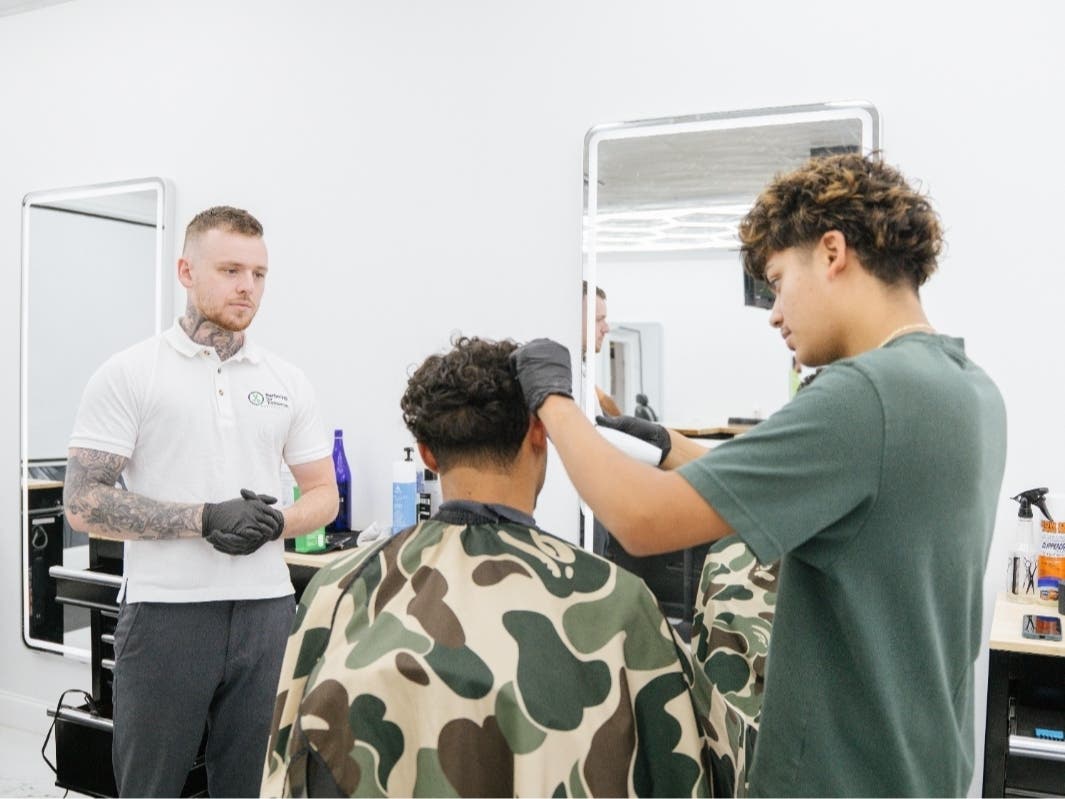
At Barbering for Tomorrow, we are turning these statistics into real outcomes for Nashua youth.
Through our partnership with the Career and Technical Education (CTE) program in the Nashua School District, students begin with a 150 hour pre apprenticeship semester during their fourth academic block.
Here, students gain:
- Hands-on skills by cutting mannequins
- Observation of experienced professionals
- Theory and fundamental knowledge of the trade.
This comprehensive experience prepares them to transition into a full apprenticeship program, where they earn income, gain independence, and contribute directly to the local economy.
Each apprentice receives:
- A $1,500 tools and equipment package, removing financial obstacles to entry
- Their own chair in the shop, giving them ownership and responsibility
- Opportunities to cut live clients, earning income while learning
This isn’t just education; it’s an earn-and-learn model that equips students with the skills and experience to thrive.
Financial Literacy and Wealth Building
Skills alone aren’t enough. To secure long term success, our program partners with Bar Harbor
Bank & Trust to provide:
Financial literacy classes
Assistance opening Roth IRAs
Guidance in establishing business and checking accounts
These components teach students how to manage their earnings, plan for the future, and build wealth. This is economic empowerment in action: students aren’t just earning; they’re learning to grow and protect their income while contributing to Nashua’s economy.
Impact Beyond Skills
The results speak for themselves: students leave our program with confidence, real-world experience, and a sense of agency. They become contributors to the local economy, mentors for younger students, and role models in their communities.
Investing in workforce development and trades education is not just about jobs — it’s about transforming lives, reducing inequality, and building stronger communities. When we equip youth with real-world skills, financial literacy, and mentorship, we generate a cycle of opportunity that benefits individuals, families, and the entire city.
A Call to Action
Nashua has the talent and the need. By supporting programs that provide pre-apprenticeships, full apprenticeships, and financial literacy, our community can:• Give students a route to meaningful work
- Reduce the economic and social cost of unemployment and underemployment
- Build long term wealth and stability in low-income communities
Trades are more than a fallback — they are a foundation for economic mobility, contribution, and independence. Our nonprofit proves this every day in Nashua. With local partnerships, strategic investment, and community backing, we can expand this model to reach every young person eager to learn, earn, and thrive. As the founder of Barbering for Tomorrow, becoming a licensed professional has allowed me to purchase my own home, acquire the building where my business resides, and open a business in downtown Nashua — providing tax revenue, job opportunities, and redeveloping previously underused buildings. My hope is to replicate this opportunity and economic impact through Barbering for Tomorrow.
By investing in workforce education today, Nashua can build a stronger, more equitable, and more successful tomorrow.
Gage Armand is the president of Barbering for Tomorrow in Nashua.
Get more local news delivered straight to your inbox. Sign up for free Patch newsletters and alerts.