Health & Fitness
Masks Return To 3 NJ School Districts As ‘Tripledemic’ Takes Toll
Three school districts, including two of NJ's largest, brought back mask mandates to combat the rise of COVID-19, the flu and RSV.


NEW JERSEY — New Jersey has reached the post-holiday phase of the respiratory-illness season. Three New Jersey school districts, including two of the state's largest, brought back mask mandates to combat the rise of COVID-19, influenza and other infectious diseases.
The Paterson and Camden school districts both announced a return to mask requirements Thursday. School officials cited the increase in COVID, flu and respiratory syncytial virus (RSV) — the respiratory threats comprising the "tripledemic," which has strained hospitals and pediatric departments around the nation.
New Jersey's emergency rooms continue to fare better than the nation's as a whole. But this week, the state still reported its highest total of COVID hospitalizations since Feb. 11, when last winter's omicron wave was diminishing.
Find out what's happening in Across New Jerseyfor free with the latest updates from Patch.
The mandate for Paterson Public Schools — the state's fourth-largest district — will kick in Jan. 3, when schools return from the winter break. Officials will re-evaluate the data and monitor changes in transmission rates. The Camden City School District's mandate ends Jan. 17.
The Passaic City School District — New Jersey's ninth-largest public school system — announced its return to universal masking Dec. 21, putting the mandate into effect until local COVID activity is no longer considered high in New Jersey's weekly COVID report.
Find out what's happening in Across New Jerseyfor free with the latest updates from Patch.
Federal health officials, meanwhile, continue to recommend masking up for indoor, public spaces in almost all of New Jersey. All but six counties in the state had "high" COVID community levels as of Thursday, according to the CDC.
.png)
The CDC adopted the community-level metric — based on hospitalizations and case rates — in late February. The agency updates its color-coded COVID maps each Thursday, recommending masks in counties with high community levels.
Some of the state made progress this week, falling from high to medium COVID levels: Morris, Essex, Warren and Atlantic Counties. Mercer County jumped from the medium to the high marker.
The mask recommendations don't trigger any mandates in New Jersey, and people may also choose to continue masking in any setting.
Here's how the tripledemic continues to impact New Jersey.
State Of NJ Hospitals
State officials reported 1,491 hospital patients with confirmed or suspected COVID as of Thursday. The New Jersey Department of Health still awaited data from one hospital for its daily tally, but the figure still marks New Jersey's highest since Feb. 11.
However, the increase in COVID hospitalizations has been gradual, with steady rises since state officials reported 977 patients on Nov. 24. The initial omicron wave brought a steeper surge of COVID hospitalizations during the same timeframe last year, going from 856 patients on Nov. 24, 2021, ending the year with 4,042 and ultimately peaking Jan. 11 with 6,089 hospitalizations.
New Jersey's intensive-care units continue to fare better than the nation's as a whole, with 46.8 percent of the state's ICU beds in use as of Friday, according to federal data. Meanwhile, 76.5 percent of ICU beds in the U.S. are occupied.
Additionally, 70.3 percent New Jersey's in-patient beds are occupied, with 7.2 percent in use for COVID. The ratio becomes concerning when COVID patients exceed 10 percent of inpatient beds, representing "extreme stress" at 20 percent, according to a framework developed by the University of Washington's Institute for Health Metrics and Evaluation.
Fifty-seven percent of New Jersey's pediatric beds were occupied as of Thursday, according to NBC News analysis of federal data.
The CDC reported 70 COVID deaths in New Jersey over the past week. The estimated national death toll from the virus totaled about 1,900 people in that span.
Flu Levels Remain High
New Jersey continues to endure one of its most severe influenza seasons in recent memory, fresh off two years in which COVID restrictions minimized the flu's impact. Every part of the state had high flu levels as of Dec. 24, according to the New Jersey Department of Health's latest weekly influenza report.
So far this flu season, which began Oct. 1, the state has reported 71,383 cases, 44 outbreaks in longterm care facilities and two pediatric deaths. New Jersey doesn't have a publicly available influenza death toll for this season. Since influenza surveillance doesn't capture all flu cases, the CDC merely has a wide-ranging, preliminary national estimate of 12,000-35,000 flu deaths from Oct. 1 through Dec. 17.
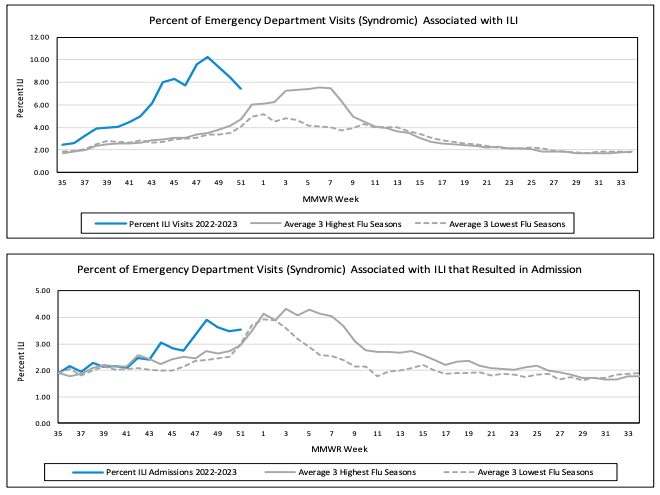
New Jersey continues to outpace its three worst flu seasons of the past decade — 2012-13, 2017-18 and 2018-19 — in two key metrics: the rate of emergency-department visits associated with influenza-like illness and the percent of those visits that resulted in admission. But those rates have fallen from the seasonal peaks reported earlier this month.
For the eighth-straight week, more than 15 percent of RSV tests administered in New Jersey turned up positive. But the positivity rate fell for the second-consecutive week, according to the state's influenza report.
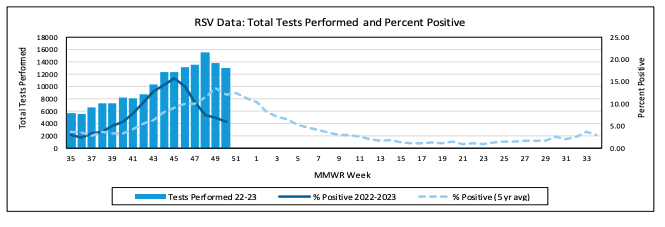
RSV is a common respiratory virus that usually causes mild, cold-like symptoms, the CDC says. Most people recover in a week or two, but the virus can be serious, especially for infants and older adults.
COVID Still Rising In The Wastewater
COVID levels in the region's wastewater have risen 145 percent in less than two months, according to Biobot Analytics, which monitors sewage as it relates to public health.
Virus levels in the wastewater can often indicate COVID's prevalence in communities before lagging indicators, such as hospitalizations or deaths. Wastewater samples in the Northeast region, which includes New Jersey, averaged their highest COVID levels since the week of Jan. 19 — toward the peak of the omicron wave.
For reference, the Northeast averaged 1,739 COVID copies per milliliter of sewage (copies/mL) this week, according to Biobot Analytics. The company reported a national pandemic record of 7,185 copies/mL in the region for the week of Dec. 29, 2021. In the ensuing weeks, New Jersey reached a state record of daily cases (33,459 on Jan. 7), approached its record for COVID hospitalizations (6,089 on Jan. 11) and logged its most significant wave of deaths from the virus since the beginning of the pandemic.
For more coronavirus numbers, visit the state health department's COVID-19 dashboard, The New York Times data page for New Jersey, the CDC's data tracker and Biobot's wastewater webpage.
Get more local news delivered straight to your inbox. Sign up for free Patch newsletters and alerts.