Health & Fitness
'Tripledemic' Becomes 'Emergency' In Nation's ERs: How NJ Is Faring
The 'tripledemic' — the respiratory-disease threat of COVID-19, the flu and RSV — has clogged emergency rooms throughout the nation.


NEW JERSEY — On one hand, federal health officials once against rescinded their recommendations for masking in indoor, public spaces throughout New Jersey. But influenza activity and respiratory syncytial virus (RSV) cases continue to rise in the state, and medical professionals throughout the country say emergency rooms have reached a breaking point.
The "tripledemic" — the respiratory-disease threat of COVID-19, the flu and RSV — has clogged emergency rooms throughout the nation, according to a letter to President Joe Biden from more than 30 medical and public health organizations. The letter, dated Monday, asks the White House for a summit to coordinate immediate and longterm solutions.
"Boarding has become its own public health emergency," the letter says. "Our nation's safety net is on the verge of breaking beyond repair; EDs (emergency departments) are gridlocked and overwhelmed with patients waiting — waiting to be seen; waiting for admission to an inpatient bed in the hospital; waiting to be transferred to psychiatric, skilled nursing, or other specialized facilities; or, waiting simply to return to their nursing home."
Find out what's happening in Across New Jerseyfor free with the latest updates from Patch.
New Jersey's ICUs remain significantly less occupied than the nation's as a whole. But early signs point to an eventful season for respiratory diseases, including higher-than-usual rates of school absenteeism and hospital visits for influenza-like illness.
But for the fifth time in six weeks, the CDC didn't recommend masking in any New Jersey counties. The agency adopted the community-level metric — a metric based on hospitalizations and case rates — in late February. The agency updates its color-coded COVID maps each Thursday, recommending masks in counties with "high" community levels.
Find out what's happening in Across New Jerseyfor free with the latest updates from Patch.
Thursday's New Jersey map changed little from the prior week's. Two northeastern counties — Essex and Hudson — fell from high to medium community levels.
.png)
The CDC's mask recommendations do not trigger any mandates in New Jersey. People may also choose to continue masking in any setting.
NJ Hospitals Faring Better Than Most
While medical professionals around the country have rung the alarm on the tripledemic, let's look at New Jersey's hospitals.
Hospitals around the state had 1,089 patients with confirmed or suspected COVID as of Thursday, according to the New Jersey Department of Health. The state has reported at least 1,050 COVID patients in hospitals — but no more than 1,171 (Nov. 2's total) — every day since Oct. 10.
Fortunately for New Jersey, the state's ICUs aren't nearly as full as most of the nation's. As of Friday, patients occupy 44.5 percent of New Jersey's ICU beds, while 74.4 percent of ICU beds in the U.S. have been filled, according to federal data.
In terms of inpatient beds, 71.2 percent in New Jersey and 78.2 percent around the nation are in use.
COVID patients occupy 4.7 percent of New Jersey's inpatient beds as of Friday. The ratio becomes concerning when it exceeds 10 percent and represents "extreme stress" at 20 percent, according to a framework developed by the University of Washington's Institute for Health Metrics and Evaluation.
Additionally, 3.4 percent of New Jersey's ICU beds include COVID patients. The University of Washington's framework indicates "high stress" at the 30 percent mark and "extreme stress" at 60 percent.
Read More: RSV Cases On The Rise At Morristown Medical Center: What To Know
Trouble Brewing?
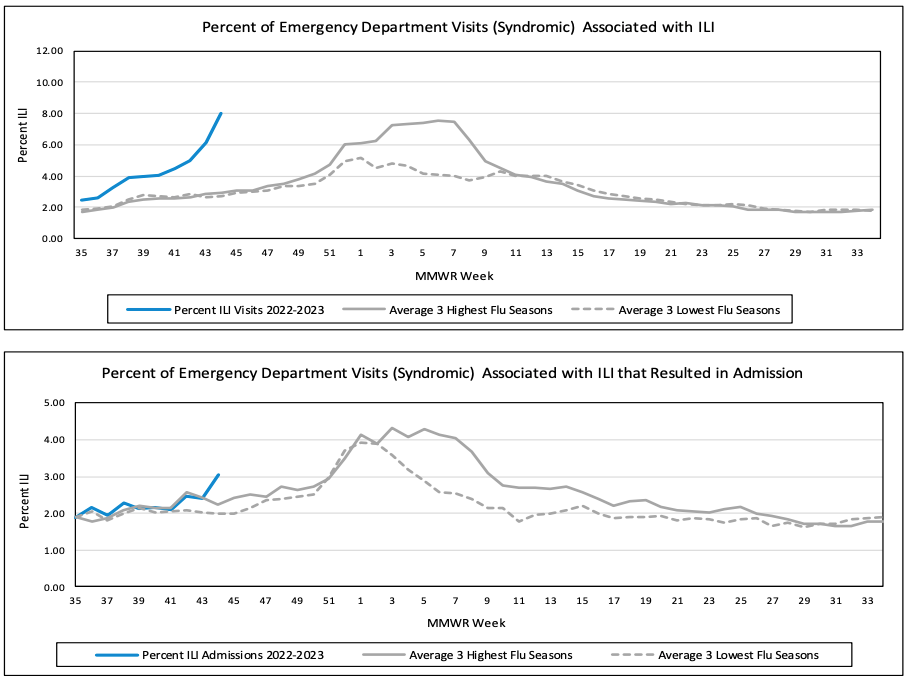
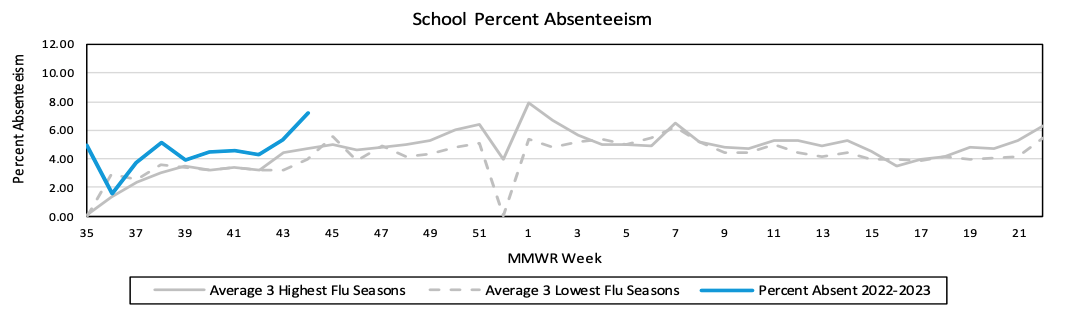
Influenza activity remains "moderate" throughout New Jersey, according to the state health department's weekly surveillance report on influenza and respiratory illness. But so far this flu season, New Jersey shows high rates of school absenteeism and hospital visits for influenza-like illness (ILI).
The state's rate of emergency department visits for ILI surged to about 8 percent last week — more than double the average of New Jersey's worst recent flu seasons during this time of year. The percentage of emergency department visits that resulted in admission and the rate of school absenteeism have also exceeded past years.
The graphs below show a week-by-week comparison of the current flu season with New Jersey's most and least severe in the past decade.
RSV activity also continues to rise. The virus is relatively common and usually causes mild, cold-like symptoms that subside in a week or two. But RSV can be serious, especially for infants, young children and older adults.
New Jersey detected an average of 143.3 RSV cases per week over the past five weeks. During that timeframe last year, the state averaged 55.8 detected infections per week. While many RSV infections go untested, the figures help illustrate how much the virus is spreading in different states.
What Else You Should Know
Thirty-nine people in New Jersey died from COVID in the past week, according to the CDC. Federal officials reported about 2,350 deaths from COVID complications around the nation during that timeframe.
COVID levels in the region's wastewater continue to gradually decline, according to Biobot Analytics, which monitors sewage as it relates to public health. Virus levels in the wastewater can often indicate COVID's prevalence in communities before lagging indicators, such as hospitalizations or deaths.
Wastewater levels for COVID are measured by estimated gene copies per milliliters of sewage. Wastewater samples in the Northeast averaged 715 copies/mL as of Wednesday. While still the highest out of any U.S. region, that's a far cry from the 1,248 copies/mL that Northeastern wastewater samples averaged for the week of Oct. 12. See the data here.
New Jersey's COVID transmission rate stood at 1.01 as of Friday morning — a hair below the rate of 1.03 at this time last week — according to state data. A transmission rate higher than 1 indicates that each infection leads to another infection — a sign that the virus is spreading more quickly.
For more coronavirus numbers, visit the state health department's COVID-19 dashboard, The New York Times data page for New Jersey and the CDC's data tracker.
Get more local news delivered straight to your inbox. Sign up for free Patch newsletters and alerts.