Schools
A Switch (Off) in Time Saves Thousands
Central Regional reports nearly $430,000 in energy savings through two years of Energy Education partnership
Motion sensors that switch lights off when a room isn't in use. Turning off lights and computers when a room is vacated. And adjusting the school calendar to cut down on the need for air conditioning.
All of those measures -- and many more -- have resulted in a savings of $427,608 in energy costs over 24 months for the Central Regional School District, officials announced on Thursday night.
And as a result, the district received recognition from Energy Education, the organization it has partnered with to find ways to save energy, in the form of its Environmental Excellence Award, honoring the district's reduced impact on the environment.
Find out what's happening in Berkeleyfor free with the latest updates from Patch.
"Reaching this level of savings at this stage of the program is a significant achievement," said Dr. William S. Spears, chairman of Energy Education, in a statement announcing the award that was read at the meeting.
"According to EPA/EGrid figures, in the first 24 months of the program, the Central Regional School District saved 12,521 MMBTU, the equivalent of 1,417 metric tons of carbon dioxide emissions being prevented, 254 cars removed from the road, or 36,251 pine trees grown for 10 years," the statement noted.
Find out what's happening in Berkeleyfor free with the latest updates from Patch.
The four-year program -- which costs the district $94,000 per year, business administrator Kevin O'Shea said -- has been looking at how the district uses energy, in the form of electricity, water, sewer, natural gas and fuel oil, and at conservation measures that reduce consumption. The goal of the project is to train Curtis Kleier, the district's energy education specialist, to analyze how the district is using those resources and how to continue to conserve after the partnership with Energy Education ends in 2013, O'Shea said.
"We can renew the commitment to the program, but their whole goal is to get you off the program," O'Shea said.
Superintendent Triantafillos Parlapanides said in 2008-09, the school year prior to the district's involvement in Energy Education, the district spent $675,000 on electricity and natural gas. "Before that we were up to $1 million on those costs," he said.
Among some of the measures taken to reduce consumption have been the installation of motion detectors in a number of rooms, including restrooms, so that when there's no activity in a room the lights shut off, Parlapanides said.
The adjustment of the school calendar, removing a lengthy spring break in favor of ending the school year earlier in June to reduce the need for air conditioning, saved $27,000 last year, he said.
O'Shea said Energy Education's calculations of the savings also take into account the temperatures, "so you can't say, 'Oh, of course the costs were lower because we had a warm winter.' These are actual savings."
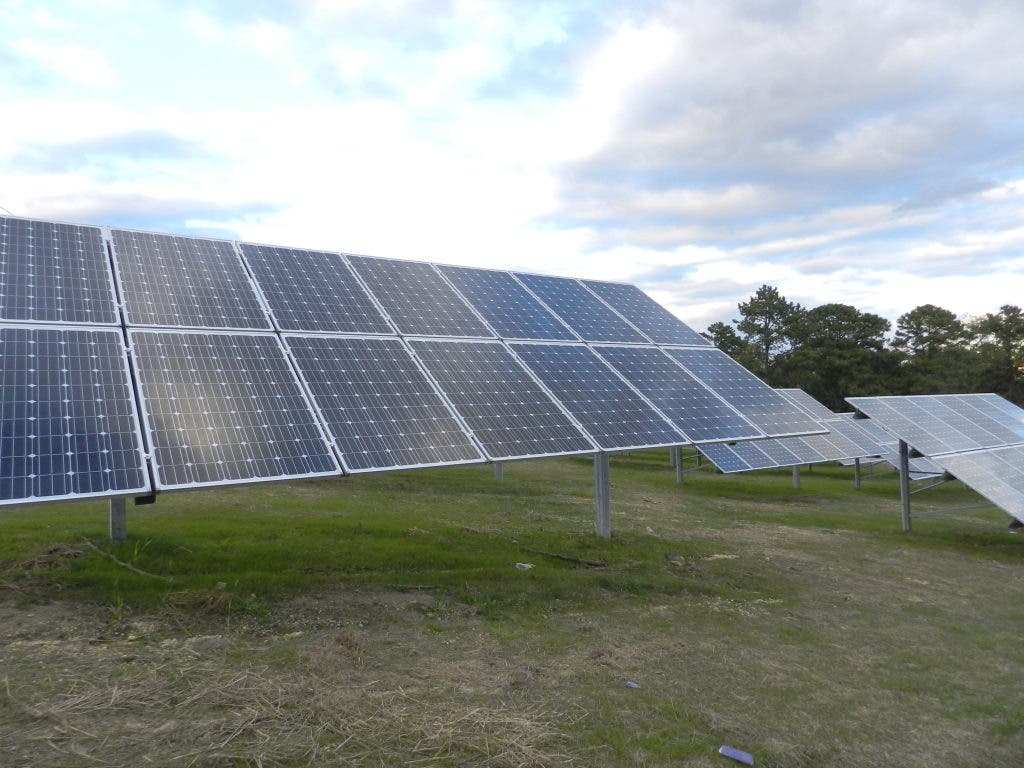
And with the solar panels having become operational in early October, the district's energy costs will go down even further, Parlapanides and O'Shea said.
"As much as another $100,000 to $200,000," O'Shea said."We've really attacked our energy costs."
Parlapanides said they hope to redirect some of the cost savings from the energy efficiency measures toward rehiring a math teacher and a language arts teacher, but much of the savings will be directed toward reducing the burden on the taxpayers.
In other news:
-- The district is finally connected to and receving water from the Berkeley Township Municipal Utilities Authority, as of Sept. 2.
O'Shea would not speculate on what the cost will be to the district, as some meters and valves are still being installed and the MUA, as a result, has not been billing the district. But he said he expects the cost of being hooked up to the MUA will balance out because under the well-water system, the district had to pay a member of the maintenance crew and and outside consultant to make sure the well water was tested every day, including weekends and holidays.
"This required we incur overtime costs for testing on days when school was closed, as well as money paid to the outside professional," O'Shea said. "I feel that the money saved in overtime and professional fees should more or less balance out the costs of the water we now get from Berkely Township MUA."
"We are very excited that Berkeley MUA is providing our water," O'Shea said. "It was a pleasure working with them on the project and the Central Regional Board of Ed thanks the MUA commissioners and its staff for their cooperation during this project.
"The phrase 'don't drink the water' is no longer the funny catch phrase around here. Students and staff are now drinking the water from our water fountains on a much more regular basis," he said.
Two wells remain operational and are used for irrigating the athletic fields and lawns, O'Shea said. Because they are used only for irrigation, they do not need to be tested, he said.
-- The district is working to set up an Academy of Humanities program in conjuction with Georgian Court University, which would allow students to take courses at Georgian Court at a reduced cost while gaining college credits, said Susan Cowdrick, chair of the board's education committee. The program is expected to be presented to the high school's junior class sometime in the spring for the 2012-13 school year, and will be expanded over the course of four years to include all four grade levels, she said.
"It will save a parent (the cost of) a semester of college," Parlapanides said. "Students taking classes at Georgian Court will reduce class size and allow us to offer more electives."
-- Parlapanides announced the passing of Cindy Thatcher, a former Central Regional teacher who had run the district's Renaissance Program and was beloved among the students and staff. Thatcher died on Friday of brain cancer at age 52.
"She's gone far too soon. She truly will be missed," Parlapanides said.