Schools
Chatham Student's Project Chosen For World Food Prize Institute
A local high school student will present his research on improving Chinese agriculture in front of Nobel Laureates next month.


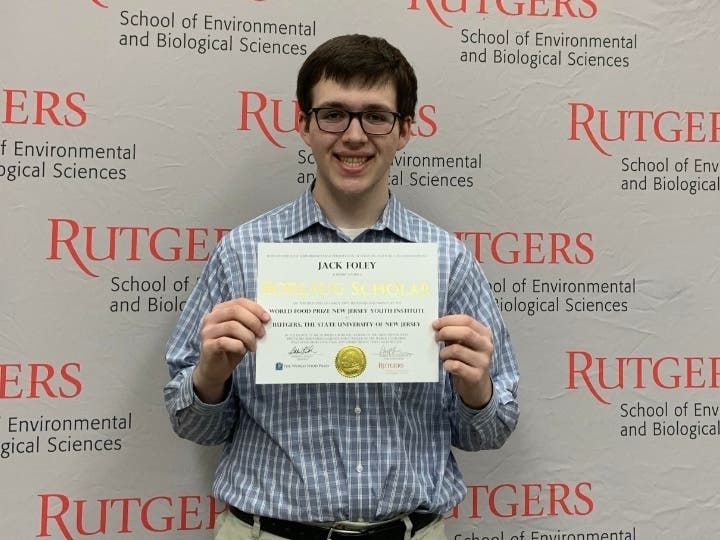
CHATHAM, NJ – A local high school student will present his research on improving Chinese agriculture in front of Nobel Laureates next month.
Chatham High School junior Jack Foley has been selected to participate in the New Jersey World Food Prize Global Youth Institute, a multi-day event where students interact with Nobel and World Food Prize Laureates to discuss pressing food security and agricultural issues with international experts.
This year's event will be held virtually from Oct. 12-23 in conjunction with the awarding of the World Food Prize and the Borlaug Dialogue, the premier international symposium on food security.
Find out what's happening in Chathamfor free with the latest updates from Patch.
Through the New Jersey Youth Institute, students research issues they are passionate about and propose their ideas to solve the problems they discover. Foley chose to research food security in China related to sustainable agriculture.
"China has about one-fifth of the world's population, yet less than one-tenth of its arable farmland to grow food," he said, in a prepared statement. "As China's middle class has expanded more in recent years, more people want a 'westernized diet,' a diet that has greater reliance on meats and fewer on vegetables. This newer diet requires about an acre of land per person, yet China can only devote about 0.2 acres currently."
Find out what's happening in Chathamfor free with the latest updates from Patch.
In order to solve this problem, Foley researched a way to create a system of crop rotations for plants in order to change the crops that grow at different points during the year. This increases the yield of crops in a given space, because the crop rotation system requires less dependency on nitrogenous fertilizers and pesticides, he said.
"I proposed a plan of working with rural farmers that includes training locals to be liaisons to communicate the ideas to the farmers so the farmers understand completely what they need to do by someone they trust instead of a foreigner," Foley said. "The liaison will also specialize in any minority languages of the area, such as Uyghur, Tibetan, Mongolian to effectively communicate with the locals."
Foley's high school teacher Dr. Margaret Holzer said his research presents an actionable plan to overcome challenges in the Chineses agricultural system.
"I was delighted that he wanted to take on the challenged of writing a competitive research paper, and presenting his research in a public setting," she said. "I commend him for his superior effort."
Foley said he was shocked to learn his project has been selected for the Global Youth Institute.
"I'm really happy because I put a lot of work into researching my paper, so I'm glad to have the opportunity to go to the World Food Prize conference."
Get more local news delivered straight to your inbox. Sign up for free Patch newsletters and alerts.