Neighbor News
NJ is Ranked the Worst State for Small Businesses
How Green Party Gubernatorial candidate Madelyn Hoffman plans to change these statistics
By Julia Hyman
Do you have dreams of starting your own small business one day? Do you imagine yourself reaping benefits from your astounding, innovative, and hip new small business? If you answered “yes” to the previous questions, I would hope that you aren’t planning to start that business in New Jersey! New Jersey is currently ranked 50th out of the 50 states for starting small businesses. According to the WalletHub Study, New Jersey just pulled out the bottom of the barrel when it came to Labor Costs, Office Space Affordability, Cost of Living, and the Average Growth in Number of Small Businesses. Furthermore, New Jersey’s labor costs are the second highest in the country with the current minimum wage being set at an average of $12 per hour. While it is beneficial to have a high minimum wage (the Green Party of New Jersey and the Hoffman for Governor campaign actually advocate for a living wage) so that civilians working minimum wage jobs can have some sort of a living, high labor costs can be used as a reason for businesses, small and large, to fear reduction in the company’s overall profits, the company’s ability to hire more workers, and the number of hours an individual can work. To add a cherry on top of the already money-draining policies here in New Jersey, the average annual single insurance premium per employee is the fourth largest in the country, reaching about $7,800. Not to mention, taxes are also very high in New Jersey and serve as a substantial money-drainer as well.
A potential cure for New Jersey’s struggling small businesses should include tax incentives, which can alleviate the drainage of money and resources that are meant to go into those small businesses. Tax incentives are defined as “deductions, exemptions, or exclusions from money owed in taxes to the government” (FreshBooks). The total spending on incentives in New Jersey barely makes up 0.13% of the Gross Domestic Production (GDP), which is one of the lowest percentages nationwide. Many opponents of tax incentives may say that these tax incentives will reward firms for the same quality work they could’ve done in the absence of tax incentives. While this logic may be true, tax incentives can make work easier and more efficient for workers, because of the businesses’ ability to invest the money that wasn’t taxed by the government into better equipment and working conditions. Moreover, tax incentives for small businesses in the U.S. include employer health insurance premiums- which covers 50% of premiums for employees’ health coverage- as well as start-up pension plans, research activity credits, and family and medical leave credits.
With this clear-cut solution right in front of us, why hasn’t Governor Phil Murphy implemented more spending into tax incentives for small businesses? Well, the answer is simple: Governor Phil Murphy profits off of large corporations and Super PACS. According to Politico, “New Direction New Jersey reported that it has taken in $6.8 million since its inception shortly after Murphy’s election in November 2017- the bulk of it from the New Jersey Education Association, which gave $4.5 million through a Super PAC it controls.” New Direction is heavily involved with Murphy’s campaign, and is funded by a plethora of private businesses and labor unions that are prohibited from donating directly to Murphy’s campaign because of pay-to-play laws. However, independent expenditure groups are often used to channel the money from these businesses and unions into Murphy’s donations. When faced with a bill that called for “dark money” political organizations to disclose donors that gave $10,000 or more, Murphy vetoed the measure at first, until he was threatened with an override.
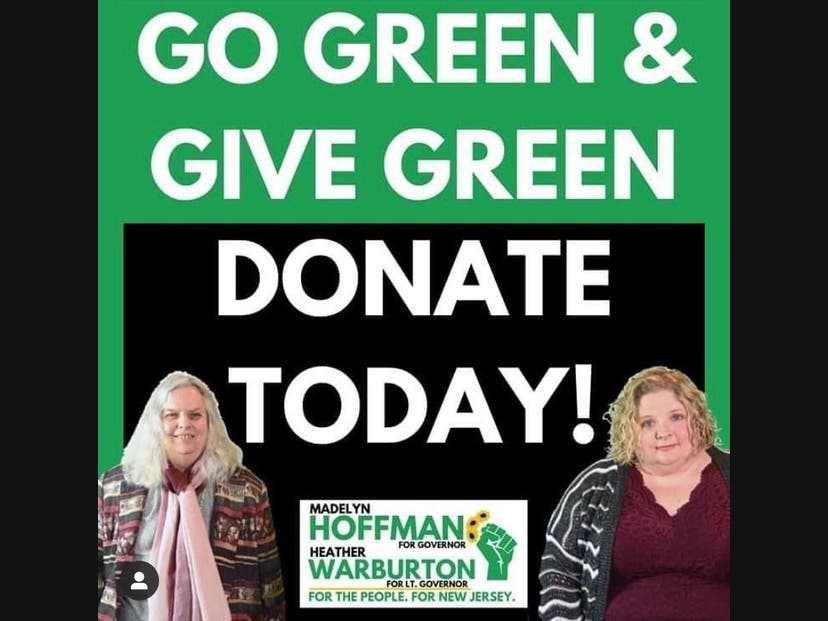
Madelyn Hoffman, the Green Party of New Jersey’s candidate for governor in 2021, and Heather Warburton, her choice for Lieutenant Governor, have pledged to not take corporate money from Political Action Committees. This single act allows these candidates to propose and support needed changes to the tax structure in New Jersey, shifting the burden from the backs of small businesses and the middle class to major corporations and the super wealthy. At this point, corporate revenue accounts for only 13% of the state’s budget, putting an inordinate amount of pressure on small business and the middle class. This state needs elected officials who are willing to stand up to the major corporations and reverse the trend of the past two decades or more -- and make sure that they are asked to pay their fair share of New Jersey’s taxes. Additionally, a state and national level improved and expanded Medicare for All will save small businesses the expense of providing for their employees’ health insurance. The Hoffman/Warburton team supports a single-payer health insurance program - this will both better protect the state’s residents, pandemic or not, and reduce one important small business expense.
https://www.politico.com/states/new-jersey/story/2019/09/12/pro-murphy-dark-money-group-releases-donors-after-nearly-two-years-of-secrecy-1185854
https://www.tapinto.net/towns/scotch-plains-slash-fanwood/sections/business-and-finance/articles/new-jersey-is-2021-s-worst-state-to-start-a-business-wallethub-study
https://njbia.org/nj-ranks-near-last-for-policies-and-costs-impacting-small-business-and-entrepreneurship/
https://www.freshbooks.com/hub/taxes/tax-incentives-examples