Neighbor News
Print vs. Digital Marketing: What Works for Local Businesses?
Discover when print or digital marketing works best for local businesses and learn how combining both can boost visibility and results.

A local business can spend money on social media ads, search advertising, email campaigns, and printed materials. The hard part is knowing which channel deserves the next dollar.
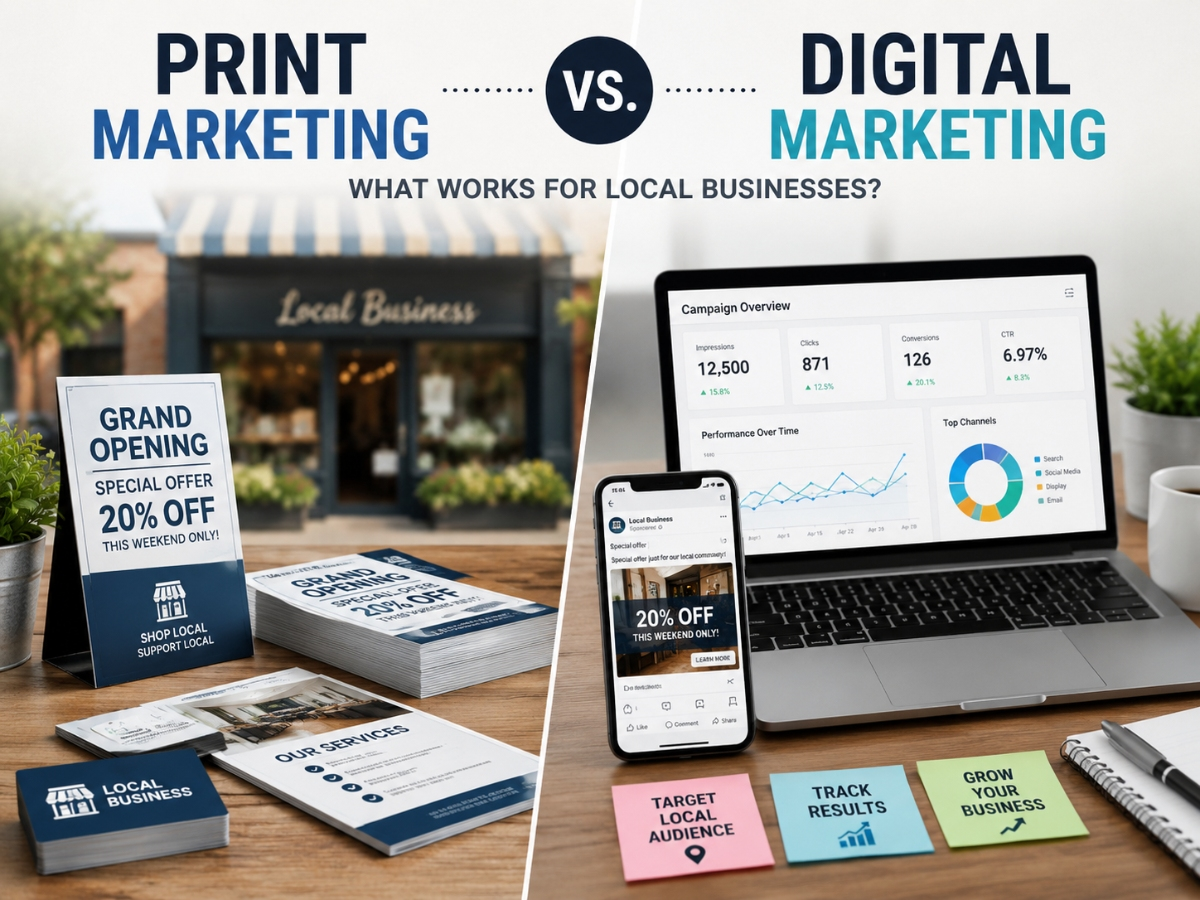
The answer is not always print or digital. For many small businesses, the strongest approach combines both. Digital marketing helps you target people quickly and measure clicks. Print marketing helps your business become visible in the neighborhood, where customers can hold, save, and share the message.
Short answer: Digital marketing is useful for fast testing, audience targeting, and online conversions. Print marketing is often stronger for local awareness, events, storefront traffic, and repeated physical exposure. A small business can test both with a limited campaign, a trackable QR code, and a clear offer.
Find out what's happening in East Brunswickfor free with the latest updates from Patch.
What Digital Marketing Does Well
Digital advertising gives a business speed. You can create an ad in the morning, set a budget, and begin collecting impressions or clicks the same day. A restaurant can promote a lunch special within a few miles of its location. A home-service company can send visitors to a quote form. A retailer can advertise a weekend sale to people who have already visited its website.
Digital channels also make testing easier. You can compare two headlines, two photos, or two offers without printing a new batch of materials. If one version receives more responses, you can adjust the campaign while it is running.
Find out what's happening in East Brunswickfor free with the latest updates from Patch.
That flexibility is valuable, especially for businesses that are still learning which message attracts customers.
But digital advertising has a weakness. Your message appears beside dozens of other messages competing for the same attention. A customer may see an ad, swipe past it, and forget the business within seconds. Even a good campaign can become expensive when many businesses target the same audience.
Quick Recap
- Digital campaigns can launch quickly.
- Online ads are easy to measure and revise.
- Targeting can focus on location, interests, or past activity.
- Competition for attention is intense.
Why Printed Marketing Still Matters
Printed materials give a local business a physical presence. A flyer on a community bulletin board, a menu insert at a neighborhood restaurant, or a postcard placed in a customer's home is not competing with a scrolling feed at that exact moment.
A printed piece can stay on a counter for several days. It may be handed to another family member or saved until the customer needs the service. That is particularly useful for businesses people do not visit every week, such as HVAC companies, real estate agents, cleaning services, salons, churches, and nonprofit organizations.
Print also creates a sense of place. A neighborhood flyer with a local phone number and a nearby service area feels different from a generic advertisement shown by an unknown company. The message is connected to the community.
The design still matters. A crowded flyer with tiny text will not perform well simply because it is printed. Use one main offer, one phone number, one website or QR code, and a headline that can be understood in three seconds.
For most standard flyers, 8.5 × 11 inches is familiar and easy to distribute. A 4 × 6 postcard is more compact. A 5 × 7 piece has more room for a photograph, offer, or event details. Choose the format based on how people will receive and use it.
Print Versus Digital Marketing
| Factor | Printed Marketing | Digital Marketing |
| Launch speed | Requires design, production, and delivery time | Can launch very quickly |
| Local visibility | Strong in specific neighborhoods and locations | Depends on targeting and ad delivery |
| Attention | Physical piece can remain visible | Often disappears after a scroll |
| Testing | Requires a new version to be produced | Easy to test multiple versions |
| Tracking | Use QR codes, coupon codes, or dedicated URLs | Clicks, views, and conversions are easier to record |
| Best use | Events, local offers, handouts, mailers, storefront promotion | Search demand, retargeting, quick offers, online sales |
Neither channel wins every situation.
When Should a Business Choose Print?
Choose print when the campaign depends on a physical location, a face-to-face interaction, or repeated neighborhood exposure. A gym promoting a free trial near its facility may benefit from flyers placed at nearby businesses. A realtor preparing for an open house needs something visitors can take with them. A church or nonprofit may need a clear event handout that people can keep on the refrigerator.
Print is also useful when your audience is already gathering in a physical place. A salon can place cards at a partner business. A restaurant can include a printed promotion with takeout orders. A contractor can leave a professionally designed door hanger after completing a nearby job.
For a short run, transparent online pricing can make the test easier to budget. Businesses comparing short-run color copies can review quantity, color, and paper choices before ordering. Free Design Setup can also help with layout, bleed, CMYK preparation, and QR code placement when the file needs improvement.
When Should a Business Choose Digital?
Digital marketing is usually the better first move when customers are actively searching for a service or when an offer must change frequently. A dental office promoting appointment availability, for example, may want a search campaign connected directly to its booking page. An online store may need digital ads that change based on products viewed.
Digital is also practical when the business serves a wide geographic area. A company selling nationwide may not want to print separate materials for every city. Online targeting can reach selected regions without producing multiple physical versions.
Why Combining Both Channels Can Work
The most practical campaign often uses print to attract attention and digital tools to measure the response.
A business can print a clear offer, add a QR code, and send visitors to a dedicated page. The printed piece creates the local reminder. The landing page records visits, explains the offer, and collects inquiries. A unique coupon code can provide another measurement point.
For example, a neighborhood plumbing company could distribute a service-area flyer with a seasonal inspection offer. The flyer might include a QR code, a phone number, and a short deadline. The company can compare QR visits, phone calls, and coupon redemptions rather than guessing whether the campaign worked.
Start with a controlled test. Pick one neighborhood, one offer, and one response method. Order only the quantity you can distribute properly. Then compare the result with the cost of your digital campaign.
If you need fast, budget-conscious production, affordable rush printing can help when a local event, promotion, or deadline is approaching. The important point is not to print blindly. Build the message around a measurable action.
Frequently Asked Questions
Is print marketing cheaper than digital advertising?
It depends on the campaign size, design, distribution, and audience. Print has production and delivery costs, while digital campaigns charge through impressions, clicks, or conversions. A small printed test can be easier to control when the audience is concentrated in one neighborhood.
How can a printed flyer be tracked?
Add a QR code, a dedicated landing-page address, a unique coupon code, or a phone extension used only for that campaign. Without one of these methods, it becomes difficult to separate flyer responses from regular business activity.
What size flyer works best for a local business?
An 8.5 × 11-inch flyer offers room for an offer, service details, and a QR code. A 4 × 6 postcard is easier to hand out or mail. A 5 × 7 piece is a useful middle option for events, promotions, and appointment-based services.
Does digital marketing replace printed materials?
Not completely. Digital marketing is strong for targeting and measurement, while print can support local visibility and physical reminders. Businesses that serve a defined area often benefit from using both channels for different jobs.
How much text should a flyer include?
Keep the main message short. Aim for one headline, three key benefits, one offer, and one clear next step. If customers need a long explanation, use the flyer to send them to a website or landing page.