Neighbor News
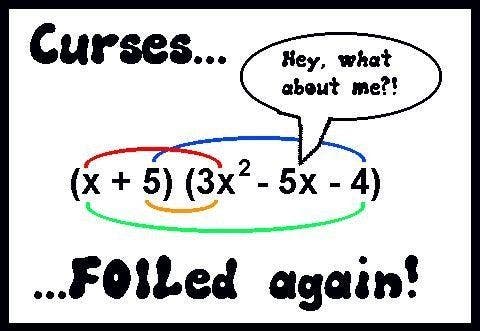
Curses! FOILed Again.
Try this simple multiplication problem. It's deeper than you think!



Which of the following is closest to 19.9 times 199?
A 4000 B 3990 C 3980 D 3970 E 3960
This is a deliberately simple question from the Bergen Academies sample test 1. If you’re pressed for time, what would you answer? Probably the first choice of 4000. It’s a good estimate.
Find out what's happening in Fort Leefor free with the latest updates from Patch.
The Bergen Academies math entrance examination consists of 40 questions to be answered in 60 minutes. That’s 1½ minutes or 90 seconds per question, to be read, comprehended, strategized, solved, then checked. With a few exceptions, with careful comprehension and a good choice of strategies, the time given is sufficient.
Let’s brute force our way through this solution using the standard multiplication method. I suggest starting a timer to see how long it takes you.
Find out what's happening in Fort Leefor free with the latest updates from Patch.
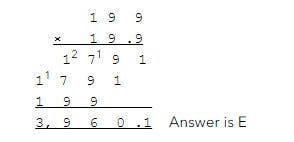
I timed myself at about 40 seconds to setup and perform the computation. That’s after having familiarity with the problem. This is obviously a time waster problem but a proficient multiplier will be able to squeak under the 90 seconds-per-question time ration. Given the possible answers, it’s obviously a trap for the estimator and those rushed for time. However, is there an accurate and fast approach?
Let’s try the lattice multiplication method that some nearby schools favor. I won’t go through an thorough explanation of the lattice method except to note that it operates on micro partial products to the extreme with positional placement enforced by the lattice. On the top and right side of the lattice are the multiplicands. Each digit of the multiplicands are multiplied with each other and the partial products are arranged as two split halves of tens and ones places. Then the split halves are summed diagonally to form the product results on the left and bottom
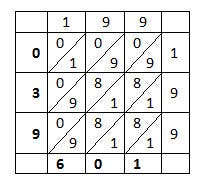
With the complex setup that must be accurately drawn, and large number of sums to perform, that took me over 1:30 minutes. My opinion of the lattice method is it’s a novelty but should be avoided as a generally usable method. It’s chief demerit is it prevents understanding of how multi-digit multiplication actually works. Understanding multi-digit multiplication is necessary for understanding polynomial multiplications that is necessary for algebra.
With that observation about polynomial multiplication, let’s then consider the so called “Ayurvedic multiplication” method. Other than some alluded mysticism, the Ayurvedic multiplication is simply binomial multiplication of "compatible numbers" -- or easy to use numbers. Recognize that 199 and 19.9 can be represented as binomials “200 -1” and “20 -0.1”. For those familiar with the Algebraic FOIL (first, outside, inside, last) method for multiplying binomials (a + b)(c + d) = ac + ad + bc + bd, then 199 × 19.9 is (200 -1)(20 -0.1) = (200 × 20) + (200 × -0.1) + (-1 × 20) + (-1 × -0.1) = 4000 -20 -20 +0.1 = 3960.1
Alternatively, we can just use the tried and true standard multiplication method that is already generalized for any polynomial:
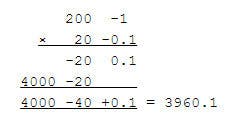
We've taken care to arrange each partial product in their most suitable placement positions. I much prefer that approach to the FOIL but if that application of the standard multiplication method is strange, feel free to consult us about it. However, it's familiarity is the reason why we prefer teaching and using the standard multiplication method over alternative methods... and I'll emphasize that there is absolutely no need to complicate algebra with the FOIL method given that the standard multiplication method works perfectly well for all arbitrary n-termed polynomials.
More importantly, that method took 20 seconds to perform with compatible numbers, half the time compared to using the standard number forms 199 × 19.9. Recognizing that numbers can be represented in simpler alternative forms to produce simpler partial products is so important that it’s now a common-core requirement taught as a method in grades 4. It's taught as a method but not necessarily integrated into the entire curriculum.
Mathnasium has always taught this concept of partial products starting from grade 2 as our part of our number sense approach to “understanding half”. It is also continued for several grade levels as an integrated approach to solving multiplication, percentage, and fraction problems. After all, math is more fun when trying to strategize solving problems than doing them!
Contact:
Ruby Yao and Benedict Zoe, Mathnasium of Fort Lee
201-969-6284 (WOW-MATH), fortlee@mathnasium.com
246 Main St. #A
Fort Lee, NJ 07024
Happily serving communities of Cliffside Park, Edgewater, Fort Lee, Leonia, and Palisades Park.