Neighbor News
Holy Batwings! A Geometry Tale
A long search for a satisfactory geometry answer leads to an epiphany about learning.



Holy batwings. I was brought this problem by a private student studying for the Bergen Academies mathematics admissions test. It looked simple enough. A rectangle of dimension 3 by 4 bounds two bat-winged shaped figures where the lengths AB, BC, and CD are equal, and lines BF, BE, CF, and CE form the edges of the wings. What is the area of the shaded bat-winged area? The answer evolves after this diagram.
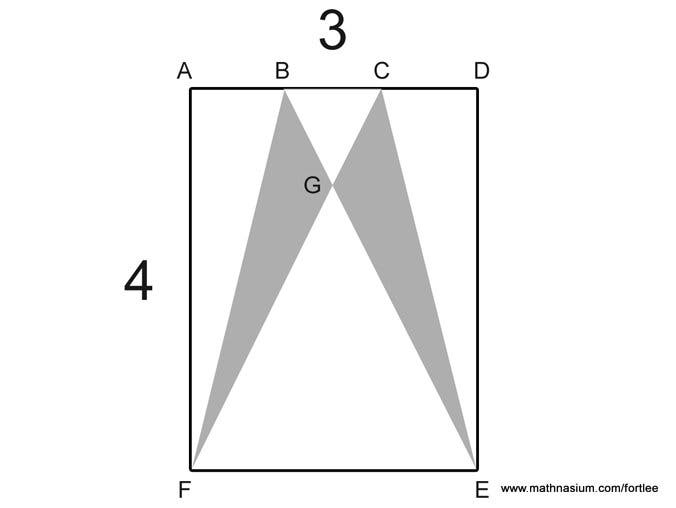
My immediate advice upon seeing the problem, considering that it was partitioned into triangles, was to ask the student to look for hidden triangles. However, I was stumped trying to use my own advice. Finding the area BCG was obviously the key to solving this problem. However, given the short amount of time required for a solution, my next reaction was to draw it to scale. It appeared that point G was 1 unit from the top and 3 units from the base. I grabbed a ruler and my estimate was correct. With that, it was easy to calculate the area of the bat-wings by subtracting from the rectangle, the areas of triangles ABF (congruent to DCF), BCG, and FGE. Do it yourself. However, this unsatisfactory answer gnawed away at me.
Later, I was teaching a geometry student (coincidentally in the BA) and when we reached a worksheet on finding areas with various cut-outs, I brought this problem up. Drawing it from memory, I commented that I could use trigonometry to solve this problem but it was inappropriate for the Bergen Academies. I could calculate angle ACF as inverse-tangent of AF/AC and ... but then ... paused when my student gave me a puzzled look. Ah, she did not know trigonometry. So, I started explaining that for a right triangle, there are 6 possible ratios of any 2 sides that are always the same for similar [proportioned] right triangles with identical angles. I busily diagrammed two right triangles to explain similarity and proportionality, when... bingo, the solution to this problem appeared. Indeed, I had found my hidden triangle!
Find out what's happening in Fort Leefor free with the latest updates from Patch.
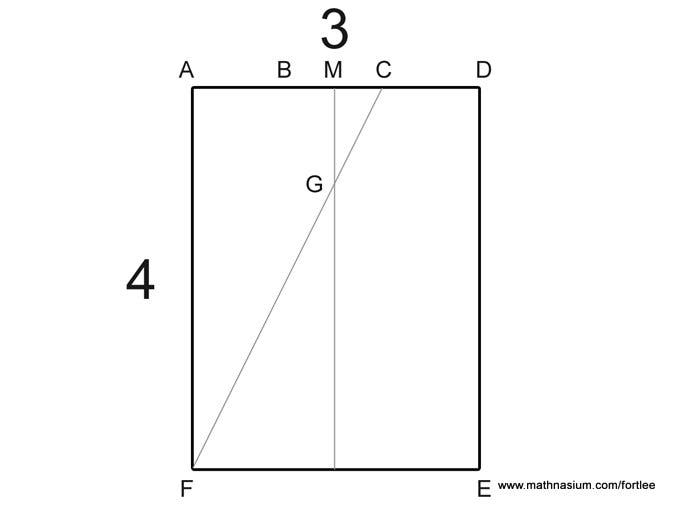
This is the same diagram simplified. It has an added vertical rectangle bisector MG. We can now see the "hidden" triangle MCG, and it is proportional to triangle ACF. This means that MG/MC = AF/AC; which are the tangent ratios to angle ACF. Expressed as purely proportions, there is no need for trigonometry. Solving for MG we get, MG = (MC) (AF / AC) = (1 / 2) (4 / 2) = 1 unit, confirming the earlier estimate.
Another approach to solving for the area is to find twice the area of BFG. BFG = ACF - ABF - BCG = (4 x 2 / 2) - (4 x 1 / 2) - (1 x 1 / 2) = 1½; and doubled = 3 units square.
Find out what's happening in Fort Leefor free with the latest updates from Patch.
Holy Epiphany! That reminded me of the Feynman Technique of learning. Enjoy!
Contact:
Ruby Yao and Benedict Zoe, Mathnasium of Fort Lee
201-969-6284 (WOW-MATH), fortlee@mathnasium.com
246 Main St. #A
Fort Lee, NJ 07024
Happily serving communities of Cliffside Park, Edgewater, Fort Lee, Leonia, and Palisades Park