Neighbor News
Mathnasium discusses Ants!
Ants are smarter than you think, read to find out why and discover something 7,000 years old!



For this installment of Mathnasium's word problem, we're challenging you to use your high school geometry knowledge to solve a creepy crawly word problem! Give it a try and check below after the video for the answer.
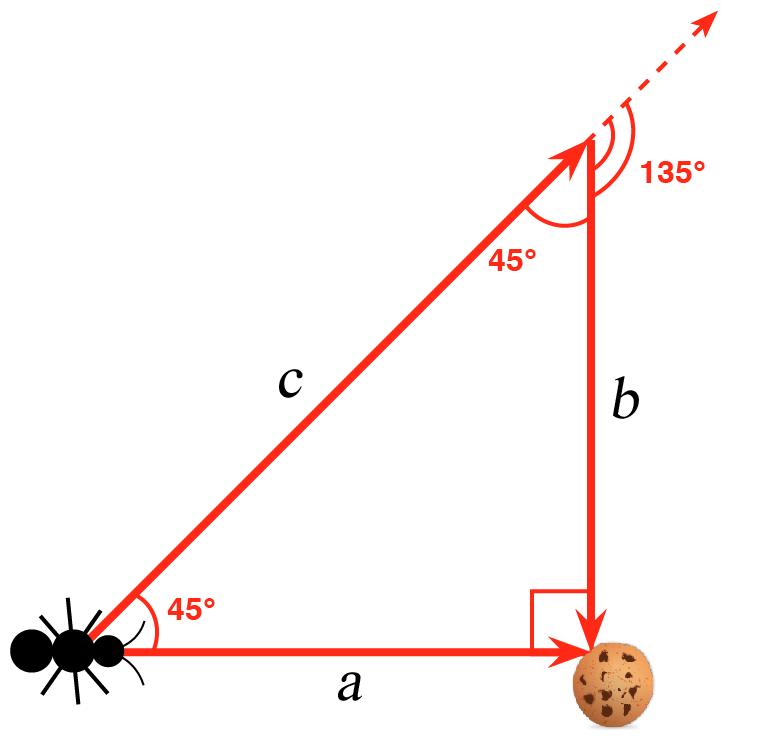
Believe it or not, ants use math to get food efficiently. Instead of following the shortest path to food, ants take the path that will take the least time. Please refer to the diagram above. The shortest route from the ant to the cookie is two inches. Because of the terrain, the ant can get to the cookie faster if it turns 45° to the left and then 135° to the right. Exactly how much greater is the distance of the path that takes less time?
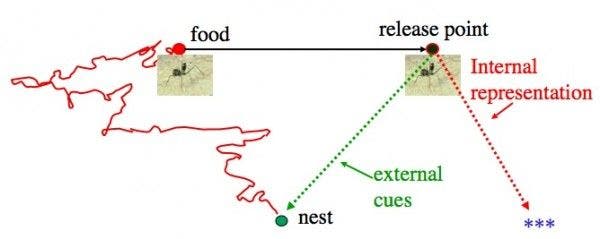
I hope you enjoyed the video that conjectures that desert ants can count. The accompanying article explains it more thoroughly than the video; although the title that "Desert ants are better at Trigonometry than most high school students" was only designed to attract the curious. All living organisms are successful within their ecosystems without needing any math. However, it's humans that have seized and exploited the power of math to understand and improve our situations.
This question asks "Exactly how much greater is the distance of the path that takes less time?" It's a trick question! We can't give an exact numeric answer! The answer is irrational :-) ... and I don't mean irrational as in "illogical" or "crazy." The numeric answer is an irrational number that cannot be expressed exactly as a rational fraction, or as an exact terminating decimal number.
Find out what's happening in Fort Leefor free with the latest updates from Patch.
The solution to this problem was discovered by the Greek philosopher Hippasus, in the 5th Century BC, and apparently it enraged his fellow philosophers so much that they drowned him for his efforts! Crazy huh! But that is not the reason why "irrational" is associated with "crazy", although it certainly seems fitting... to be killed for something we'd consider trivial today. This being a math blog, we're not going to get side track by the etymology of "irrational = crazy".
So, the geometry of the question deals with a right isosceles triangle since the triangle has two identical angles of 45°. We're told that the leg "a" being obstacle laden, forces the ant to traverse side "c" then leg "b" to reach the remarkably tiny cookie. Legs "b" and "a" are the same length, and since we're asked how much further the ant had to travel, we're actually tasked with identifying the length of side "c". Hippasus demonstrated that the length of side "c" cannot not be represented as a ratio of two integers, and hence could not be represented "exactly". That's what enraged his fellow philosophers to whom math was religion. He had just found a "flaw" in their "religious" thoughts.
Find out what's happening in Fort Leefor free with the latest updates from Patch.
Hippasus was from the school of Pythagoras and knew that c^2 = a^2 + b^2 (where ^2 means squared). So, plug in a = b = 2, we get c^2 = 2^2 + 2^2 = 4 + 4 = 8, or c = √8 = 2√2 inches exactly if you accept the presence of the radical (square-root) symbol. The decimal numerical value is the non-terminal 2.8284271247461900976033774484194... and on and on without any repeating pattern. Try to find that measure on any ruler! Irrational huh? But only if we let it bother us. The ant blissfully, only wants the cookie.
Contact:
Ruby Yao and Benedict Zoe, Mathnasium of Fort Lee
201-969-6284 (WOW-MATH), fortlee@mathnasium.com
246 Main St. #A
Fort Lee, NJ 07024
Happily serving communities of Cliffside Park, Edgewater, Fort Lee, Leonia, and Palisades Park.
Photo credits: https://blogs.scientificamerican.com/thoughtful-animal/desert-ants-are-better-at-trigonometry-than-most-high-school-students/