Neighbor News
Mathnasium looks Space-wards!
We have a rocket word problem to solve, and a call to our young to look at engineering solutions for tomorrow!

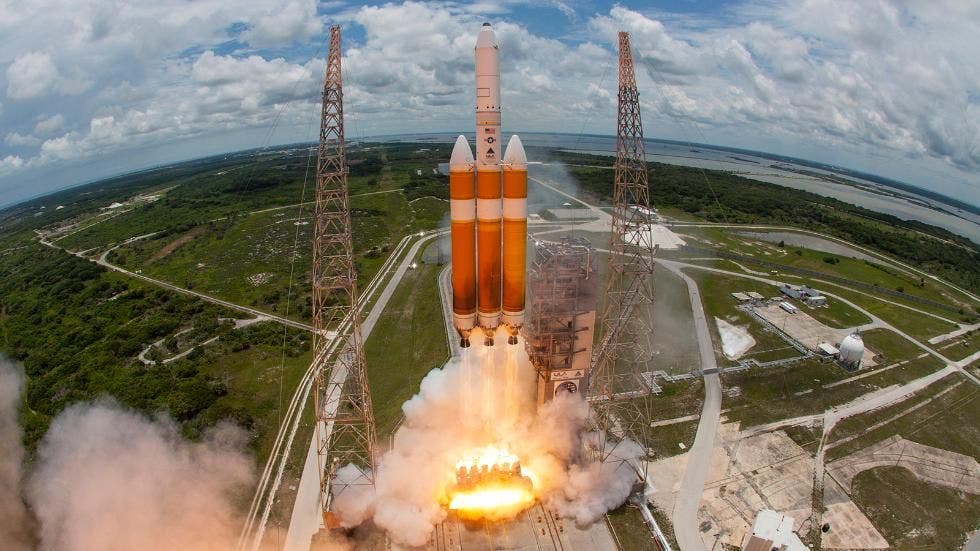


In this Mathnasium Word Problem, we're looking up toward the stars... and beyond! Solve our rocket word problem and check below after the commercial for the answer!
A rocket has 1 large fuel tank and 3 small fuel tanks. The tanks are filled with 600 tons of fuel in total. The large fuel tank is completely filled with 400 tons of fuel, and the rest of the fuel fills 2½ small tanks. How much does each small tank hold when full?
This video was taken on June 11, 2016 a scant 6 months ago. It's the launch of a Delta IV Heavy, the world's largest rocket today. Less soaring is it's mission of launching a reconnassiance satellite to observe us. Reaching space is still a very expensive endeavor and it's the commercialization of the immediate space around the earth that helps to fund some of the far reaching scientific space missions.
Find out what's happening in Fort Leefor free with the latest updates from Patch.
While most commercial companies are only concerned with planet earth, Elon Musk, the charismatic CEO of SpaceX has ambitions to reach Mars. He echoes the views of leading scientists that humans must escape earth to survive as a species, not just to escape the inevitable end of our solar system -- immensely far in the future -- but the more immediate depletion of our resources on tiny earth.
I grew up watching the Jetsons. Hence this advertisement from Arconia caught my attention when it first aired. It's a commercial that calls for engineers. Let's hope that the bright minds we teach at Mathnasium go on to become engineers that solve the problems we face today and conquer the problems of expanding into space.
Find out what's happening in Fort Leefor free with the latest updates from Patch.
Now back to the problem on hand. It starts with a whole-and-parts question. The whole is 600 tons of fuel and a part of 400 tons is stored in the large tank, leaving 200 tons of fuel distributed between 2½tanks. That 2½ is puzzling because we're given that there are 3 smaller tanks. When we're puzzled, I tell our students to explain clearly their rational, and a caring teacher should award points for a valid rational.
So, ignoring 2½ as a possibly useless piece of information, if 200 tons of fuel is evenly distributed between those 3 smaller tanks, then each tank holds exactly 200/3 = 66⅔ tons of fuel.
Alternatively, this could mean that 2 tanks are completely full and the 3rd tank is half full. The solution then is to consider how many half tanks can be filled. 2½ tanks is 2 whole tanks and 1 half tank; and since 1 whole tank holds 2 halves, this means a total of 5 halve tanks. In fact, converting the mixed number 2½ into the improper fraction 5/2 means exactly that, 5 halves. Hence 200/5 = 40 tons per half tank. Hence, the 2 full tanks hold 80 tons each, and the 3rd half full tank holds 40 tons. Look at the question again, and it asks "How much does each small tank hold when full?" The answer is each small tank holds 80 tons of fuel when full.
Finally, now that we understand the model of how fuel is distributed, this answer is simply derived without any fuss by evenly distributing 200 tons of fuel between 2½ tanks! That means (200)/(2½) = (200) / (5/2) = (200 x 2) / 5 = 80 tons. Or, for students comfortable with decimals, (200)/(2½) = (200)/(2.5) = 2000/25 = 80 tons.
Contact:
Ruby Yao and Benedict Zoe, Mathnasium of Fort Lee
201-969-6284 (WOW-MATH), fortlee@mathnasium.com
246 Main St. #A
Fort Lee, NJ 07024
Happily serving communities of Cliffside Park, Edgewater, Fort Lee, Leonia, and Palisades Park.
Photo credits: https://weather.com/science/space/news/largest-rocket-delta-iv-heavy-ula-launch