Neighbor News
Mathnasium Wishes Everyone a Happy New Year 2017!
We wish everyone an extra second of joy this year and a Happy New Year 2017!

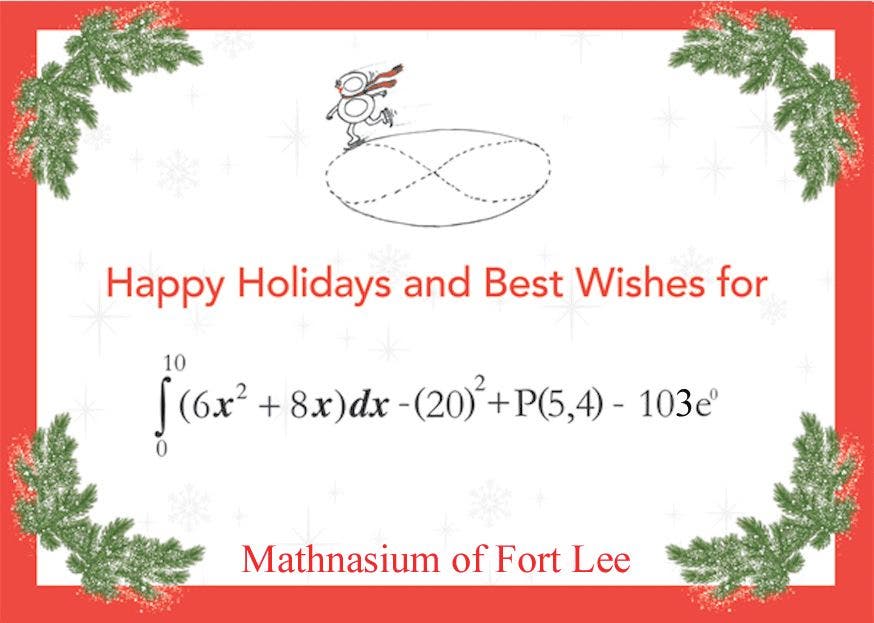


Happy New Year 2017! We hope our dear reader had a wonderful year and have grand plans for the New Year. If so, you have an extra second to make this year greater still, or if not, you have an extra second to procrastinate :-). So, if you had an extra second, how will you use it?
This year is coming to an end 1 second late. The world's timekeepers have added a whole extra second to this year on December 31. It will end at December 31, 2016 23:59:60 seconds immediately before the New Year on January 1, 2017 at 00:00:00.
This extra second accounts for the the wobble of the earth and the effects of the oceans' water dragging on the Earth. It's not noticeable to us in comparison to an entire year, but if affects the scientific community. Without leap seconds, time will drift from observed solar time -- how we observe days using the day and night -- by a minute every 60-90 years.
Find out what's happening in Fort Leefor free with the latest updates from Patch.
Apart from the scientific community, accurate timekeeping is also necessary for legal and business activities. Date and time stamps on a document determine its legal existence, whether it's early or late; in financial systems, the date and time on a trade determine whether it was executed on time; and perhaps if you're on a super-tight deadline to complete a homework, was it submitted just before midnight? Sometimes having an extra second can be a life saver :-)
Whatever the reason, time drifts can add up quickly and must be timely fixed to avoid confusion. There have been 26 leap seconds applied since this system of time correction was defined in 1972. The last leap second that was added was on June 30, 2016. For those not convinced, 1 second is indeed quite a long time as John Oliver explain then...
Find out what's happening in Fort Leefor free with the latest updates from Patch.
Since we've agreed to align our day to the Earth's rotation, how is such a small change in the Earth's rotation measured? Historically, it was done by observing a star. Stars are so immensely far away that for measurement purposes, they can be considered stationary. Using a telescope, astronomers can observe a star passing a telescope sight, then using a very accurate clock, measure how long it takes the Earth to rotate for the star to come into view again. This is accurate for normal everyday purposes but for scientific purposes, it's not precise enough because the atmosphere interferes with the light from the stars. If you look out at night and see stars -- actually it's pretty difficult in the New York area with atmospheric and light pollution, but if you could -- you'd see them twinkling. That's the atmospheric effect and its clearly visible to you; and terrible for accurate measurements.
However radio waves are immune to atmospheric effects and there are very distant star-like objects called quasars that emit high energy radio signals. With a radio telescopes spaced thousands of miles apart, scientists can precisely measure the time difference between the radio signal arriving from a quasar to each radio telescope. This provides great resolution and measurement of position, and allows them to calculate the Earth's rotation with an accuracy in thousandth (1/1000 = 0.001) of a second. That accuracy is surprisingly low when we consider that Olympic athletes are measured a 1000 times more precisely to the millionth (1/1000000 = 0.000001) of a second! Nonetheless, radio telescope measurement is a tour de force! The NASA video below will tell you more. See if you can spot the Pythagorean theorem …
So, Happy New Year 2017, and we wish you and extra second of joy this year!
Contact:
Ruby Yao and Benedict Zoe, Mathnasium of Fort Lee
201-969-6284 (WOW-MATH), fortlee@mathnasium.com
246 Main St. #A
Fort Lee, NJ 07024
Happily serving communities of Cliffside Park, Edgewater, Fort Lee, Leonia, and Palisades Park