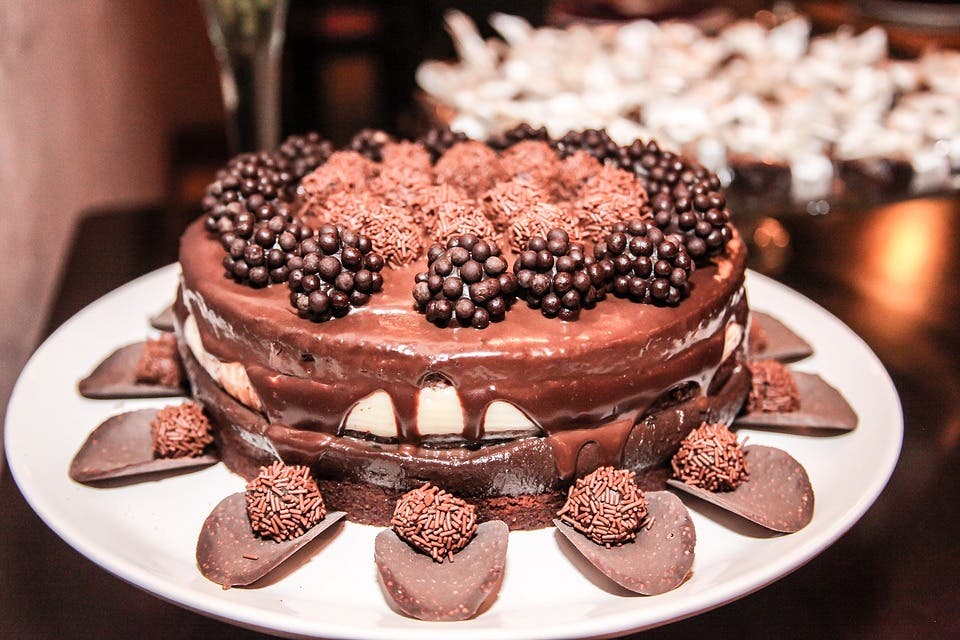


Here at Mathnasium, we think math is pretty yummy ... hence this week's delightfully delectable installment of Word Problem Wednesday! Sink your teeth into our cake word problem. Nom, nom, nom, indeed!
If you bake 2 layers of cake in circular cake tins that are 10 inches across and 2 inches deep, what volume of cake will you have?
(Hint: the volume of a cylinder is π × r^2 × h; r is the radius and h is the height.)
Find out what's happening in Fort Leefor free with the latest updates from Patch.
The problems of the week come courtesy of our curriculum writers. For fun, rather than stating the answer, we like to use these problems as inspiration to provide local flavor in an extended essay. We’re delighted with this question because it’s a geometry problem just in time to complement the Geometry that we’re teaching a bright new student, Kent. As we explained to Kent, Geometry is composed of two words, “geo” meaning “earth”, and “metry” as in “metric” meaning measurement; literally, measuring the earth. Measuring the earth was highly practical and absolutely necessary to govern property rights. I’ll posit that with property rights measurably assured, civilization flourished and better buildings using more geometry could be developed. Doesn't it seem that math enabled civilization?
In our previous cake problem, Colette had to cut a cake into the least number of cubes. This problem asks about the volume itself. What is volume? Volume is a measure of space. But what is “measure”, and what does it mean to measure space? Let’s start at the beginning with a point. A pure-point, unlike the period at the end of this sentence, is a dimensionless position. A line joins two points, and we take it at face value that a straight line between two points is the shortest distance between the points. Originally, the Greeks measured comparatively, by comparing the distance between another distance. We called that comparison a ratio. A longer distance compared to a shorter distance will have a larger ratio. Comparing distances is cumbersome and standard length measurements were developed. Various civilizations developed their own length measurements; but using a body part such as feet is unsurprisingly common (we’ll discuss this in a future article). Now rather than comparing two distances, we can count-off the number of feet-lengths, then compare their “feets” instead. Feet is the proxy -- the stand-in -- for the distance. This is similar to the replacement of bartering with money. Bartering is difficult because it relies on comparing value of dissimilar things being exchanged, whereas money assigns each thing a directly measurable value that is easily compared and exchanged for dissimilar things. Money, as a practical use of math, is another example of math enabling civilization.
Find out what's happening in Fort Leefor free with the latest updates from Patch.
Length measures a single dimension -- a linear distance. But not everything is linear. If I fence in a piece of land, I have occupied an area, a two dimensional space that has length and width. We’re pretty good at comparing small areas, for example, when someone has else has more seating area on an airplane. Humph! But how about larger areas, or differently shaped areas -- a rectangle compared to a circle? Again, instead of comparing two areas directly, it’s efficient to assign a measure. The simplest practical measure is the number of identical square-tiles that can cover an area. The number of tiles becomes the proxy for an area, and two areas of entirely different shapes can be efficiently compared by their number of [square] tiles. A tile that is 1 feet on all four sides is a 1 square-foot tile. A rectangle that is 4 feet by 8 feet = 4 × 8 = 32 square feet. Notice how we employed multiplication to efficiently count all those tiles? That rectangular area is the same as another rectangle ½ feet by 64 feet = ½ × 64 = 32 square feet. Note that while the measure of the areas are the same, their utility may differ, for example I’d rather picnic on a 4×8 rug rather than ½×64!
Now that we can compare area, we can extend the concept to compare physical space. We can extend squares into cubes. A space that is 4 feet by 8 feet by 10 feet high can be filled with 4 x 8 x 10 = 320 foot-cubes. Another space ½ feet by 64 feet by 10 feet high is also 320 foot-cubes. Identical volume but definitely not the same utility for living in! By the way, most folks don’t think about it, but when comparing living space, we’re really considering volume rather than purely area -- think about the headroom we’d like to have.
Notice that to measure volume, we started with area and multiplied it by the height. In abstraction, since measure of area abstracts away its shape, the volume of any shape is the area it occupies multiplied by the height. Hence, the volume of the cake is the circular area it occupies by it’s height.
Volume of cylinder = circular area × height = π × r^2 × h where h is the height of the cylinder, and the radius (r) is half the diameter of a circle; and Pi for extra deliciousness :-). The ^2 denotes squaring.
The cake is made of two layers each 2 inches high, a total of 4 inches. The diameter of the cake tins are 10 inches.
The volume of cake = π × (10 / 2)^2 × 4 = 100π inch-cubed= 314 cubic inches.
Cake is a complex result of multiple farming products: wheat, milk, butter, sugar, and eggs; and lots of necessary peaceful time to grow, raise, harvest, and process those products. As commerce expanded, more exotic produce -- like chocolate -- makes it extra yummy. It would not be possible to have the tasty cake we enjoy without the supporting civilization. I think Kent agrees that math had a helping part in creating civilization and all the delicious things we take for granted today.
Contact:
Ruby Yao and Benedict Zoe
www.mathnasium.com/fortlee
201-969-6284 (WOW-MATH)
fortlee@mathnasium.com
246 Main St. #A
Fort Lee, NJ 07024
Happily serving communities of Cliffside Park, Edgewater, Fort Lee, Leonia, and Palisades Park.