Neighbor News
Mathnasium Pecan Brittle
The temperature is dropping and it's time for hot sweet treats.

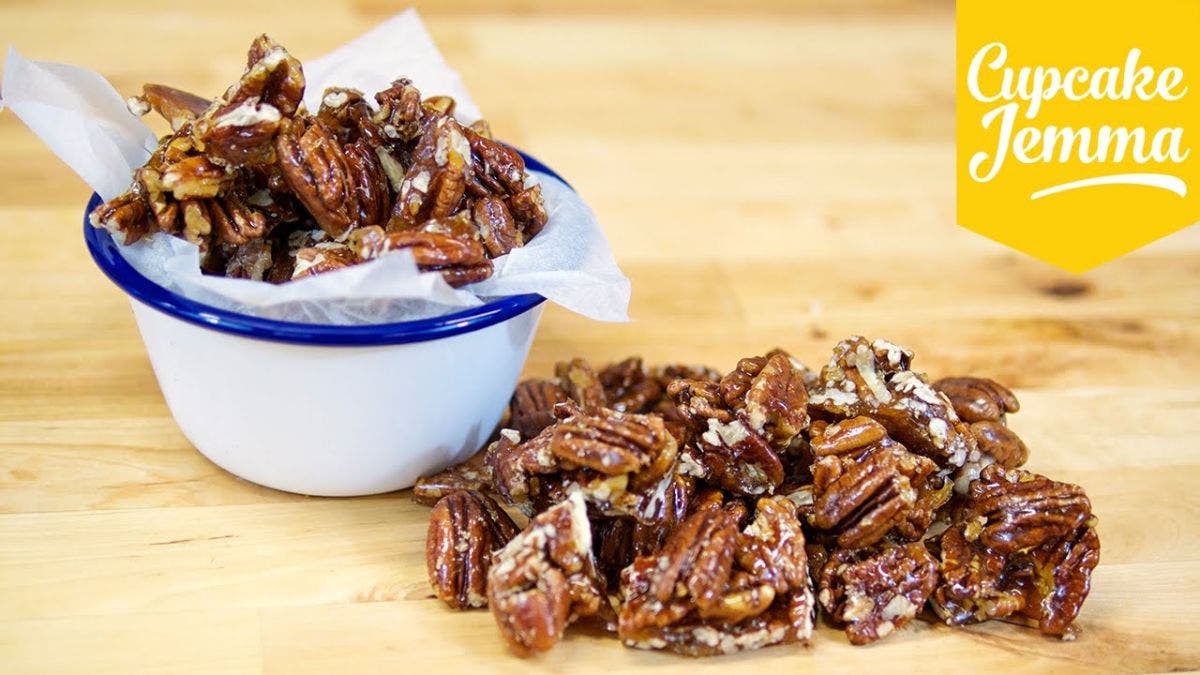


Holiday spirit is in the air, and one of our favorite festive traditions is making homemade sweet treats to share with our friends! Of course, with much kitchen wizardry comes much math, which is our inspiration for this week's Word Problem of the week. Solve our word problem below and check your answer after the video.
You can find the approximate temperature in Celsius by subtracting 32 from the temperature in Fahrenheit, then dividing that number by 2. A recipe for pecan brittle needs to be heated to 300°F, but your candy thermometer only measures in Celsius. Find the temperature in Celsius to which you should heat the candy... or...
... fortunately you can ignore the math and feel your way through this easy instructions. You'll mess up a few times, but it's all good learning fun -- and hopefully still tasty! Then when you're ready, math and measurements are great when you need to create massive amounts perfectly each time.
Find out what's happening in Fort Leefor free with the latest updates from Patch.
We have two temperature measurement systems in daily use, the Fahrenheit scale and the international Celcius scale -- commonly known as Centigrade. Both measurement systems are named after their inventors, Daniel Fahrenheit and Anders Celcius. Did you know that when Celcius established his scale, he chosed 0°C for boiling point and 100°C for freezing? Wow! That would have made conversions between these two scales really challenging, and a headache to even think about temperature in centigrade. Fortunately, that strangeness was inverted after Celcius died....
... allowing that quick rule of thumb to convert between the two scales and answer this question, which is C = (F - 32) / 2 = (300 - 32) / 2 = 268 / 2 = 134°C. Subtraction and halving (not dividing) are basic building blocks that we teach from grades 1.
Find out what's happening in Fort Leefor free with the latest updates from Patch.
Today, we tend to think about two temperature reference points, when water freezes and when it boils, and the number of markings (the span) between them. The centigrade scale, we agree, has a sensible 100 markings from 0°C to 100°C, hence it's name "centi" for 100, and "grade" for degrees. In comparison, most of us think it strange and arbitrary that the Fahrenheit has a span of 180 markings from 32°F to 212°F.
The choices for the Fahrenheit scale are not arbitrary. Within the constraints of the still crude experimental apparatus of the 1700s, Daniel Fahrenheit chose to measure two stable reference points available to him, the absolute lowest temperature point achievable in his lab, a mixture of ice, salt, and water (used to freeze cream into tasty ice cream) and the temperature of the [healthy] human body. That lowest temperature was of course 0°F and he chose 96°F for the human body (later we more accurately revised that as 98.6°F). Why 96 and not 100? Well, similarly to other strange measure numbers such as 12 inches per foot, 5280 feet per mile, 60 minutes per hour, 360 degrees per cycle; it was sensible to choose numbers that had many convenient factors (divisors) because dividing was difficult (and it still is!). Anyway, it was later when the standards committees chose the stable reference points of freezing and boiling point of pure water that the Fahrenheit scale seems arbitrary... or is it?...
... I like to point out the wonderful coincidence that the Fahrenheit span between freezing and boiling point of water of 180° is exactly the same value as the straight angle of 180°!! Wow!
And with that, let's consider the conversion process we were given above. We now know that the span of 100°C = 180°F, that means a 1°C span = (180 / 100)°F = 9/5 °F span or roughly 2°F. That's the 2 in the rule of thumb conversion above! But since the freezing point of water is 0°C = 32°F, the sugar caramelization point of 300°F is 32°F too high to match against 0°C so we subtract 32 to match, then we can divde by 2. The exact conversion recipe is:
C = (F - 32) (5/9) -- which is approximated as subtract 32 and halve
and it's converse is
F = C(9/5) + 32 -- which is approximated as double and add 32.
Feel free to approximate 32 to 30 too, after all being off by a couple of degrees usually does not matter.
All that is great to know, but whether you prefer Fahrenheit or Celcius, the temperature in our math center always seems arbitrary!
Finally, what is temperature? What is the absolute lowest possible temperature and why?
Contact:
Ruby Yao and Benedict Zoe, Mathnasium of Fort Lee
201-969-6284 (WOW-MATH), fortlee@mathnasium.com
246 Main St. #A
Fort Lee, NJ 07024
Happily serving communities of Cliffside Park, Edgewater, Fort Lee, Leonia, and Palisades Park.