Neighbor News
Mathnasium's Marble Madness
A nostalgic post celebrating a classic toy with a binary twist.




We're feeling a bit nostalgic on this about this Mathnasium Word Problem and celebrating one of our favorite classic toys! Try answering our word problem about marbles—then don't lose your marbles following our solution after the video!
Anna has 6 less than three times the number of marbles that Bela has. Bela has 2 more than half as many marbles as Connie. If Connie has 12 marbles, then how many marbles does Anna have?
Now let's solve this problem. We'll just use the marble collectors' initials to denote the amount of marbles they have.
Find out what's happening in Fort Leefor free with the latest updates from Patch.
Anna has 6 less than three times the number of marbles that Bela has.
A = -6 + 3B or in standard form A = 3B - 6
Bela has 2 more than half as many marbles as Connie.
B = 2 + ½C or in standard form B = C/2 + 2
Find out what's happening in Fort Leefor free with the latest updates from Patch.
If Connie has 12 marbles, then how many marbles does Anna have?
C = 12
The solution is to back substitute C into B into A. Why don't you do it?
We'll do the same, but in binary just for the fun of it!! We'll need the 4 basic arithmetic operations to solve this problem. Binary uses only 2 digits to represent numbers, the famous 0 and 1. 0 behaves exactly like a decimal 0. 1 behaves like a 1 and somewhat like a decimal 9. Let's explore the operations:
0 + 0 = 0
0 + 1 = 1
1 + 0 = 1
1 + 1 = 10 Aha, behaves like decimal 1 + 9.
0 - 0 = 0
1 - 0 = 1
1 - 1 = 0
10 - 1 = 1 This follows from 1 + 1 = 10
0 × 0 = 0
0 × 1 = 0
1 × 0 = 0
1 × 1 = 1
Multidigit operations build on those basic rules. Lets look at multiplying binary 101 × 10 (decimal 5 × 2), i.e., doubling 5:
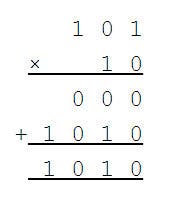
Well, doubling worked exactly like multiplying by a decimal 10, just append a 0 at the end! Indeed, computer engineers call this the left shift operator. So, dividing by binary 10 (decimal 2) is the right shift operator, and behaves exactly like dividing by decimal 10 (we're ignoring rounding the resulting fractional decimal for the sake of brevity).
Translating C into binary, see the video for an explanation :-)
C = 1100
Solving for B:
B = 1100 / 10 + 10
Divide 1100 / 10 = 110 (or right shifting).
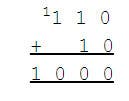
Add 110 + 10 = 1000 using standard method...
Solve for A:
A = 11 × 1000 - 110
Just like decimal, 11 × 1000 = 11000. Now subtract 11000 - 110. Let's pretend these are decimal numbers, and one way we'll teach this is
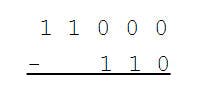
Rewrite with all the necessary regrouping:
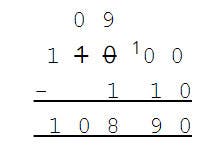
The binary equivalent is:
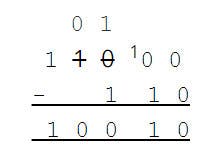
And using the video's explanation for binary encoding, we find that Anna has 16 + 2 = 18 marbles.
That was lots of fun for us. We hope you did not lose your marbles following that explanation!!
Contact:
Ruby Yao and Benedict Zoe, Mathnasium of Fort Lee
201-969-6284 (WOW-MATH), fortlee@mathnasium.com
246 Main St. #A
Fort Lee, NJ 07024
Happily serving communities of Cliffside Park, Edgewater, Fort Lee, Leonia, and Palisades Park