Sports
Word of Life Pastor Comes from Legendary Genes
Barry Ross' father was a two-time Olympian and is regarded as the Father of American Long Distance Running.


Barry Ross is the pastor of Word of Life Christian Fellowship church at 508 South Second Ave. in Galloway Township. His work has touched the lives of people in the Galloway area in positive ways since he founded the church in 1983.
An extraordinary man because of his care and concern for people, it may not be surprising to others that he is the son of a South Jersey native who was extraordinary for other reasons.
Ross competed in the pole vault for Woodbury High School. He grew up to become a pastor, and he also served for 14 years as the golf coach at The Richard Stockton College of New Jersey.
Find out what's happening in Gallowayfor free with the latest updates from Patch.
Participating in track and field came naturally to him.
He’s the son of the late H. Browning Ross, the Father of American Long Distance running and, some would say, a true son of South Jersey. American membership in the National Road Runners Club is estimated at more than 200,000 today.
Find out what's happening in Gallowayfor free with the latest updates from Patch.
He won eight National AAU Cross Country championships, 10 Berwick (Pennsylvania) Marathons, a gold medal at the Pan American Games, appeared in two Olympic Games, received the first annual Long Distance AAU Award in 1969, served as Chairman of the National AAU Long Distance and Road Running Committee from 1968 through 1971, coached at Woodrow Wilson High School, Gloucester Catholic High School and Rutgers University, founded the National Road Runners Club, and is honored in the National Distance Running, Villanova, Gloucester County and Woodbury High School halls of fame.
H. Browning “Brownie” Ross, who was born, raised and spent his life in Woodbury, NJ, made athletic history in America and did extraordinary things when he represented the USA in two Olympic Games. He was also an All-American at Villanova.
Running was not Browning Ross’s first love. However, when he was cut from the high school baseball team, he turned to track and field and began to make history in South Jersey and around the world. He was named the New Jersey State Mile Champion and the National Interscholastic Indoor Mile Champion in the spring of 1943.
He joined the Navy after high school and met a man named Jim Elliott during World War II in North Africa. Jim “Jumbo” Elliott, the track and field coach at Villanova University, offered him a full scholarship after seeing him win a two mile race at Madison Square Garden a few years later.
Browning Ross won the 1948 Steeplechase championship and was selected as a member of the 1948 Men’s All-American Track and Field Team. That victory led to his first Olympic appearance in 1948 where, as the only American in the event, he placed seventh.
He went on to win a gold medal in the 1,500-meter race in the first Pan American Games in 1951 in Buenos Aires running before a huge crowd that included Juan and Eva Peron. He made his second Olympic appearance at the 1952 games.
“My dad would take us to races all over the place,” Barry Ross said. “I was really young, 4 or 5 years old, when he carted us off to see him run. He loved to race. He started a publication called The Long Distance Log to promote road racing, and kept it going until Runner’s World began publishing. They dedicated their first issue to him. The American Athletic Union called him before their court with a charge of ‘professionalism’ because he was trying to do some fundraising to promote the sport, but when he showed them that he was running in the red in his efforts they dropped the charges. He even took me along that day, too.”
Mark Yellin has his own memories of Browning Ross.
“I went to Haddon Township High School, but when I was 14 or 15 Mr. Ross used to gather up a bunch of us who loved to run and take us to races all over the area,” Yellin said. “He would often mark out road courses and paid for the prizes out of his own pocket. He even took us to Swarthmore College to race.”
In 1972 as a junior at Haddon Township, Yellin was the New Jersey State Mile Champion. He repeated his effort as a senior winning the prize again in 1973, 30 years after Browning Ross won the title in 1943.
“The public doesn’t realize the incredible effort that goes into training for long distance running,” Yellin said. “I would run six miles twice a day, in the morning and afternoon, for a total of 12 miles a day, 84 miles a week and 4,000 miles a year. It is a brutal regimen that requires total commitment.”
An account executive in the food industry today, Yellin still competes whenever he can, and he makes an effort to attend racing events whenever possible.
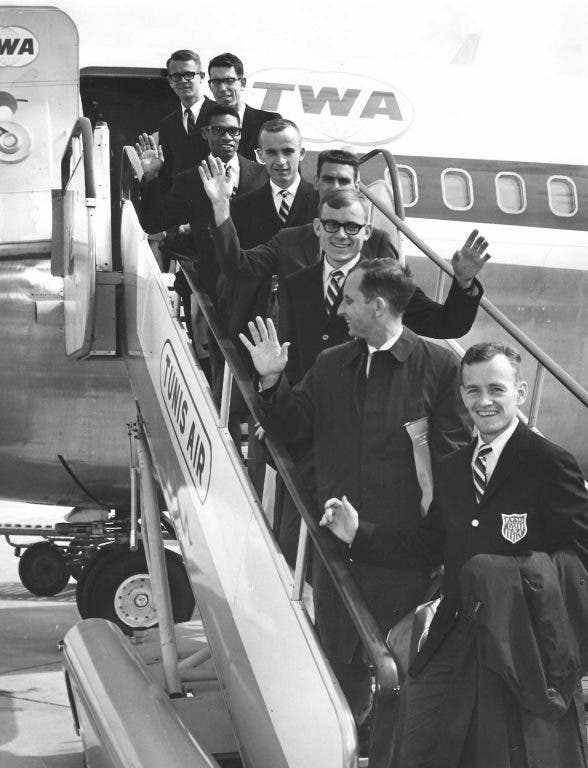
H. Browning Ross led a State Department sponsored goodwill trip with runners he chose in the early 1960s to Ethiopia where he discovered why Africans would come to dominate the sport of long distance running. He came out of his hotel and a young man ran up and challenged him: “Catch me if you can!”
He chased the man for mile after mile and never caught up to him. Cross-country running in Ethiopia is a bit different from the American version. There, runners have to leap fences, swim rivers and overcome obstacles not found on American courses.
He ran his last competitive race in 1986: a Saint Patrick’s Day 10-mile event. At the age of 62 Ross averaged 59:59 (under six minutes) for each of the 10 miles.
Born April 26, 1924, H. Browning “Brownie” Ross died as he chose to live: enjoying the sport that filled his life with, awards, trophies and recognition by thousands of runners across America and tens of thousands around the world.
He had finished his morning run of three miles and gotten into his car when he became ill. He could not be revived. The date was April 27, 1998, one day after he turned 74.