Arts & Entertainment
Finding the Words for the Children of Sept. 11
BJ Ward still receiving thanks for his poem "For the Children of the World Trade Center Victims."

As a poet from a working-class New Jersey background who teaches at a small community college tucked into the Northwest corner of his home state, BJ Ward is accustomed to being ignored.
Which makes the public’s awareness — and gratitude — for one of his poems, For the Children of the World Trade Center Victims, all the more remarkable to him.
Ten years after the Sept. 11 attacks, Ward still hears from the children and wives of Sept. 11 (but no husbands so far) emailing or calling to thank him for expressing what they are still trying to absorb.
Find out what's happening in Jeffersonfor free with the latest updates from Patch.
“They are the living victims. They still have an inability to grasp what happened. Their most personal tragedy is linked to our greatest national tragedy,” said Ward during a phone interview from his office at Warren County Community College, where he is a professor.
The 330-word poem, which he began writing on the evening of Sept. 11, but wrestled with for two months, is an expression of anger and horror at the attack and solidarity with those who died.
Find out what's happening in Jeffersonfor free with the latest updates from Patch.
Ward said he cut “20 times more” words from the poem, eliminating the “merely emotional” he had to write until he found the poem’s core, concluding with these three stanzas:
Note: The sound of a scream in 200 languages
is the same sound.
It is the sound of a scream.
Note: In New Jersey over the next four days,
over thirty people asked me
if I knew anyone in the catastrophe.
Yes, I said.
I knew every single one of them.
Repeatedly employing the word “Note” to show the poem is “having trouble existing,” Ward boldly lets his readers know its author struggled with the realization that no poem is truly up to the task at hand.
While For the Children is, as he writes, the most important poem he’s ever created, it also “says nothing important” because it “cannot save 3,000 lives.”
And yet by self-consciously admitting inadequacies throughout the poem, Ward’s verse succeeds.
"Words are the footprints the poem left behind," explained Ward, remnants of "what moved through me" during the making of the poem. Read it for yourself: Ward and his publisher, North Atlantic Books, have allowed Patch to reprint the poem in its entirety at the end of this story.
Except for grad school in New York state, Ward is a Jersey-made writer who originally thought he was destined to work as an apprentice pressman at the Star-Ledger newspaper in Newark.
Then, like so many writers, an influential high school teacher, Ed Ramon, opened him up to the world of words.
That continued for four years at the of New Jersey in Galloway Township under the tutelage of Pulitzer Prize-winning poet Stephen Dunn.
His professor, since retired, taught him to be a contrarian and Ward says that is the model he emulates.
Master's degree in hand from Syracuse University, Ward worked as a waiter by night in Clinton, NJ, and wrote by day, eventually teaching and publishing.
In a happenstance meeting with philanthropist and sculptor J. Seward Johnson following a reading of his poems, Johnson approached Ward after hearing the Sept. 11 poem.
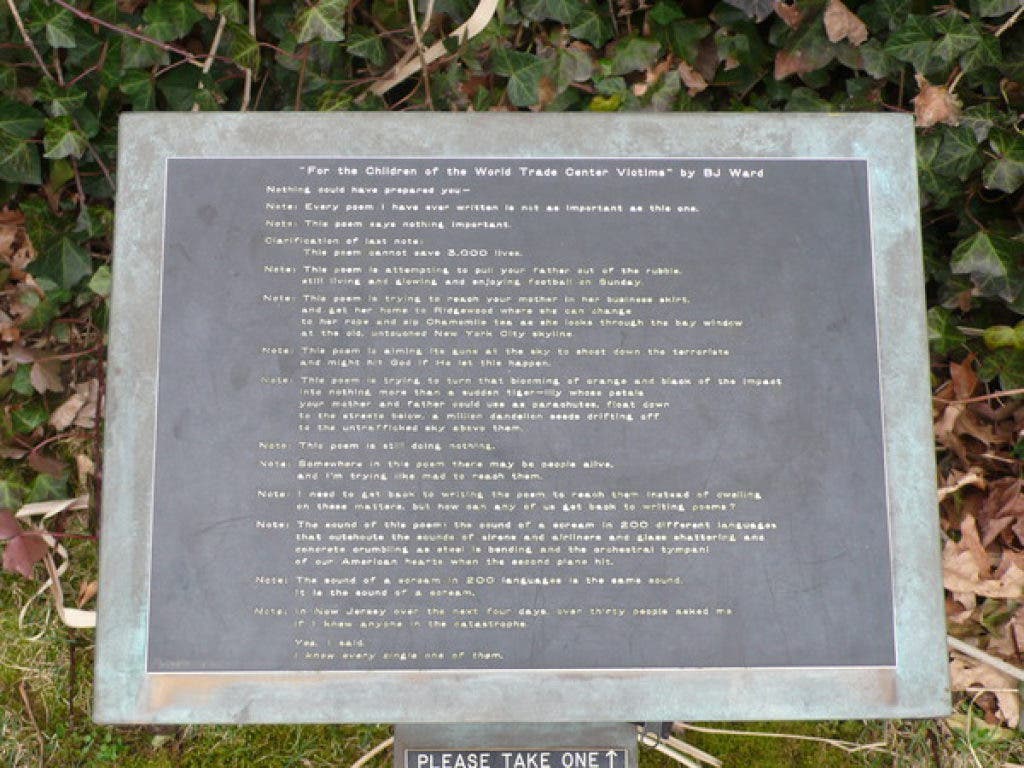
Now there is a cast bronze version of it just outside one of the main meeting rooms at the world-famous Grounds for Sculpture near Trenton.
For the Children of the World Trade Center Victims is, as Ward himself says, “my most public poem.”
Literally, as well as figuratively.
For the Children of the World Trade Center Victims
Nothing could have prepared you—
Note: Every poem I have ever written
is not as important as this one.
Note: This poem says nothing important.
Clarification of last note:
This poem cannot save 3,000 lives.
Note: This poem is attempting to pull your father
out of the rubble, still living and glowing
and enjoying football on Sunday.
Note: This poem is trying to reach your mother
in her business skirt, and get her home
to Ridgewood where she can change
to her robe and sip Chamomile tea
as she looks through the bay window at the old,
untouched New York City skyline.
Note: This poem is aiming its guns at the sky
to shoot down the terrorists and might
hit God if He let this happen.
Note: This poem is trying to turn
that blooming of orange and black
of the impact into nothing
more than a sudden tiger-lily
whose petals your mother and father
could use as parachutes, float down
to the streets below, a million
dandelion seeds drifting off
to the untrafficked sky above them.
Note: This poem is still doing nothing.
Note: Somewhere in this poem there may be people alive,
and I’m trying like mad to reach them.
Note: I need to get back to writing the poem to reach them
instead of dwelling on these matters, but how
can any of us get back to writing poems?
Note: The sound of this poem: the sound
of a scream in 200 different languages
that outshouts the sounds of sirens and
airliners and glass shattering and
concrete crumbling as steel is bending and
the orchestral tympani of our American hearts
when the second plane hit.
Note: The sound of a scream in 200 languages
is the same sound.
It is the sound of a scream.
Note: In New Jersey over the next four days,
over thirty people asked me
if I knew anyone in the catastrophe.
Yes, I said.
I knew every single one of them.
— BJ Ward
from Gravedigger’s Birthday (North Atlantic Books)
Get more local news delivered straight to your inbox. Sign up for free Patch newsletters and alerts.