Politics & Government
Former Gov. Brendan Byrne Is Dead
Gov. Brendan Byrne, who presided over the state during the tumultuous 1970s and helped establish the state's income tax, has died.


Brendan Byrne, the affable ex-prosecutor and World War II hero who served as New Jersey governor during the 1970s, has died. His most notable accomplishment: Muscling the state's first income tax through the state Legislature.
Byrne, 93, who died of an apparent lung infection, served as governor from 1974 until 1982. At one point, after getting the income tax passed, the Democrat had the lowest approval rating of any governor in history - a mark since surpassed by Gov. Chris Christie.
Faced with that burden as he ran for re-election, Byrne was polling at least 17 points behind Republican Raymond Bateman heading into the final weeks of the 1977 gubernatorial race. When Bateman failed to offer his own plan to replace the income tax's revenue, Byrne's fortunes reversed. He won re-election by a comfortable margin.
Find out what's happening in Livingstonfor free with the latest updates from Patch.
Byrne has since become a much-revered figure in New Jersey politics, often telling off-color jokes at public appearances that leave audience members in stitches. In a recent Monmouth University poll of New Jerseyans who were old enough to vote for him, Byrne held the second highest net-positive rating – behind former Gov. Tom Kean – of all New Jersey governors since 1974.
He once even had an arena named after him. The now-closed Brendan T. Byrne Arena at the Meadowlands, the former home of the New Jersey (now Brooklyn) Nets and the New Jersey Devils, opened with a Bruce Springsteen show in 1981. The name was eventually changed and replaced with those of corporate sponsors.
Find out what's happening in Livingstonfor free with the latest updates from Patch.
Byrne, who once served as Essex County prosecutor, also was known as the "man who couldn't be bought," a unique distinction in New Jersey politics. A book even quoted FBI tapes of mobsters who complained about the Democrat being too much of a "Boy Scout."
Christie paid tribute to Byrne on Twitter.
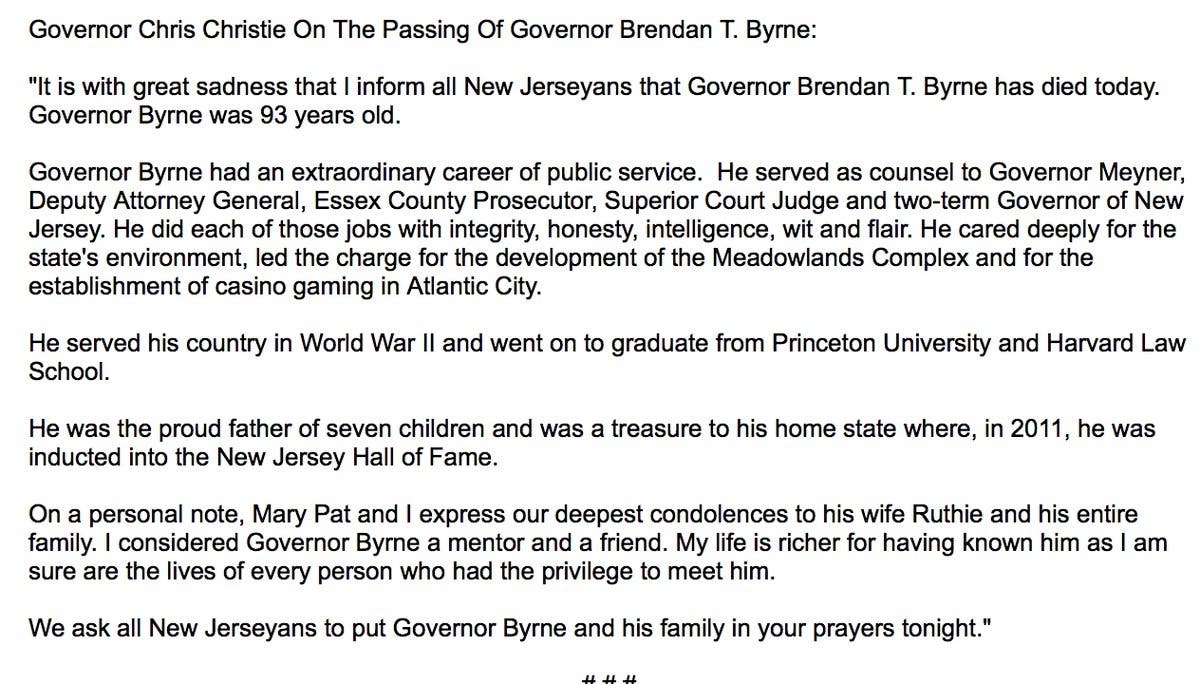
Byrne, who was born and raised in West Orange, served in the U.S. Army during World War II and received the distinguished Flying Cross. He graduated from Princeton University in 1949, and was appointed as Essex County Prosecutor in 1959.
Relatively unknown when he ran for governor in 1973, Byrne easily won by beating the hard-right Republican Charles Sandman, perhaps helped by the fact that the GOP was also dealing with fallout from the Watergate scandal. His first biggest challenge was finding a new revenue source for public education after a state Supreme Court decision declared that the state's system was unconstitutional.
His solution? The income tax, passed during his first term in 1976. That same year, he successfully pushed for a referendum that legalized gambling in Atlantic City.
The income tax was initially very unpopular, but future public officials and the public eventually determined that the move was necessary.
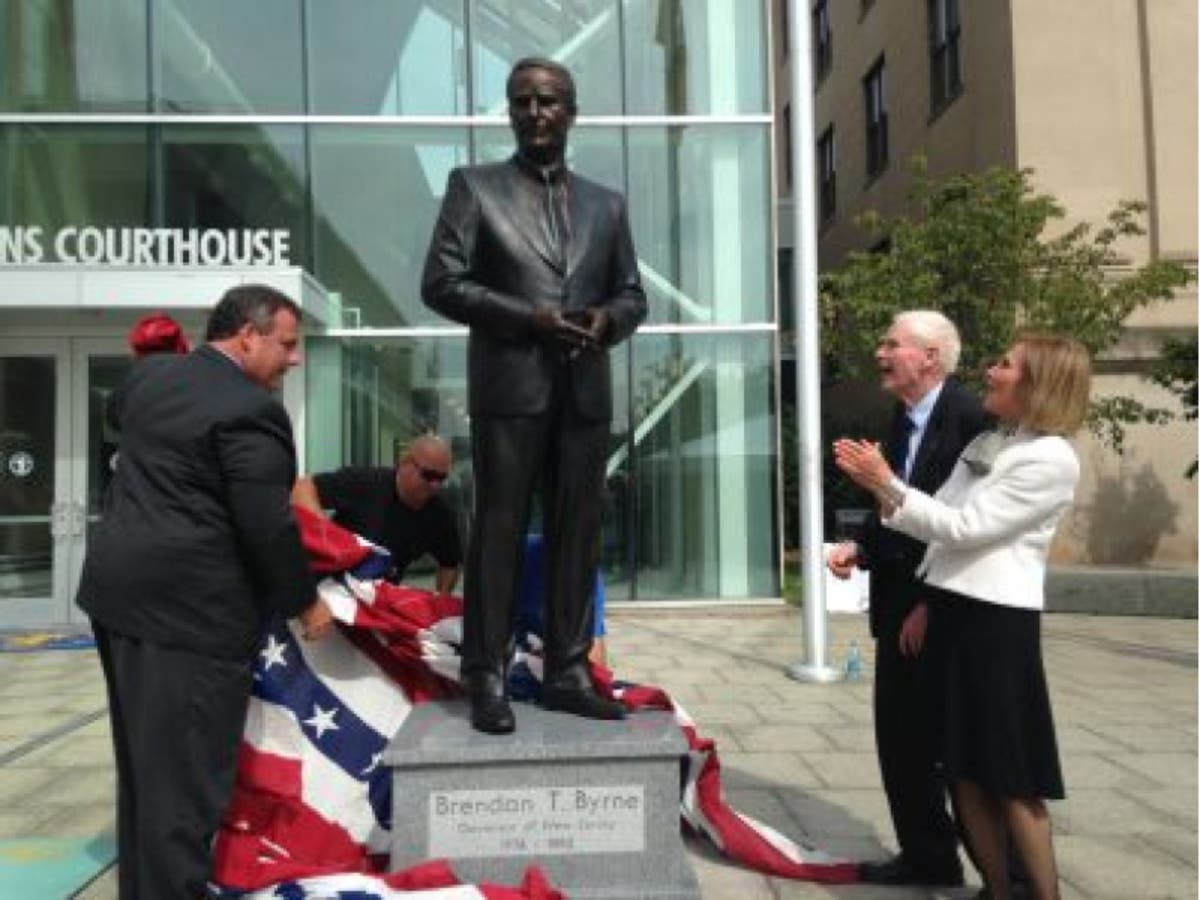
Five years ago, nearly every surviving elected governor came to Newark for the unveiling of a statue of Byrne. His peers also praised the West Orange native's wit and spirit of bipartisanship.
"People used to say to me, 'He's a Democrat, you're a Republican, how did you get to be such close friends?'" Kean, who was the head of the GOP in the Legislature when Byrne was governor in the 1970s and early '80s, said at the 2013 event.
"He set the kind of example some of our friends in Washington should be following today …. His is the politics of inclusion. He brought people together, conservative, liberal," added Kean, who was Byrne's immediate successor in 1982 and with whom he later wrote a popular column in The Star-Ledger featuring dueling left- and right-wing takes on the issues.
"Few men have had the privilege to respond to the dedication of a statue in their honor as I have at this moment," Byrne said at the event. "As Casey Stengel said, most men my age are dead already."
"I got a statue that represents what you did," he also said, referring to those who worked with him during his time as governor.
The statue and plaza, which was completed in 2008, were paid for with private donations in an effort spearheaded by Essex County Executive Joseph DiVincenzo, a fellow Democrat.
"When I called him for advice, he would tell me, 'When you're traveling the state and people are waving all five fingers at you, you know you're doing well," Christie said at the event, drawing knowing laughter from a crowd that included former members of Byrne's administration.
"First and foremost, you're there to serve the people, and while the office is serious, you can't take yourself too seriously," Christie added.
With reporting by Paul Milo
Patch photo of Christie (left), with Byrne (right), during a 2013 unveiling of a statue of the former governor in Newark.
Get more local news delivered straight to your inbox. Sign up for free Patch newsletters and alerts.