Health & Fitness
Unsafe For Swimming? Dangerous Things In NJ Waters This Summer
From flesh-eating bacteria to dangerous jellyfish, NJ has had some risks this summer. Two beaches are under advisory. Here's what's happened


It's not the storms that have created the most problems for New Jersey swimming areas this year. It's the things that have appeared in the water – sometimes after a storm – that could be presenting the biggest risk.
From flesh-eating bacteria to rip currents, dangerous jellyfish and bacteria, New Jersey has had its share of risks this summer. Indeed, two beaches are currently under advisory for a problem that's plagued a number of beaches this year: bacteria found in human or animal waste.
The two beaches are at the Monmouth Highlands Borough Highlands Recreation Center and the Manasquan River beaches in Point Pleasant Boro. Both beaches exceeded the limit for Enterococci, the state Department of Environmental Protection says. They will be tested again; if these beaches continue to exceed the allowable limits, they will be closed.
Find out what's happening in Livingstonfor free with the latest updates from Patch.
Some of the harmful effects of Enterococci are infections that cause fever, fatigue, nausea, vomiting and diarrhea. Larry Hajna, a DEP spokesman, says the problem is caused largely by the rain, which caused a lot of stormwater runoff that carries animal waste into the swimming areas.
In June, one-third of New Jersey's beaches were at risk of closing because of "unsafe" levels of bacteria found in animal and human waste, according to the DEP. Of the 47 beaches at risk of closing, 44 were at the ocean Read more here....
Find out what's happening in Livingstonfor free with the latest updates from Patch.
A number of swimmers have also found themselves in trouble this summer – just as Tropical Storm Chris has evolved into a hurricane, creating swells along the Jersey Shore that could cause life-threatening surf and rip current conditions.
Rip currents have been a steady problem at the Jersey Shore, and a number of people have suffered because of it. Read more: 17 NJ Water Deaths Since May As Tragic Trend Continues
Here is what also has happened:
13 Jersey Shore Beaches Closed After Needles, Syringes Washed Up
A large number of needles and syringes washed up on beaches from Long Branch to Loch Arbor in July, according to the state DEP and the Surfrider Foundation's Jersey Shore chapter. The group warned people not to pick them up. Read more here...
Man Got Flesh-Eating Bacteria In NJ Waters, Family Says
A man is fighting for his life after he recently was contaminated by flesh-eating bacteria in New Jersey waters, his family told Patch.
Angel Perez, 60, of Millville was recently crabbing in the waters off Matts Landing in the Maurice River when he began to have severe pain and swelling in his right leg, according to his daughter, Dilena Perez-Dilan.
Since contracting the infection on July 2, it has spread to his blood, and his forearms are black. He has blisters and scarring, according to Perez-Dilan. Read more here...
Dangerous Portuguese Man-Of-War Washing Up At Jersey Shore
The potentially harmful Portuguese man-of-war has been reappearing at the Jersey Shore in recent weeks.
One beachgoer, Christine Perna Burns, attracted the attention of researchers on Friday when she posted a picture of the potentially deadly animal on the Wildwood Crest beach (see photo).
Paul Bologna of Montclair State University acknowledged that man-of-war have appeared in Cape May and Wildwood over the last few weeks. He also confirmed that the animal photographed by Burns is indeed a man-of-war.
Usually, by the time they wash up on the beach they are roughed up in the surf, Bologna said.
People can die typically if they encounter them in the wild, where they can get tangled up and repeatedly stung by tentacles that can be up to 100 feet long, Bologna said on Montclair University's website.
By the time they wash up on beaches, they’ve been bounced around and their tentacles are often torn up, he said. But it's still possibly to get stung by one, and get hurt – even the tentacles of a dead man-of-war can still sting you. Read more here...
15 Toxic-Sting 'Clinging' Jellyfish Spots At Shore In One Week
Fifteen "clinging" jellyfish spots were discovered at the Jersey Shore in one week in June. More than 20 have been discovered at the Shore since May.
The Department of Environmental Protection wants users of northern Barnegat Bay to exercise caution following confirmation of the clinging jellyfish, a non-native species with a powerful sting, in Brick, Point Pleasant Boro and elsewhere.
Boaters who love to hang out at Tices Shoal and wade in the water are being warned to pay careful attention as more than 40 clinging jellyfish were found at the popular hangout after two people had to be treated for extremely painful stings last week, according to one of the researchers monitoring the creatures.
The clinging jellyfish, a native to the Pacific Ocean, is small and very difficult to spot in the water. A sting can produce severe pain and other localized symptoms and can result in hospitalization in some individuals. Read more here....
Fishermen Encounter Great White Shark Off Jersey Shore
A boat crew fishing for mako near the wreck of a steamer that sunk in 1860 recently encountered a great white shark, according to a crew member.
Chris O'Neill of Little Egg Harbor told Patch that he and three other crew members caught and then released the 4- to 6-foot juvenile-age shark about 14 miles off Atlantic City at 3 p.m. The crew had been fishing since 4:30 a.m.
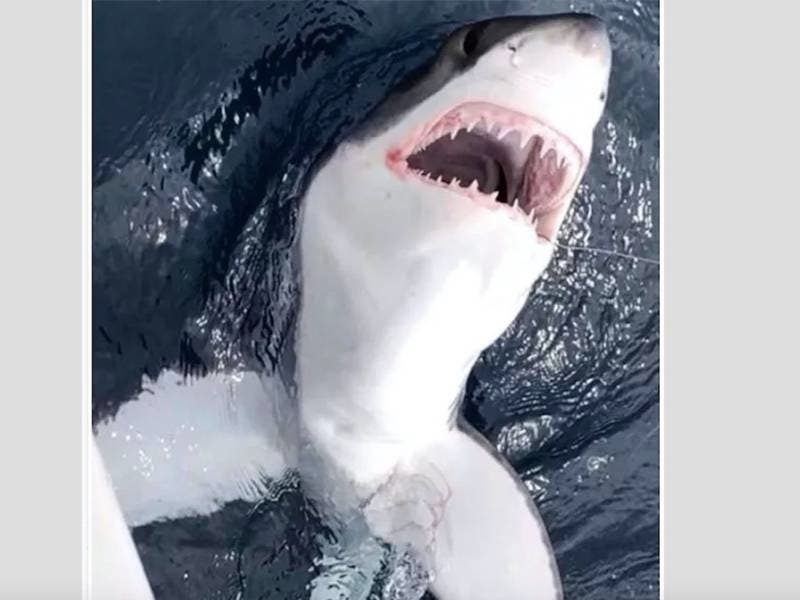
O'Neill said he, Joe O'Neill and Sam Messler, both of Manahawkin, and Robert McLaughlin from Barnegat released the shark as soon as they realized what they had. Fishermen are not permitted to land great white sharks and must release them if they are hooked.
"I said, 'That's a great white. You gotta cut it off," O'Neill said of his reaction to the catch.
Photo of Portugese Man-Of-War courtesy of Christine Perna Burns
Get more local news delivered straight to your inbox. Sign up for free Patch newsletters and alerts.