Schools
'Christmas Tree Phenomenon' Experiment Lands WMC Scientists $5K Grant
Seven seniors and their biology teacher will try and prove mold on festive tees harms residents in their homes during holiday season.



Is your Christmas tree killing you?
It may sound like an evening news teaser, telling viewers to check back at 11 p.m. and live in fear until the broadcast, but for a group of seven West Morris Central seniors and their teacher, it’s a legitimate concern – one that has granted them $5,000 from one of the world’s largest chemical companies to help with an experiment.
Lisa Gizas, teacher of Advanced Biology at the high school, had her students write grant proposals for an assignment. Those who received perfect scores would have their proposals combined and submitted to BASF, which awards $5,000 grants to 20 separate science project proposals in New Jersey each year.
Find out what's happening in Long Valleyfor free with the latest updates from Patch.
“We didn’t think we had a shot,” said Daniel Tafone, one of the seven seniors whose proposal was part of the submission.
About two weeks after Gizas submitted the paperwork, BASF alerted the school that it would indeed be given the money to carry out the experiment.
Find out what's happening in Long Valleyfor free with the latest updates from Patch.
School administrators and district assistant superintendent Robert Beers notified the students in a small ceremony, who were as excited as they were anxious.
“That’s when we realized that we had a great opportunity in front of us,” said Kailene Brobst, one of the students on the team.
So, what is the Christmas Tree Phenomenon, and why does it matter?
Studies have shown that Christmas trees, which grow outdoors for several years before being cut and brought indoors, have mold spores living on them. But because they remain outside, those spores remain dormant, the student scientists said.
But what happens when those trees – with mold spores in tow – come inside to temperature controlled climates?
The scientists’ hypothesis asserts that mold will grow, leading to increased respiratory issues such as asthma and bronchitis during the holiday season.
The group has deployed ager plates to 120 participating families in the area. The ager plate is put in someone’s home prior to bringing a Christmas tree inside. That plate is removed and a second plate is placed in the same location for 24 hours after the tree is set up in the home.
While interviewing the group, Patch was able to see firsthand what a completed ager plate study showed – it was also the first set of results the scientists came across.
And it was gross.
The mold spores were large and abundant, proving, in part, the students’ hypothesis that Christmas trees were as fungus-filled as they were festive.
The funds from the BASF grant have enabled the group to purchase a $3,500 autoclave, as well as a new incubator, two pieces of equipment that will significantly aid the studying process.
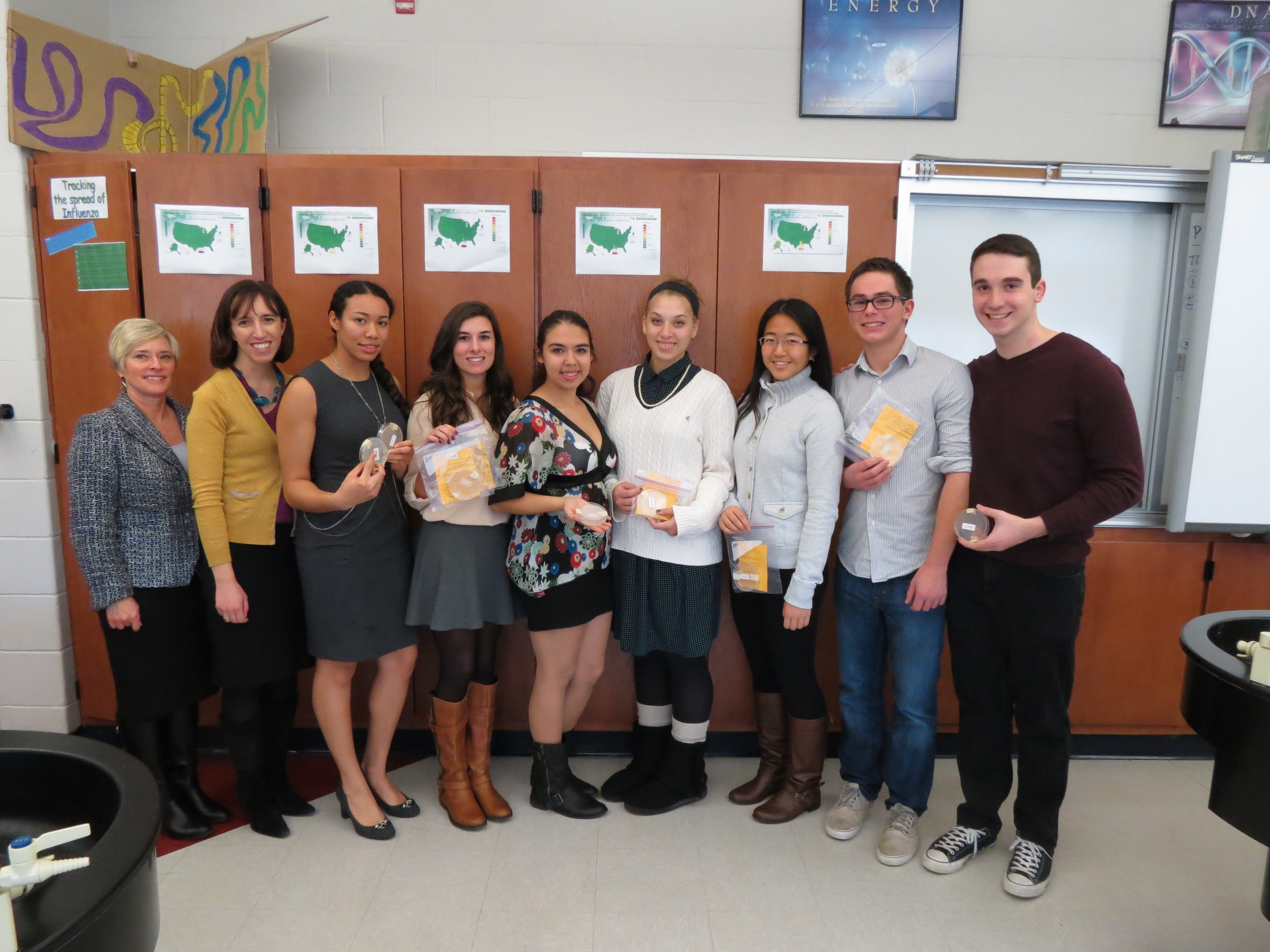
The scientists, Tafone, Brobst, Scott Schumacker, Brianna Meola, Hasoni Austin, Janet Liu, and Danielle Rivers, are working hand-in-hand with Gizas and under the direction of District Supervisor of Science Margaret Sheldon, who was the recipient of a BASF grant herself in recent years.
The project will take the students into the new year before completion, and they’ll likely put in some time during their winter break at the end of December.
Just remember, when the Christmas Tree Phenomenon proves true and the sale of artificial trees skyrockets, know it was West Morris Central’s young scientists who cracked the case.
Pictured: From left, District Supervisor of Science Margaret Sheldon, AP Biology teacher Lisa Gizas, Hasoni Austin, Brianna Meola, Kailene Brobst, Danielle Rivers, Janet Liu, Scott Schumacker, Daniel Tafone. Second photo: Results from an auger plate being placed in a home with a Christmas tree.
Get more local news delivered straight to your inbox. Sign up for free Patch newsletters and alerts.