Schools
Twp. Schools 'Copy Cat' Program Honored
Use of technology for Autistic students awarded by New Jersey School Boards Association.


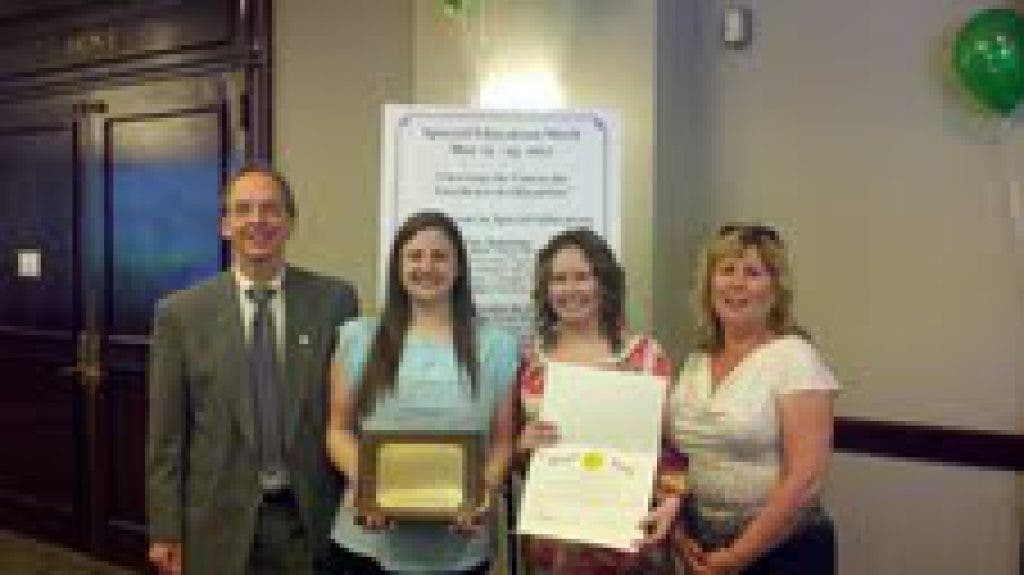
Members of the District's special education department were recently recognized for their achievement of helping students on the Autism spectrum successfully recognize proper social actions with the use of iPads.
The program is called "Copy Cat Kids."
The following explanation of the project, as described by the school district, is below.
Find out what's happening in Long Valleyfor free with the latest updates from Patch.
The program entitled Copy Cat Kids began in December, 2010, from a grant received from the New Jersey Association of Educational Technology (NJAET), Parent Teacher Organization grants and donations from local businesses.
It continues to be funded by private donations and it has garnered support as an innovative project from district administrators. Since the implementation of this program, 30 preschool students with disabilities and 22 school age students identified with social skills deficits and autism spectrum disorders in Washington Township Schools, have been directly involved in this project.
Find out what's happening in Long Valleyfor free with the latest updates from Patch.
The program developers have been guest speakers at NJAET workshops and they have presented in districts interested in implementing this innovative program. It is our hope to continue to expand this program across our district and in surrounding districts.
Teachers who harness technology and understand its power to foster thinking, creativity and innovation engages students as digital learners to acquire and apply knowledge and skills for 21st century learning. This is ever so true for students who have autism because they lack social skills and often, limited language skills. Many of these students, if observed on the playground, are viewed as the social outliers. They have difficulty understanding and interpreting body language and lack the social language repertoire to engage others.
Video self-modeling is a powerful tool that can teach students with social disabilities because they can watch themselves doing activities successfully through a visual model. When someone views images of him/herself successfully performing a behavior, he/she has visual evidence that he/she can do it. To take the Little Engine analogy one step further, it is no longer “I think I can, I think I can.” It becomes “I know I can, I know I can- I’ve seen it.”
Video self-modeling involved filming and editing footage to create a video of a student's ideal performance of a skill. The student then watched the video of him/her and gathered valuable information about a replacement behavior to help him/her master social interactions or other areas targeted as difficult for the student.
Our team used carefully edited video of self-imaging behavior so that students could view themselves performing a behavior at a slightly advanced level. We used iPads to develop clips teaching student-specific skills (standing in line, asking for help, asking someone to play, how close to stand when near a friend, etc.) and then edited the video to show only positive examples of behavior that our team identified as problematic. iPads were used with students outside the classroom in more natural settings such as the playground, hallways, lunchroom and bus rides to and from school where the behavior could be watched and then immediately practiced. Regular classroom teachers are now asking for training as Copy Cat Kids have improved our student’s transition and behavior within mainstream settings.
The program developers identified behaviors to be taught through a close examination of data collected on each student and through collaboration with parents and Child Study Team members. A task analysis was done to break down behaviors into the individual steps and to identify which parts of the sequence are most challenging for the student.
Older students assisted in the illustrated representation of the scenes in the movie through a storybook format before the filming was begun. Our team looked at each storyboard and added a script to encourage the student to focus on the important elements. The students practiced role playing the storyboard before the actual filming began. During the filming of the video self-modeling, the students became the stars of their own movie. Our collaborative team videotaped the targeted skill based on the individual needs of each student. We collaborated as a team to edit out the "mistakes" the student made so that we were left with a 'movie' of successful completion of a task. The student then looked at the video in the environment where the task was required (lunchroom, outdoor recess, classroom, etc.) to practice the skill again. When our students thought they could perform a skill, they were more likely to succeed. For many of our students, they know they could because they saw themselves perform the skill successfully in their movie.
Copy Cat Kids allowed for students to view self-modeling clips in the generalized setting. The iPad gave us the ability to deliver the instruction in the specific situation (playground, hallway, and cafeteria) where it needed to be delivered and generalization of skills could occur naturally. Children on the autism spectrum process everything in pictures so video learning is quite an attraction to them. Pictures help students visualize their tasks and when and how to do them.
Steve Jason, Director of Special Services, teachers Amanda Scairpon, Denise Scairpon and occupational therapist Sharon DiPaola are the program developers. Steve Jason has been inspirational in giving this staff the guidance and support to create excellent programs for students on the autistic spectrum. He has challenged this staff to address our students’ needs and to implement 21st century teaching strategies so that involved students could be effectively taught and remain in our district. He challenged us to think out of the box to assist our students in developing critical social skills.
Amanda Scairpon has been teaching special education for four years and she is responsible for identifying school age students in need for social skills training. She currently teaches in a severe language and learning classroom for students in grades 3 through 5.
Denise Scairpon has been a special education teacher for 31 years and she has been teaching in the district’s preschool disabilities class for the past 25 years. Sharon DiPaola is our district occupational therapist who assessed/remediated issues our students were having with motor planning and execution when using the iPad. Prior to creating a video, the students worked with Dr. DiPaola on familiarizing and navigating through the iPad applications. All have received various awards and honors over the years for their innovative projects they have brought into the district.
Get more local news delivered straight to your inbox. Sign up for free Patch newsletters and alerts.