Neighbor News
Joyce Kilmer's Affinity for Mahwah, in His Own Words
The famous poet/patriot lived the longest of his adult life in Mahwah, and they were the most prolific literary years of his life, as well.
MAHWAH -- When Mahwah land promoter Leo Bugg began advertising in the New York papers about home plots for sale in the “wonderful land scenes” of the Jersey hills “so close to New York,” rising literary star Joyce Kilmer made up his mind to move his growing family to Mahwah’s beautiful Cragmere Park.
He bought two plots in 1911 and moved into a new house the following year. Kilmer lived only for 31 years, yet became one of the most celebrated poets and patriots in history. He spent five of those years in Mahwah, the longest period of his adult life. And they were the most productive literary years of his life, as well. It was here in Mahwah on February 2, 1913 that Kilmer wrote the poem “Trees,” which remains today one of the most popular poems in the English language. He also penned many other admired poems in and about Mahwah.
In his own words, Kilmer described in the following letters and interviews located by the Joyce Kilmer Society of Mahwah his move to Mahwah, his intermingling with his Mahwah neighbors, his love of Mahwah’s mountains and river and his declaration that his Mahwah home was his most-loved of all of his earthly belongings:
Find out what's happening in Mahwahfor free with the latest updates from Patch.
“We are living in Mahwah now. The floor and woodwork are not yet stained, and there is no electric light as yet, but otherwise we are very comfortable.” -- Joyce Kilmer in letter to his mother, Annie Kilburn Kilmer, June 25, 1912
“The mountains about here are very interesting. I climbed two of them with my friend Richardson Wright, who was visiting me. We found on Mt. Houvenkopf an old artist and his wife...There is a fine view from the mountains, and the valley between them is full of wild honeysuckle. You must climb these mountains this autumn.” -- Letters to his mother, circa 1912-1914.
Find out what's happening in Mahwahfor free with the latest updates from Patch.
“I live in the Ramapo Hills in Jersey and don’t mind the commuting. I have a wife and two children, am catholic in my tastes and Catholic in religion, am socially a democrat, and politically a Democrat. I am special writer on the staff of the New York Times Sunday Magazine, the Times Review of Books and the Literary Digest. ... I like to go fishing. This is not a pose. I really catch the fish.” Interview with Book Monthly magazine, Spring, 1915.
“We went to a dance last night, and expect to go to another next Saturday.” – Letter to his mother, May 4, 1913,
“The city has no more enthusiastic admirer than myself. I like restaurants and clubs and theaters and balloon peddlers and parades and hurdy-gurdies and German bands and Fifth Avenue busses and small unexpected parks. Therefore I live in the country.I do so in order that the city may continue to be the rare show it is normally intended to be...There are four other reasons why I live in the country. They are called Kenton, Rose, Deborah and Michael. (his children)” Interview in Countryside magazine, 1916.
“We are making quite a garden out at Mahwah, or rather (wife) Aline is.” – Undated letter to his mother.
“I hope that by the time you get back you will find vines growing about our house. We are going to plant some seed.” – Letter to his mother, 1913.
“We are now back in Mahwah, thank God. It’s the chief thing I thank Him for of all the splendid things He’s given me – this home of mine.”-- Joyce Kilmer in letter to the Rev.James J. Daly of Campion College in Wisconsin, November, 1914.
Kilmer, a reporter for The New York Times, was killed in action in France in World War I, and was posthumously awarded the French Croix de Guerre for courage under fire. He was the most distinguished America to die in that war.
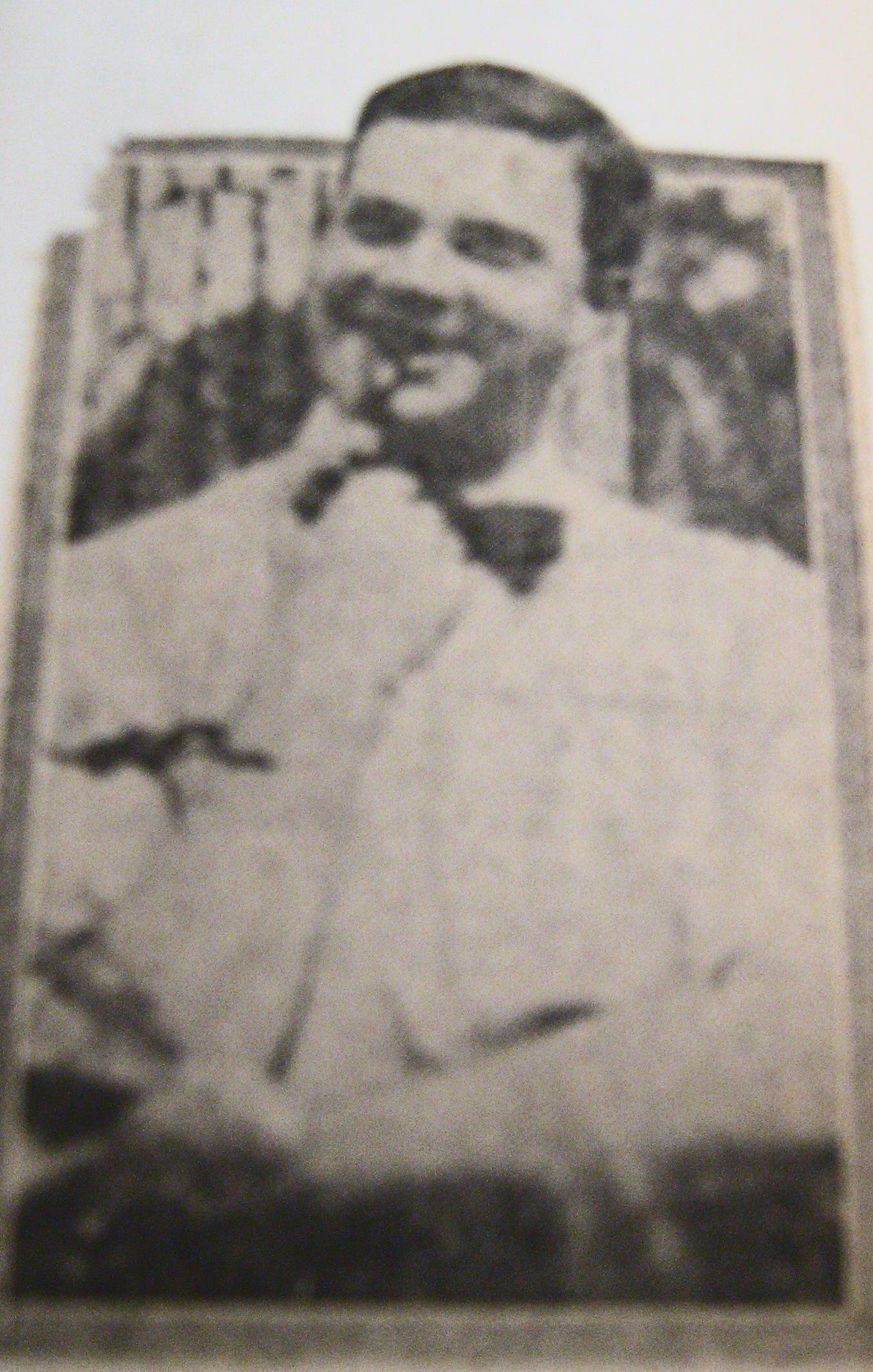
PHOTO: A smiling Joyce Kilmer as a rising literary star who moved out of New York City to the woodsy hills of Mahwah, NJ., where he and his wife, Aline, raised four of their five children. Photo, courtesy, Special Collections and University Archives, Rutgers University Libraries.