Neighbor News
250th Anniversary of America: Recognizing the Irish & New Jersey
The significant role the Irish played in helping to establish America, especially in New Jersey
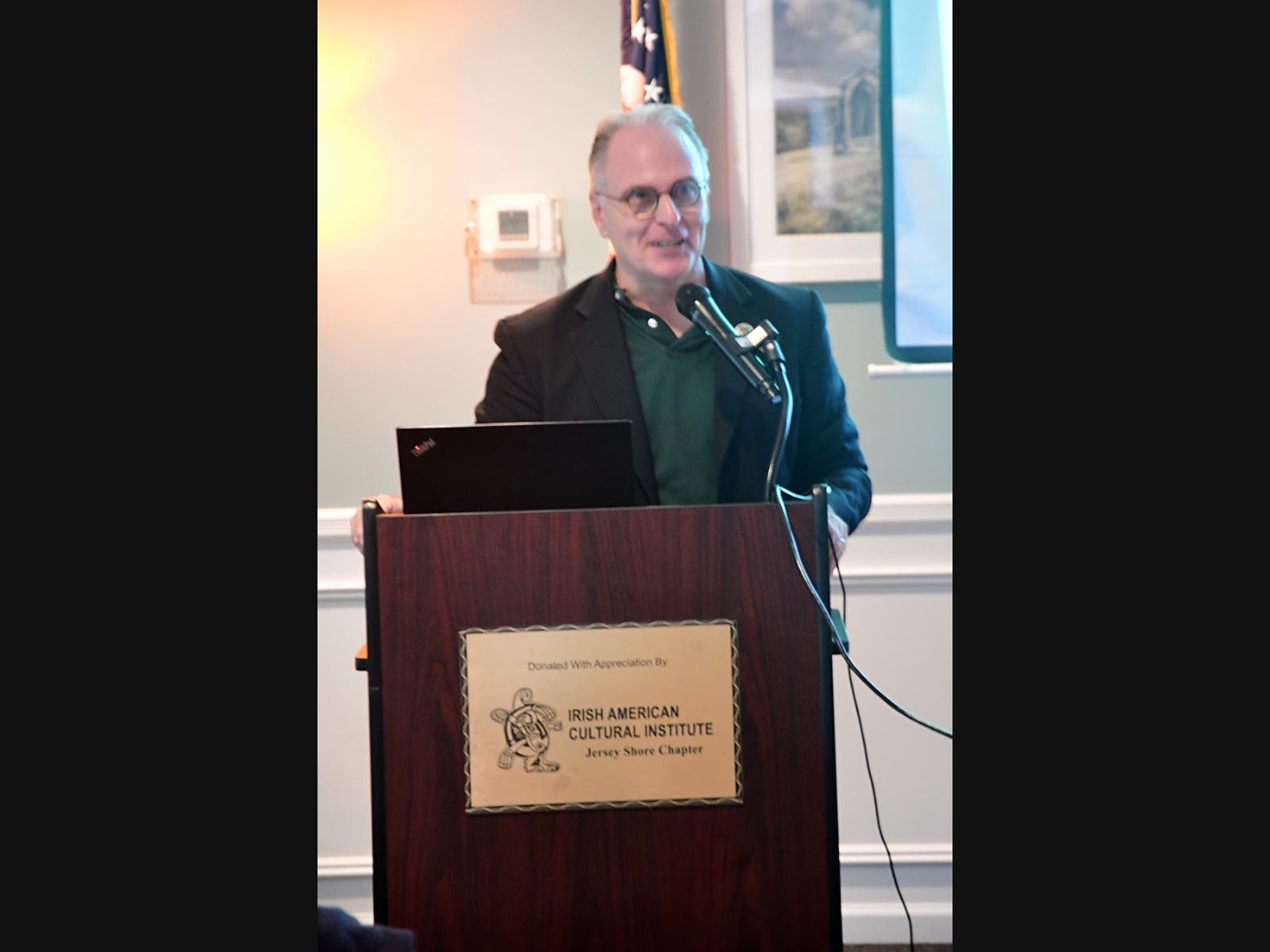


In honor of the 250th anniversary of our nation, the Irish American Society of the Jersey Shore sponsored a talk on Monday, July 13, entitled “Irish & New Jersey in the American Revolution – An Introduction” by Dr. Alan Delozier, noted historian and author.
Delozier, who holds a Doctor of Letters (D.Litt.) in Irish Studies from Drew University and a Master of Arts (MA) in History from Villanova University, is Humanities Librarian at Seton Hall University. He is also the State Historian for the Ancient Order of Hibernians (AOH) New Jersey. Delozier has authored numerous articles and presentations on Irish-American history, New Jersey history, and Catholic heritage.
Fran Griffin, Founder of the Society, welcomed a sold-out crowd, saying, "the semiquincentennial provides an ideal opportunity to hear stories of Irish and Irish American individuals whose important contributions to America's founding are not often in the historical spotlight. We’re pleased to welcome Alan as he shares the significant role the Irish played in helping to establish America, especially in New Jersey.”
Find out what's happening in Manasquan-Belmarfor free with the latest updates from Patch.
While many Americans are familiar with the waves of Irish immigration during the nineteenth century, especially during the Great Hunger (1845-1852), Delozier shared how Irish influence on American society began much earlier.
To emphasize this aspect of Irish-American history, he began his talk with a quote from an article in the New York Times entitled “Irish in America: How Early They Came” dated November 5, 1898 written by Thomas Dunn English (1819-1902) saying, “Irish immigration to this side of the ocean began at the very beginning. It is claimed, and I believe with justice, that when Columbus first landed the bowman of the boat which brought him to shore and who sprang on the sand to steady the little bark as it struck was born in Ireland, and thus an Irishman was the first to tread the soil of the Western world.”
Find out what's happening in Manasquan-Belmarfor free with the latest updates from Patch.
From the 1680s to 1750, Presbyterians from Eastern Scotland settled in East Jersey, particularly in the present-day counties of Monmouth, Middlesex, Somerset, and Mercer. Additionally, hundreds of “Scots-Irish” left Ireland between 1683 and 1685 to settle in Freehold along with “New Perth” at Amboy Point (present day Perth Amboy), Plainfield, or the Watchung Mountain area. As a nod to the World Cup currently underway, Delozier amusingly referred to these settlers as the original “Tartan Army.”
The last pre-Revolutionary wave of emigration from Ireland to America, like other previous waves, was largely a Protestant one. Irish Protestant emigrants, chiefly Presbyterian, made up three-fourths of those leaving Ireland from 1700 to 1776, though they constituted only one-fourth to on-third of the island.
Delozier went on to name particular Irish individuals whose contributions to the early days of the New Jersey colony deserve recognition. One of those individuals was General William Maxwell, a Presbyterian of Scottish descent born in County Tyrone, Ireland about 1733. Maxwell distinguished himself as the commander of the legendary 2nd New Jersey Regiment (the Jersey Brigade) as a Continental Army General during the American Revolution. After his service, he settled on a farm in Warren County and held a position in the New Jersey state legislature.
New Jersey had a pivotal role in the American Revolution where there were many clashes between the Americans and British forces. In total, there were 296 engagements that occurred within New Jersey, more clashes than occurred in any of the other Colonies during the war.
Irish soldiers comprised a significant portion of the Continental Army fighting in these battles. Many contemporary observers saw the role of the Irish immigrants as a crucial one that helped America win the Revolution. Historians estimate that approximately one-half of George Washington’s Continental Army were either born in Ireland or of Irish descent.
Of the roughly 2,400 troops who crossed the Delaware River with Washington on Christmas night in 1776, it is estimated that Irish immigrants and Irish Americans made up between thirty to fifty percent of the ranks of his Continental Army.
During the harsh winter encampment of 1780 at Morristown, NJ, General George Washington issued a general order granting his soldiers a day of rest on March 17. This was the first day off the Continental Army had received in over a year. He instructed officers not to detail "the sons of St. Patrick" for duty, allowing his heavily Irish forces to celebrate their patron saint in solidarity with their Irish homeland. Washington’s order included a caveat “that the celebration of the day will not be attended with the least rioting or disorder.”
Irish DNA is also heavily associated with the Declaration of Independence. Eight signers were of Irish heritage, with three born in Ireland and five of Irish parentage. The three born in Ireland were Matthew Thornton (New Hampshire), George Taylor (Pennsylvania), and James Smith (Pennsylvania). The others claimed Irish roots through their immigrant parents, including Charles Carroll (Maryland), Thomas Lynch, Jr. and Edward Rutledge (both of South Carolina), Thomas McKean and George Read (both of Delaware).
John Hart, born in Hopewell, NJ, whose paternal roots trace further back to Irish immigrants was also a signer of the Declaration. A delegate to the Second Continental Congress, he is celebrated not only as an Irish-American Founding Father but also for the immense sacrifices he made during the Revolutionary War, which included having his farm ransacked by British troops. Hart was elected twice as Speaker of the New Jersey General Assembly and served until 1778.
John Dunlap, who was born in County Tyrone, Ireland, also served under George Washington in the Continental Army during the Revolutionary War. Later, he was the printer responsible for printing the first copies of the Declaration of Independence. Ultimately, he became one of the most successful Irish-American printers of his time.
"The story of America's founding is incomplete without recognizing the early contributions of Irish immigrants and Irish Americans," said Delozier. "Their commitment to liberty, public service, faith, and community helped leave a lasting imprint on the development of the nation."
The Irish American Society of the Jersey Shore is dedicated to celebrating and preserving the rich heritage of Ireland while honoring the profound contributions of Irish immigrants and Irish Americans to the fabric of American society. For info on upcoming events, follow the Society’s Facebook page at www.facebook.com/IrishAmericanSocietyJerseyShore.