Arts & Entertainment
Maplewood's David Winitsky Traces Jewish Theatre Roots
Director David Winitsky talks about his play "Under the Cross" and his path to Jewish theater.
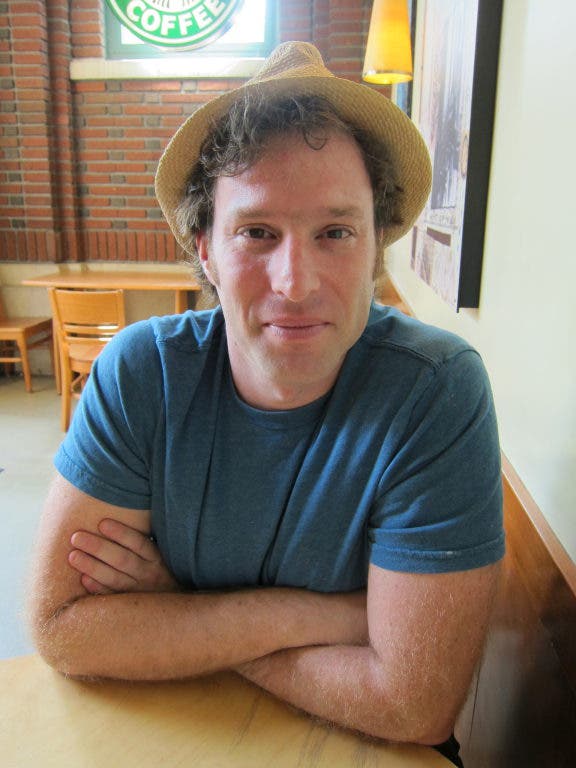
I never get tired of telling friends outside of the area about the creative hotbed that is South Orange and Maplewood. Recently, I had the pleasure of sitting down with director and Maplewood talent David Winitsky for a chat about his recent project, “Under the Cross,” a Yiddish play written by Isaac Dov Berkovitch.
Deborah: The last time I saw you, you were sporting a full beard, and now you are clean-shaven. Is this a summer do?
David: You know the kids asked me to grow a winter’s beard....
Find out what's happening in Maplewoodfor free with the latest updates from Patch.
Deborah: In honor of the Oscar nominated film Winter’s Beard? Oh no, that would have been . Never mind.
David: Well, it wasn’t in honor of anything in particular, but I did keep it through Purim for our family costume, Mount Rushmore. I was Abraham Lincoln.
Find out what's happening in Maplewoodfor free with the latest updates from Patch.
Deborah: How fitting for our conversation about your involvement in Jewish theater, given that Abraham Lincoln spoke out against anti-Semitism. He was the first president to stand up for the Jewish peddlers when Ulysses S. Grant tried to prevent them from selling goods to the Union soldiers.
David: Huh, I did not know that.
Deborah: I’m surprised to be teaching you something considering your study of Jewish history and theater.
David: I’m learning all the time. As a matter of fact, the pursuit of Jewish education is essentially how I got involved in Jewish theater.
Deborah: Do tell.
David: I grew up in a Reform Jewish household, which is kind of like being a Presbyterian. My mom converted to Judaism from Catholicism to upset her family, and my dad came from Russian engineers who identified to Judaism as an ethnicity but were not observant. Art was my religion. I played the alto-saxophone throughout school and performed with bands. I didn’t get involved in acting or theater until high school. And then, I tried out for a play but realized I couldn’t be in it because the show dates conflicted with my younger brother’s Bar Mitzvah.
Deborah: You would have thought that would turn you off to Judaism.
David: Luckily, the director of the show proposed that I work with him as a student director. I loved it.
Deborah: Was it a Jewish play?
David: No, the Jewish part comes later.
Deborah: So then upon discovering your inner thespian, you went on to Juilliard and perfected your craft?
David: Actually, I went to Cornell and majored in math. I let the theater go, but I continued to play music. Towards the end of college, a friend asked me to join his theater company, and I performed in an original play of his. I directed the company’s next show, Good Doctor by Neil Simon. The minute I sat in that director’s seat, I realized that this was it.
Deborah: Because you were too lazy to stand up?
David: Hyeah. No, because this is where everything came together- music, rehearsing, putting on shows. This was what I was supposed be doing on the planet. It helped that I knew how to talk to people to bring out the best in them, too.
Deborah: And your parents thought that getting involved in show business was a good thing to do with your math degree?
David: They were very supportive – very much of the belief that people have to make their own choices in life.
Deborah: And what led you to choose Jewish theater?
David: I met my wife, Elizabeth, through theater. I was managing a concert, and she was working on it, too. Elizabeth comes from an observant Jewish family. Her father’s a (Holocaust) survivor. I wanted to learn about Judaism, and I was able to do so through theater. I’m learning about our history through the arts while my kids learn about it in school.
Deborah: And what have you learned, Dorothy?
David: Well, Auntie Em, I learned that the basis of Jewish theater is Yiddish theater, and Yiddish theater formed the narrative of what became the Broadway musical.
Deborah: Is that why Jews love musicals? Is it some sort of “call of the wild” connection we have to Yiddish theater?
David: Without going into a historical lecture about it, there is definitely something there. So many of the founders of Hollywood and Broadway got their theatrical education from Yiddish theater.
Deborah: So it’s not just the case that Jews own Hollywood. We invented it!
David: I can tell you that much of the narrative revolves around Yiddish themes like the triumph of the individual.
Deborah: That brings us to the play. Can you tell me a little bit about it?
David: “Under the Cross” is about a businessman named Moshke who converted to Christianity and married a religious, Christian woman. Moshke and his wife have a son, Yakov, who is about to be married to a Christian woman-a woman his father found for him. One day, Moshke offers shelter to a Jewish woman who has been raped during a pogrom (organized massacre of the Jews), and Yakov is not pleased. Moshke later discovers that his son Yakov not only participated in the pogrom but also was the Jewish woman’s rapist.
Deborah: Uch, now THAT’S a shanda! Do you think this play was a warning to Jews about turning their backs on their religion-marrying out or converting?
David: It’s possible. I’m sure that’s one of the messages, but I think that it’s more of a taste of the verboten. Every culture is fascinated by the forbidden, and this is definitely an exploration of “what would happen if.” Also, in the end, Moshke considers moving to Palestine not to study Talmud and go back to his parents’ version of Judaism but because there is good machinery there, and he can work the land. It’s more of a Zionist, socialist message than a warning.
Deborah: Tell me about the choice to use black actors to play the Jewish characters in the play.
David: The producer chose to cast black actors to emphasize a thematic stand in the play. The audience can evaluate that choice and determine if it’s successful. Either way, it doesn’t keep you from investigating the themes in the play.
Deborah: Like whether or not we should all learn to farm and move to Israel?
David: Like Otherness and the effects it has on all people.
Deborah: Do you think it’s a negative thing to be Othered?
David: In the play, the Christians saw the Jews as holy and recognized their status as ‘chosen.’ It was a positive kind of Other status though the ideal form of Otherness is when groups receive validation and equality in spite of their differences.
Deborah: And therefore, it's such a relavent piece to catch during Pride Month. And after the play closes? What's next?
David: I’ve just launched The Jewish Plays Project to reinvigorate the Jewish theater canon. The first event will be a Jewish playwriting contest in February.
Deborah: We’ll have to get together again to share all the details with Patch readers. I now have a Starbucks app on my phone that allows me to pay for my green tea via a barcode scanner. I’m all set for our next conversation. I'll buy.
Under the Cross runs through June 25 at Abingdon Theatre Arts Complex, 312 West 36th Street, NYC. Remaining performances: 8 p.m. June 21-25. You can purchase tickets HERE.