Schools
Helping a Child to Answer “But Why …”
Mendham Township School District's science program starts in the early grades and provides a rigorous, hands-on learning experience.
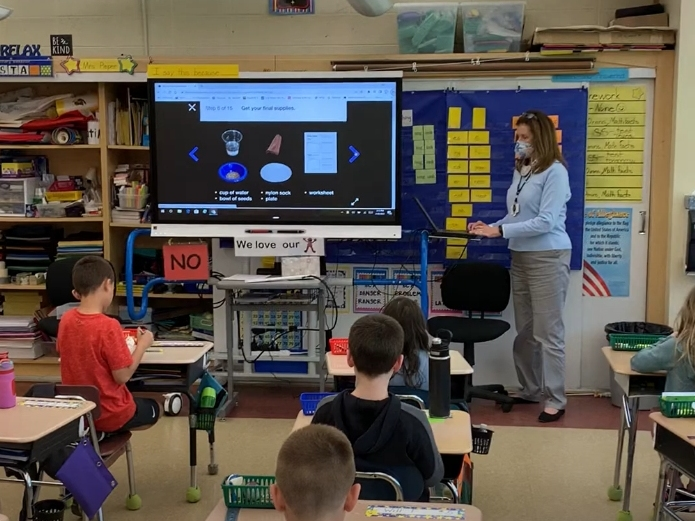


Mendham Township, NEW JERSEY (March 24, 2023) – From an early age, the science curriculum for elementary and middle school students spans three main areas: physical science, life science, and Earth and space science. At Mendham Township School District (MTSD), emphasis is placed on providing students with hands-on experience and enabling the students to engage as many senses as possible in embracing their understanding of a science lesson. The goal is not only for students to investigate a phenomenon, but also how to make sense of what they are observing. Can students describe the phenomenon? Can they make sense of what is happening? Can they predict what may happen with a change in a variable? Can they devise solutions to a problem? In kindergarten, it may start with using magnets and observing how the magnets attract certain objects but not others (physical science). In first and second grade they will have the opportunity to sprout seeds and collect data on plant growth by manipulating variables, such as light exposure. They will study different animals (habitat, diet, lifespan) and be able to identify examples of how animals can adapt based on their environment. By third and fourth grade, students will transition to studying more complex concepts such as friction and gravity and the attendant impact on motion caused by these forces, or the existence of different forms of energy, such as heat, light, and sound.
At the Mendham Township Elementary School (MTES), science lessons and experimentations are augmented with STEM classes. For example, during STEM classes, students enthusiastically demonstrate how blocking the path of a light source creates a shadow. The students have an opportunity to create their own shadow box and demonstrate a storyline by manipulating objects to create moving shadows. Teamwork comes into play as the students face a challenge to design a tower from which a ball can drop from the top of the tower to the bottom, all while removing pieces from the tower and keeping the tower standing.
This year marks the return of the MTES STEM Expo (the event was canceled during the COVID pandemic). Students who have developed questions or interests based upon their science studies at MTES can create their own investigative project. This school event is open to students from kindergarten through Grade 4. There are four categories of projects for students to choose from:
Find out what's happening in Mendham-Chesterfor free with the latest updates from Patch.
- Invention
- Environmental Innovation
- Scientific Inquiry/Experiment (like a "typical" science fair or research project)
- Demonstration
The MTES STEM Expo in April will display students’ projects so that all MTES classes have an opportunity to visit the Expo and parents will be able to attend on one evening, as well.
“These young students are building a scientific vocabulary and learning how to employ a basic research approach that will serve them well, both in future science classes and in other subjects as well,” said Michal Ferenc, MTES Assistant Principal. “The MTES science program is greatly enhanced by the hands-on experiments and is designed to engage all students. I am looking forward to the upcoming MTES STEM Expo and seeing the discoveries these students have made.”
Find out what's happening in Mendham-Chesterfor free with the latest updates from Patch.
Over in Mendham Township Middle School (MTMS), Grade 5 students eagerly participate in investigative labs. For example, in a Mixtures and Solutions Unit the students studied the concepts of concentration and saturation and created a real world experiment using ordinary household items: salt and water. To demonstrate the concept of saturation, the students tasked themselves with finding the limit to the amount of salt that would dissolve in 50 ml water.
As expected in the higher grades, the topics, experiments, questions, and solutions become more advanced and require independent investigation by the students. For example, older students study different organisms and their food chains, food webs, and energy pyramids as part of their Ecology Unit in science. For example, the student will dissect an owl pellet to investigate its diet and map out its part in a food web. To identify the owl’s consumed prey, first, students have to separate and identify all the bones in the pellet. Next, they must reconstruct the skeleton, and compare their skeleton with published data to identify the animal that was the owl's prey.
MTMS students also participate in an annual multi-district STEM EXPO. This annual event provides an opportunity for students from the participating districts to showcase their technology skills and share/discuss their achievements. This year the STEM Expo included students from Randolph, Chester, Long Valley, Mendham Boro, and Mendham Township. During the day at the EXPO, teams composed of students from the different schools tackled challenges, such as Cup Stacking Challenge, Bridge Building (Design and Critical Load Challenge), Drone Obstacle Course, Lego Mindstorm Color Matching Challenge, Catapult Design and Target Contest, and finally Escape Room Breakouts. The day concluded with presentations from each school.
Not every student will consider science to be their preferred subject. Yet, the discipline of studying science has benefits in other subjects and it is vital for understanding our environment, for encouraging innovation, and for creating a solid foundation for critical reasoning.
“These young scientists are well on their way to being able to craft a hypothesis, research, analyze, and solve complex scientific problems,” said Nick Angrisani, MTMS Assistant Principal. “The MTMS science program is designed to ignite interest and instill confidence in students as they acquire increased proficiency in the assigned science curriculum.”
You can view a short video clip of a science lesson at MTSD at: