Health & Fitness
The Luyster House: An 18th-Century Dutch-American Farmhouse
Overview of the Luyster family and their 18th-century house.


During the mid 17th century, control of New Jersey changed hands several times between the Dutch and the English. While the Dutch population in New Jersey never grew very large during the colonial period, its impact on the cultural landscape was irrefutable. Small enclaves of Dutch were entrenched in towns throughout the state. One of these enclaves, known as “New Holland” was located along the western border of Middletown Township. The present-day Holland Road was the main thoroughfare through this neighborhood. A magnificently well-preserved surviving example of the Dutch settlement in New Jersey is the Luyster House, originally located on Holland Road near the intersection of Laurel Avenue and Van Schoick Road. This was the homestead of one of the earliest Dutch settlers in Middletown, Johannes Luyster.
Before discussing the site, I’d like to give a brief history of the Luyster family prior to their arrival in New Jersey. The story of the Luysters of Middletown, like so many other American families, has its origins in seventeenth-century Europe. The founder of the Luyster family in America was Pieter Conrelisz Luyster, who came to New Netherland from Holland in 1656. He settled in Newtown, Long Island during a time when the area was under Dutch control. Pieter and his wife Aeltje Tyson had three children: Johannis, Cornelius and Gertrude. Cornelius married Sara Catherine Nevius and moved to Flatbush sometime prior to 1687. Cornelius and Sara had three children: Peter, Sara Rapalje and Johannes. It was Johannes, Cornelius and Sara’s son, who would be the first of the Luysters to move to Monmouth County.
It is unclear exactly when Johannes moved to Middletown, due in large part to the confusing, often contradictory documentary record. A plaque on the house gives a date of 1680, but the earliest known deed is 1717. Interestingly, according to the deed, Johannes purchased the property in late 1717, however records of the Dutch Reformed Church in Marlboro list the Luysters as congregants as early as January 1715, and numerous times shortly after. Although the date of Johannes Luyster’s arrival in Middletown is in question, it clearly predates the land purchase in 1717, but probably not as early as 1680. Archaeological evidence also suggests that there may have been an earlier structure on the site prior to the existing building. As a farmer, Johannes was apparently successful, adding two more lots between 1717 and 1750 to expand his holdings from approximately 97 to 189 acres.
Find out what's happening in Middletownfor free with the latest updates from Patch.
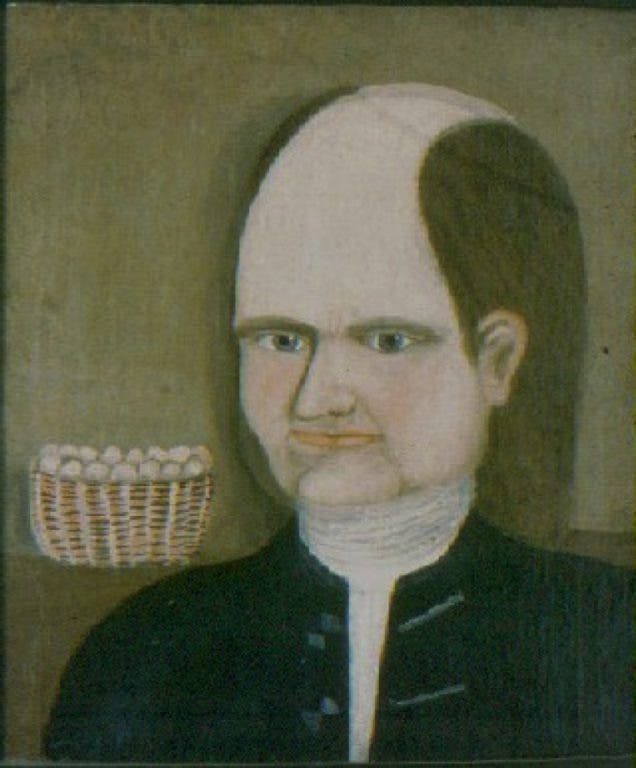
Johannes and his wife Lucretia would eventually have six children: Sara, Peter, Cornelius, Johannes, Antje and Lucretia. It was Peter, born on May 5, 1719, who would take control of the Luyster farm after Johannes’ death on January 29, 1756. Peter lived at the farm during the American Revolution and was very outspoken in his disdain for the British crown and his support for the patriot cause. He was also a successful farmer, particularly in egg production. You can see a basket of eggs in a painting of Peter from around the time of the American Revolution. This was a common practice in the 18th-century, that is, to have a successful individual’s source of wealth also depicted. After the Battle of Monmouth, British troops raided the Luyster farm and confiscated all of the crops and livestock. The soldiers attempted to ransack the house, but were outsmarted by the Luyster women. While the British looted the barns, the women dressed in several layers of frocks and hid silver spoons in their mouths. A locked cedar chest with other valuables, however, was forced open with bayonets. This piece survived, bayonet-marks and all, into the 1930s. Other surviving eighteenth-century pieces from the Luyster house include a heavily-decorated “kas” or closet and a cupboard with the date “1722” painted on the front.
The Luyster House structure is a classic example of Anglo-Dutch architecture. Although the exact date of construction of the house is unclear, dendrochronology of wood samples from the floor joists returned a date of 1724. The structure stood on a very shallow, dry-laid fieldstone foundation one or two courses deep. The main block of the house has no cellar, although a deep cold room under an 1862 addition may have been associated with the earlier portion of the building. Other additions included an 1890s mud room and a 1920s kitchen. Originally the south-facing structure consisted of two side-by-side ground floor rooms – each with a Dutch entry door. This configuration can be seen in a circa 1840 painting that also shows an early barn to the left and a wood-cut based on the same painting from circa 1860. One of the doors was sealed in 1862 during an extensive renovation, which resulted in the current single doorway entrance flanked by paired windows. Further renovations occurred during the 1940s, when dormers were added to the second floor.
Find out what's happening in Middletownfor free with the latest updates from Patch.
Although the house had seen a number of renovations over the years, the Luyster House retains many of the classic Dutch architectural elements. The gable roof still has different pitched slopes with wide, front and rear overhanging eaves. The large Dutch, jambless fireplace with moveable swing-arm for kettles is located in a room with exposed ceiling beams purported to have been salvaged from a sunken ship in the Navesink River. Overall, the Luyster House, now a private residence, remains one of New Jersey’s finest examples of surviving colonial period Dutch Architecture.
Next month’s column will feature the archaeological study of the Luyster House property.