Politics & Government
History Mystery: Marlpit Hall and Slavery
A look at the history of slavery in Middletown and where the historic Marlpit Hall comes in


Middletown has a rich history dating back to the earliest days of European settlement.
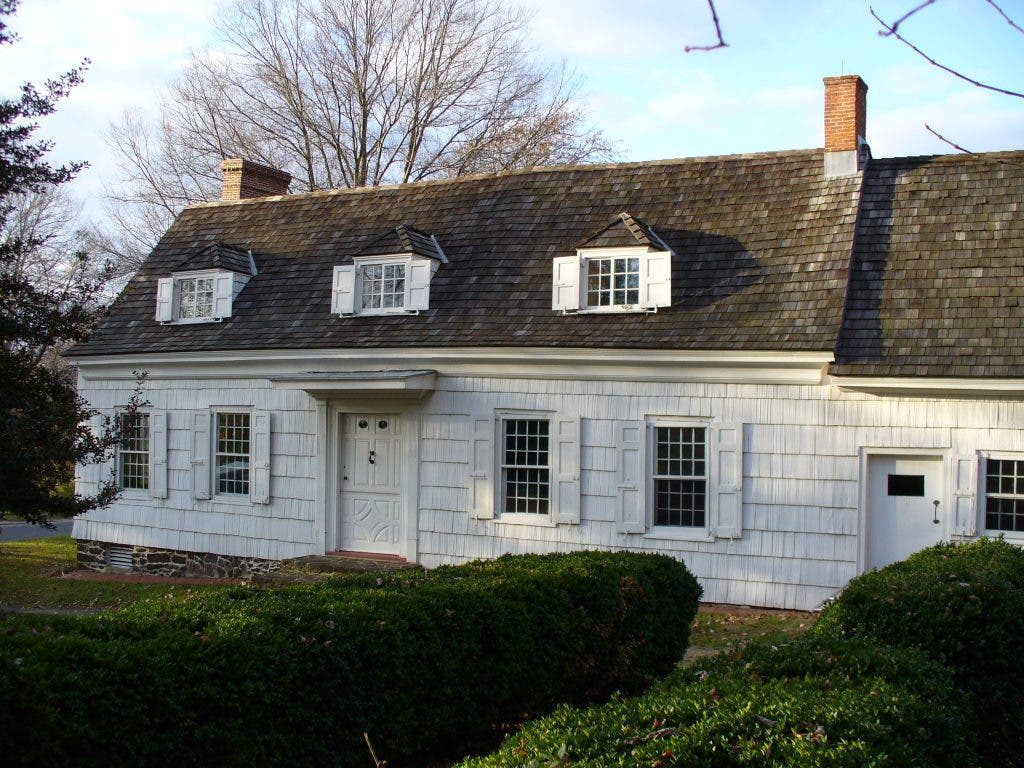
Much of that history is centered around the Middletown Village Historic District, which includes properties clustered along Kings Highway and Red Hill Road. The district contains one of the oldest residences in the township — Marlpit Hall.
There is some question as to whether or not slaves belonged to the family that owned the circa 1756 house before slavery was abolished in the second half of the 1800s.
Find out what's happening in Middletownfor free with the latest updates from Patch.
Glenn May, education coordinator with the Monmouth County Historical Association, said members of the Association believe there were slaves working in the house. They base that assumption on the fact that they found corn cobs and clam shells laid out in the eaves in such a way that they seemed to be part of a ritual — an African religious ritual. “The kind of ritual that slaves used,” he said.
May explained that New Jersey didn’t eliminate slavery until the 1880s, sometime after the emancipation of slaves in the south. He added that the slaves helped in the house, but there is no indication that there were separate slave quarters in the house.
Find out what's happening in Middletownfor free with the latest updates from Patch.
So, Marlpit is purported to have been the actual home of slaves who worked for the family that owned the house during the years before the civil war.
But Mary Lou Strong, chairwoman of the Middletown Landmarks Commission, questions the entire slavery assumption. She said she didn’t think that the African Americans that came in to work for the family during the day were slaves. "The family was not the kind of people who would have had slaves," she said. "They were sensitive, well educated people,” she said.
But, there is some written documentation that the Taylor family, earlier residents of the house, did own slaves. According to a one-page document that the Historical Association provided, with the headline African-Americans and the Taylor Family, the Taylors owned quite a few slaves during the time they lived in the house, 1740-1880.
The document lists individual slaves that belonged to the family in 1806. It also dates when, and if, they were manumitted, which usually happened upon the death of the owner.
For instance, the list includes "Clarisse ?." Although her last name is not noted, there is some speculation that her name may have been Clarisse Leonard. She was born in 1789, but there is no notice of her death.
She was owned by John Taylor and may have been the mother of Matilda, another slave also owned by Taylor. Matilda was born at Marlpit Hall on May 5, 1806.
Then there is "Hannah ?," who was also owned by John Taylor. There is some speculation that her last name was "Vancleve" and that she may have been the mother of Elizabeth Van Cleaf. The entry also states that Hannah may have been manumitted by Tunis Forman of Freehold. If that’s the case, then she would not have been a slave but could have been an indentured servant.
Elizabeth Van Cleaf probably gained her freedom under the Gradual Emancipation Act in 1827. She may have been living at Marlpit Hall in 1830 or may have moved to New York City with Mary Holmes Taylor before 1830. She worked in the home of Mary Holmes Taylor at Orchard Home between 1853-1880 and died on March 20, 1883 near Matawan.
And then there is "Prime ?." He was born in 1755 and owned by Squire John Taylor along with his son-in-law Absolom Bainbridge of Princeton. According to the records, he was "described in a 1778 advertisement as a mulatto, 23 years old, about five foot six inches with hair of a remarkable light coloured wooly kind."
Another Van Cleaf, William, was born in Marlpit Hall in 1804, two years before Elizabeth. He may also be a son of Hannah. He was manumitted by Samuel Taylor on Aug. 15, 1832.
Ephraim Leonard was owned by John Taylor in 1818. He was born in 1797 and bequeathed to Samuel Taylor in 1818. Samuel Taylor manumitted him on May 19, 1828.
He may have been the partner of Mary Ann Brown who was also owned by John Taylor in 1818. She was born in 1792 and is the mother of "George ?" who was manumitted by Edward Huldah and Samuel Taylor on Dec. 22, 1823.
According to Wikipedia, by 1860, the slave population in the U.S. had grown to four million. The first record of slavery in British Colonial America was made in 1619, but the first legally recognized slave was an African American man who came to the South as an indentured servant, but when he tried to regain his freedom through the courts, he was ruled against and declared property for life.
New Jersey banned the importation of slaves in 1788, but, at the same time, forbade free blacks from other places from settling in the state. It was the last of the Northern States to gradually abolish slavery and a small number of black slaves were listed as still held in NJ in the 1860 census.
It considered African Americans to be born free, but required children to serve apprenticeships as a type of indentured servant until early adulthood, which was 21 years for women and 25 years old for men.
A graph shows that the number of slaves in NJ went from 11,423 in 1790 to only 18 by 1860, but both numbers may have been higher.
New Jersey state legislature was the third state to apologize for slavery: "The Legislature of the State of New Jersey expresses its profound regret for the State’s role in slavery and apologizes for the wrongs inflicted by slavery and its after effects in the United States of America;
"expresses its deepest sympathies and solemn regrets to those who were enslaved and the descendants of those slaves, who were deprived of life, human dignity, and the constitutional protections accorded all citizens of the United States; and we encourage all citizens to remember and teach their children about the history of slavery, Jim Crow laws, and modern day slavery, to ensure that these tragedies will neither be forgotten nor repeated.”
Marlpit Hall, which is listed on the National Registry of Historic Places, is now an historic museum, owned and maintained by the Monmouth County Historical Association. The Taylor-Butler House, which sits close by it on Kings Highway, is also a Historical Association property.
The house was donated to the MCHA in 1936 and is a stop on the NJ Women’s Heritage Trail because of the women who have worked to preserve its history.
Upon the death of the third Mary Holmes Taylor, who eventually became the owner of both Marlpit Hall and Orchard House, Marlpit Hall was sold, in 1930, to a well-known Monmouth County antiques dealer, Edna Netter, on behalf of Margaret Moore Riker Haskell, who in 1936 donated it to the Monmouth County Historical Association.
Haskell was a well-respected figure in a historically significant trail of women who restore homes. According to May, Mrs. Haskell had it entirely rescued and restored and furnished with 18th century American furniture before it was handed over to the Association.
Strong explained that Marlpit Hall is not the oldest house in Middletown, but has the distinction of being the first colonial house in Middletown acquired by the Historical Association. "It was very exciting when she left it to the Association," she said.
As with other homes in the area, the house reflects the Dutch and English building traditions. In 1993 it was closed for restoration and underwent more than $800,000 in renovations that were made possible by a N.J. Historic Trust matching funds grant.
The grant funds totaled about $390,000, and the matching funds came from individual contributions, the Monmouth County Historical Commission, several other state grants and donations from other foundations. The Hall reopened in 2001 and has been open ever since.
According to a history of the house provided by the Historical Association, the earliest section was built as a one-and-a-half story house in 1686 by James Grover Jr.; and John Taylor made substantial additions and improvements between 1740 and 1752.
It is noted in the history, that members of the Grover and Taylor families were among the areas leading politicians, farmers and merchants. Marlpit Hall reflects the lifestyles and tastes of the owners, as well as the early history of Middletown as an important colonial village.
Apparently paperwork, like pertinent bills, invoices and estate inventories were used by the Historical Association to guide the furnishing plan that you can see today in the house. It reflects the way the house was used from 1700-1820 and includes a number of objects that can be traced back through the history of ownership.
The Middletown Village Historic District is the heart of the Township's first and foremost settlement. Most of the ninety-nine properties within the village district are clustered along Kings Highway and Red Hill Road between Township Hall and Spruce Drive on the east and Holland Road on the west.
In addition, the district includes properties on Church Street, Liberty Street, Conover Avenue. Most of the properties, 75, are residential. Along with the homes, there are a variety of non-residential historic structures: three 19th century landmark churches, a blacksmith shop, a school, a former tavern, the first store, a former leather and harness shop and six cemeteries.
Marlpit Hall is open Thurs., Fri, and Sat. from 1 to 4 p.m.
For more information on Marlpit Hall, call the Monmouth County Historical Association at 732-462-1466.