Schools
No Contract For Montclair State Adjuncts: Teachers Union Wants 'Equal Pay'
MSU's adjunct professors are alleging that they make "less than their full-time faculty counterparts for teaching exactly the same classes."


If you’re a student taking a class with an adjunct professor at Montclair State University, your teacher is working without a contract.
“Contract negotiations are currently stalled,” said Bob Noonan, president of the Montclair Adjunct Union AFT Local 6025, which represents the 1,100 adjunct professors at MSU who teach more than half of the university’s 20,000 students.
MSU spokeswoman Erika Bleiberg told Patch that the most recent adjunct contract was effective from July 1, 2011, to June 30, 2015.
Find out what's happening in Montclairfor free with the latest updates from Patch.
But members of the school community with questions about the delay between contracts need to reach out to the state, not MSU administrators, Bleiberg said.
“In accordance with New Jersey law, statewide labor agreements for the various organized employees at the state colleges and universities - including adjunct contracts - are negotiated by the Governor’s Office of Employee Relations and not the individual institutions,” Beliberg stated. “As a consequence, Montclair State University does not have control over the timing of the negotiations process.”
Find out what's happening in Montclairfor free with the latest updates from Patch.
‘EQUAL’ PAY
The school’s adjunct professors are currently working under terms of an expired contract that pays them “less than their full-time faculty counterparts for teaching exactly the same classes,” members of the Montclair Adjunct Union AFT Local 6025 charge in an online petition titled “Support Equal Pay for Adjunct Faculty.”
See the Change.org petition here.
“In seeking pay equity with the full-time faculty and staff, the union is not seeking equity with the full-time salary of faculty, which can range as high as $158,000,” Noonan said. “We are rather seeking pay for what full-time faculty are paid for teaching courses beyond their required load - 12 credits - and what professional staff are paid for teaching a course beyond their working day.”
Noonan told Patch that in their last contract, The Council of New Jersey State College Locals – a body of the AFT and AFL-CIO that negotiates on the adjuncts’ behalf - negotiated an increase in overload for full-time MSU professors with the understanding that the adjunct unit would get the same increase.
“But when the state came to resolving the adjunct contract, they reneged on this agreement,” Noonan said. “The result is a $100 difference per credit.”
“We are trying to make the MSU Board of Trustees aware of the situation,” Noonan told Patch. “In the event that the contract is not settled this year, we are asking that the board set aside at least enough money to close the $100 differential in per credit pay.”
“Many of our adjuncts who teach at multiple colleges teach twice as many classes for far less than half the compensation,” Noonan stated. “We are simply asking for some fairness to be established and adjunct professors be paid the same rate for a single course. This would be the first step in establishing fairness and ending the exploitation of adjuncts.”
‘ADJUNCT’ AND ‘FULL-TIME’: WHAT’S THE DIFFERENCE?
“Adjuncts are selected and hired for a specific term or terms to teach one or two specific courses for which they are deemed to be qualified,” Bleiberg explained. “Full-time faculty are appointed through a rigorous, national, and highly competitive recruitment process, and they generally have many additional and significantly different responsibilities than adjuncts.”
In accordance with the last negotiated labor agreement, adjuncts are paid a minimum of $1,300 per credit, or $1,350 per credit after 15 semesters, Bleiberg stated.
“Most courses are three credits, so that would be $3,900 or $4,050 per course,” Bleiberg said. “That is the minimum, and some adjuncts are paid at a higher rate if they have served as adjuncts for a period of time, or for example, if they teach in a high-demand discipline.”
According to Noonan, full-time faculty members are generally required to hold doctorate degrees.
Adjuncts only need to have a master’s degree in their field, but many at MSU have doctorates regardless, Noonan said.
“I, for instance, was a school superintendent for 12 years,” Noonan told Patch.
Adjuncts are generally limited to six credits per semester at a single college, Noonan said.
Sign up for Patch email newsletters here.
Send local news tips, photos and press releases to eric.kiefer@patch.com
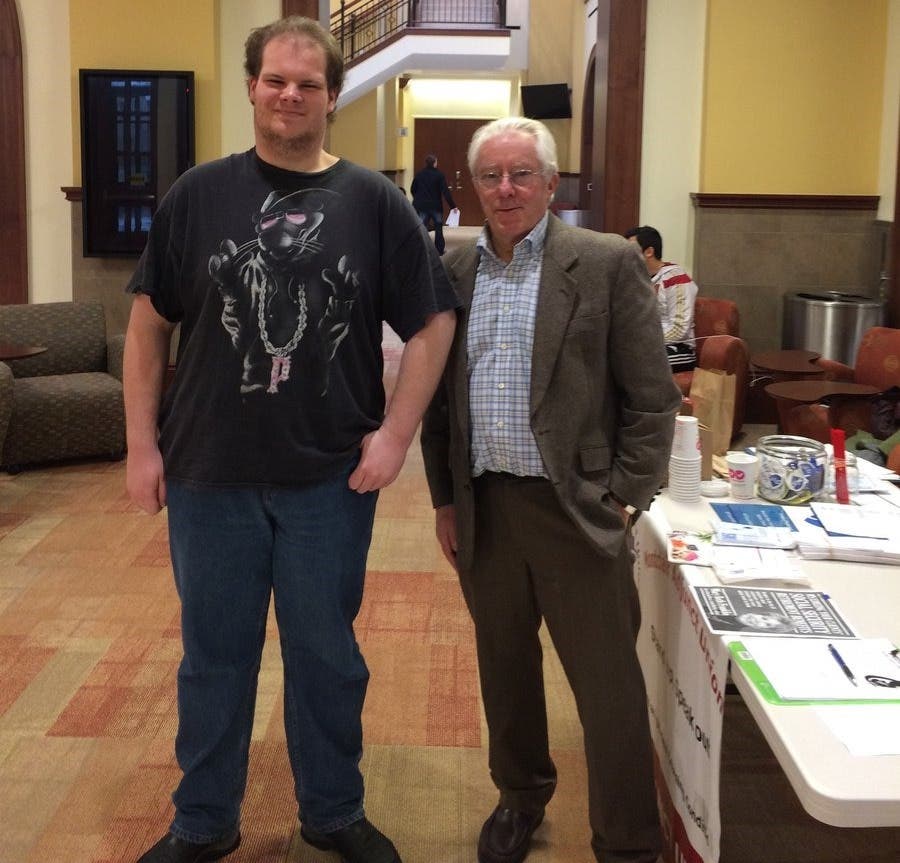
Photo of Bob Noonan, right, and a student supporter of the adjunct teachers at MSU, courtesy of the Montclair Adjunct Union AFT Local 6025
Get more local news delivered straight to your inbox. Sign up for free Patch newsletters and alerts.