Schools
'Citizenship Rutgers' Walks Prospective Citizens through Complex Process
More than 500 legal permanent residents have found help at Eagleton Institute's free events.


By Fredda Sacharow, Courtesy of Rutgers Today
A pioneering program of Rutgers’ Eagleton Institute of Politics is looking to take the hurdles out of the process of becoming an American citizen – or at least wrestle them down to manageable size.
Working with a team of volunteer lawyers, faculty, staff, students and alumni, Citizenship Rutgers offers one-stop workshops that provide the tools legal permanent residents need to proceed through the maze that confronts them.
Find out what's happening in New Brunswickfor free with the latest updates from Patch.
“Sometimes fear holds people back. It is kind of a daunting bureaucracy, and I say this as an immigration attorney who’s used to navigating this landscape,” says Joanne Gottesman, clinical professor of law at Rutgers Law School-Camden and director of the school’s Immigrant Justice Clinic.
More than 500 prospective citizens from 60 nations have taken part in the statewide program since its inception in April 2011. Workshops take place on Rutgers campuses in Newark, New Brunswick and Camden.
Find out what's happening in New Brunswickfor free with the latest updates from Patch.
They are geared to state residents – many of them members of the Rutgers community -- who have their green cards and have lived in the United States for five years (three years if they’re living with and married to a U.S. citizen), making them qualified to naturalize as full citizens.
“Abundant evidence shows that immigrants who become citizens earn higher wages and have higher rates of civic engagement,” says Anastasia Mann, an assistant research professor who is on leave from her position as director of the Eagleton Program on Immigration and Democracy. “Becoming a citizen is good for the individual, and it’s also good for the community.”
The tri-campus collaboration is modeled on a similar initiative at the City University of New York that has been going strong for more than a decade, Mann says.
“We know New Jersey has one of the most diverse immigrant populations in the country,” she says of the state’s 600,000 green card-holders, most of whom are already eligible for citizenship. “Since we are a public university, this is a great opportunity for Rutgers.”
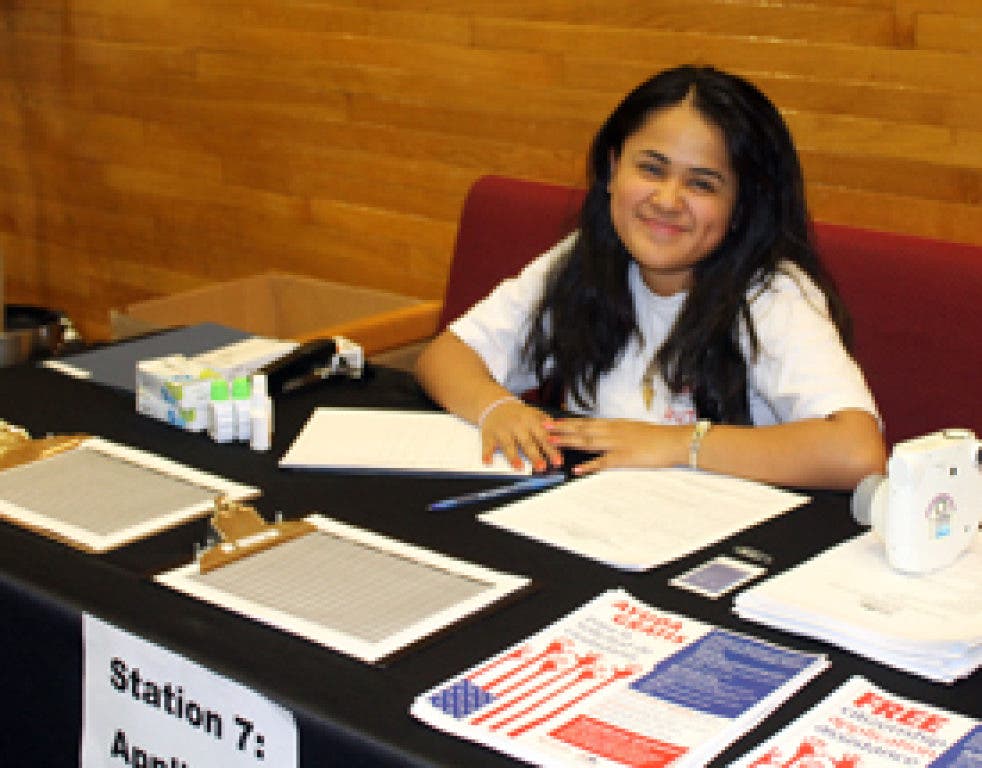
Organizers describe the three-hour workshops as lively, multigenerational affairs, with grandparents toting toddlers and applicants moving from station from station as they have their documentation reviewed and their questions answered.
In one part of the room, volunteer lawyers are screening applicants to make sure they meet certain requirements; hopefuls must be at least 18 and must have remained in the United States for at least half of the five- or three-year period. In another area, volunteer photographers are shooting passport photos.
Everywhere, there’s a buzz of excitement and energy.
“It’s an intensely feel-good atmosphere,” Mann says. “This is a big step for the applicants – becoming a citizen will be a highlight of many of their lives.”
The alumni and students who volunteer share a sense of camaraderie, adds Randi Chmielewski, Eagleton's events and special projects coordinator. "The atmosphere at these workshops is inspiring and gratifying."
Andrea Huerta, a senior at Rutgers-Newark majoring in political science, is an AmeriCorps Fellow at Eagleton who’s likely to be found translating from Spanish to English for applicants at the workshops. (In order to pass the citizenship test itself, however, applicants except those exempt due to age will be required to pass an English-language test.)
The daughter of immigrant parents who came from Puebla in central Mexico in 1989, two years before she was born, Huerta says helping immigrants become citizens gives her an enormous thrill.
“The assistance is very much needed,” she says. “A lot of people would like to seek the help of an attorney, but it might be too costly. Everybody I work with at the events is very appreciative – not just that it’s free, but that it’s something they can rely on. Coming to Rutgers feels safe; they know they will get reliable guidance.”
Count Maribel R. Granja among Citizenship Rutgers’ most satisfied customers.
The 2012 Rutgers graduate, now a candidate for a master’s in public health at Columbia University, was 4 when her parents brought her here from Nicaragua. “I decided to apply for citizenship because over time I’ve come to appreciate this country as if it were my own,” Granja says.
The longtime New Brunswick resident says program volunteers spelled out how the entire naturalization process works, and walked her patiently through every step.
“They were very friendly and attentive, and with their assistance I completed a successful application. My citizenship came through about six months after the event,” she recalls.
Like others who have made similar journeys, Granja considers that day one of the most transformative of her life.
“When I finally had my naturalization certificate in my hands, I knew that from that point on the world would finally see me and treat me at the citizen I always felt I was,” she says. “I felt that everything my family had to endure to bring me here had been worthwhile.”
Citizenship Rutgers is a project of the Eagleton Institute of Politics; Rutgers School of Law-Camden; Rutgers School of Law-Newark; the Center for Migration and the Global City, Newark; and Rutgers School of Management and Labor Relations. The next workshops will take place Saturday, March 30, at Camden Campus Center; and Saturday, April 6, at Rutgers School of Law-Newark. Registration is required.
Get more local news delivered straight to your inbox. Sign up for free Patch newsletters and alerts.