Arts & Entertainment
Creating Art Brick by Brick
Brick and mortar are things of wonder in the sculptures of Rory Mahon, now on display at the Arts Council of Princeton.
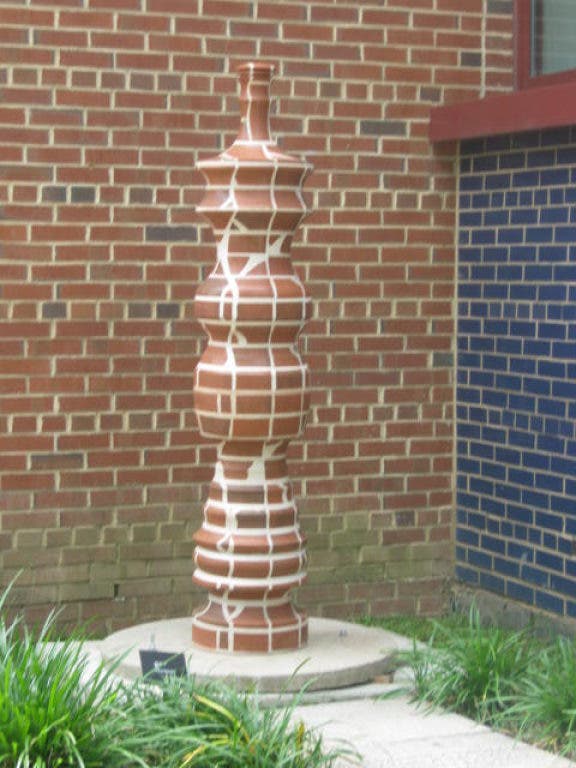


When artists talk about suffering for their work, it’s not a broken wrist that comes to mind, but that’s the very injury Rory Mahon sustained while creating one of his works.
He was almost finished making his brick sculpture titled “Brick Bollard,” when the wheel on his grinder exploded and sent chunks of stone flying. A plum-sized piece of stone hit his wrist and as painful as that is, Mahon says it could have been much worse.
“A lot of it went into my face but because I was wearing a good-quality face shield,” Mahon says. “I was protected from what would have been a very bad accident, involving facial disfigurement or blindness, something bad would have happened to me for sure.”
The impact, he says, felt like he was punched by a heavyweight prizefighter and knocked off his face shield. It wasn’t until he recovered from the shock of the incident that he noticed the pain in his wrist.
“Brick Bollard” is now part of an outdoor installation of Mahon’s work at the Arts Council of Princeton’s Paul Robeson Center for the Arts that will be on display through December.
Sculptures like “Brick Bollard” begin with a pile of loose bricks, which the artist puts together into a solid block, then carves into shape with blades and body grinders. The last step is to finish them with diamond polish. The result is brickwork that is smooth and rounded, instead of square and rough.
“I think it’s a great material and when you look closely, there are lots of colors inside the brick,” Mahon says. “There’s real beauty inside the brick and that surface when polished, I think is very inviting.”
The sculpture “Labyrinth” is made of two parts, a cylindrical base of white bricks and red mortar on top of which is a large, oval of red brick and white mortar. The contrast between the brick colors is interesting, but the real beauty, Mahon says, comes with looking into the holes he carved into the oval.
“It’s really about interior space, it’s called ‘Labyrinth’ because there is a series of four channels that connect,” Mahon says. “When you look inside, you can see light coming from the distance, but you don’t see the exit. It’s about hope, seeing that there’s light at the end of the tunnel so to speak. When you look inside you can see that there’s a way out and that can be a metaphor for so many things.”
In addition to the curvy and smooth appearance of the brick, Mahon’s works feature spaces where the mortar pattern strays from the usual rectangle surrounding a brick. An oval swirl is on the top part of “Labyrinth” and interesting mortar patterns are seen in “Bollard.”
Those patterns represent space between bricks. They form after Mahon cuts into the brick. Mahon says he actually had an idea of how the patterns in “Bollard” would form because of a 3-D modeling software he used to create an image he gave to the Arts Council to provide an idea of what the piece would look like.
“I had a very good idea but it almost doesn’t matter because I kind of know in my head, it’s going to be nice no matter what,” he says. “I don’t need to know.”
The third brick piece in the installation is “Constantin, Isamu and Me,” which is a tribute to two sculptors Mahon admires, Constantin Brancusi and Isamu Noguchi. Mahon’s piece features two sections, the bottom influenced by Brancusi and the top’s twist-like appearance representing Noguchi’s work.
This piece is something of an exception for Mahon in that it’s clearly influenced by other artists, something he tries to avoid, to the point that he won’t look at books of the works of Andrew Goldsworthy, one of his favorite artists. One of the reasons Mahon started making his brick sculptures is because he hadn’t seen anyone else do it.
Find out what's happening in New Brunswickfor free with the latest updates from Patch.
"The last thing I want to do is show people something that already exists,” he says.
Mahon does much of his work at the Hopewell home he lives in with his wife Ayami Aoyama, a stone carver. He works at the Princeton University Art Museum, helping to set up and take down exhibits, and is also a photographer.
His fourth work on view at the Paul Robeson Center is the cast-iron piece “Venus Vessel.” Cast-iron is Mahon’s usual medium, he started his brickwork about two years ago.
“I made it around the time my wife was pregnant with our first son,” Mahon says, “because I started doing a lot of photography and a lot of sculpture, mostly photography, revolving around fertility.”
Find out what's happening in New Brunswickfor free with the latest updates from Patch.
Rory Mahon’s works are on view outside the Arts Council of Princeton’s Paul Robeson Center for the Arts, 102 Witherspoon St., Princeton. For information, go to www.artscouncilofprinceton.org.