Neighbor News
New Jersey District Aims For Every Child Reading Well
NJ dyslexia therapist shares her district's winning strategy to increase reading engagement in struggling learners by 36%.

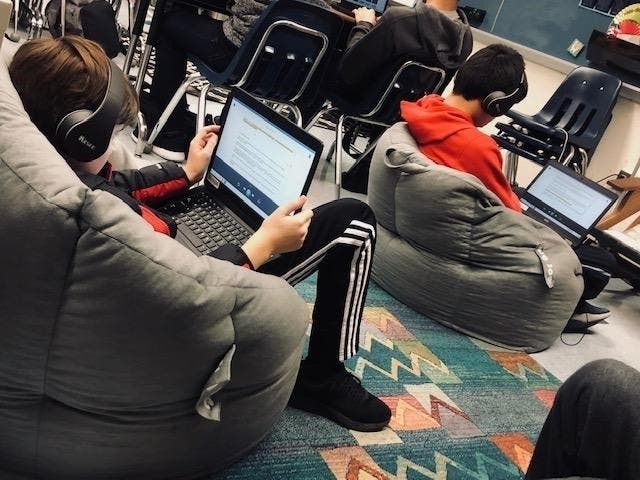
Joelle Nappi, a Dyslexia Therapist for Dwight D. Eisenhower Middle School, in Freehold Township, NJ is an avid user of audiobooks for reading and learning.
After her school embarked on an initiative to ensure more students with reading deficits received grade-level text in digital format, she saw marked improvements in their reading frequency and self-esteem. “We won’t stop until every child feels confident as a learner,” she says.
Students in Ms. Nappi’s classes are not proficient readers and spellers, and are often unable to keep pace with classwork. “Reading can be a super hurdle for some students. Many times, they would rather do anything else. At this age, if they cannot enjoy great stories and if they are not exposed to rich language and complex literary structures, they are likely to be turned off to reading for good.”
Find out what's happening in Princetonfor free with the latest updates from Patch.
Beyond Leveled Readers - Target Instruction with Accessible Curriculum
To prevent this scenario, Ms. Nappi uses programs like the Wilson Reading System, Project Read®, and Learning Ally for accessible literature. The goal of the interventions is to promote reading accuracy (decoding) and comprehension, as well as spelling (encoding) skills for students with word-level deficits. The interventions also teach phonemic awareness, alphabetic principles (sound-symbol relationship), word study, spelling, non-phonetic/high frequency words, fluency, vocabulary, and comprehension. “Students with dyslexia and readers who struggle need targeted instruction that directly teaches the sound-symbol relationship using controlled, decodable text while they are growing their decoding skills. In addition, they need to listen to self-selected grade level texts.” Nappi points out how vital good comprehension skills are to learning success.
Find out what's happening in Princetonfor free with the latest updates from Patch.
“We simply cannot just give leveled texts and ask students to read more in the hopes that this will improve outcomes. Coupling targeted structured literacy interventions with audiobooks of novels and literature, above a student’s independent decoding level, has been critical to our students’ reading growth. Every struggling reader should receive tiered supports, including modifications, technology accommodations, and accessible books.”
Jumping on the Accessible Book Bandwagon
She credits her principal, colleagues and parents for jumping on the accessible book bandwagon. At first, there was some skepticism, but through progress monitoring on the Learning Ally teacher dashboard, she was able to report sustainable growth in her students’ reading performance in reading frequency, vocabulary and the number of books read.
Changing Reading Habits to Increase Reading Engagement
Reading data confirms that her 6th, 7th and 8th graders improved in reading engagement on average by 36%. And, some students now read on or above grade-level and study in general education Language Arts classes. Students, who never saw themselves as readers, read regularly and show marked improvements.
“Human narration in the Learning Ally audiobooks has helped my students improve comprehension and fluency skills by following highlighted text and listening to appropriate modeling of phrasing and intonation,” she says. Ms. Nappi recommends six to eight weeks to create new reading habits. “Listening to audiobooks coupled with direct instruction in the alphabetic code at students’ decoding level, is having a positive effect in my district.”
District-Wide Usage
Seeing the transformation in her students, her district leadership broadened their access of Learning Ally to support students at every grade level on a district-wide basis. Ms. Nappi says, “We are proud of the amount of reading that is taking place. This investment in accessible literature to enable all children to read well is a perfect example of the mindset that sets Freehold Township Schools apart and can be a model for more schools in our area and in our country.”