Community Corner
A Community Pulls Together: Life in Ridgewood During WWII
The Second World War changed the way the village operated


[Editor's note: Ridgewood has seen many wars come and go. With each new conflict, residents headed off to join the fight, sometimes triumphantly returning, sometimes not. Here, we take a look at what life in Ridgewood was like during World War II, a very interesting time in the community.]
According to first-hand accounts in the library's Heritage Center, the attack on Pearl Harbor came during a warm, quiet Sunday in Ridgewood in 1941. Most residents expected the war that followed to be brief; few anticipated the shortages of sugar, stockings, gasoline and rubber that would ensue.
“I thought the war would pass by us,” said Joe Vrana, a Ridgewood resident who was drafted in 1943 and later served at the Battle of the Bulge. “I just waited for the government to come get me.”
Find out what's happening in Ridgewood-Glen Rockfor free with the latest updates from Patch.
Newspaper articles and scrapbooks in the library’s archives and Heritage Center preserve the feel of daily life in the village during wartime. With the Wright Aeronautical Plant just a few miles away and a Nike missile station in Mahwah, fear of enemy bombers was constant.
“There were spotting camps in town,” said Peggy Norris, a Ridgewood historical librarian. “And there was some kind of camp in the southwest part of town. A resident said she remembered, as a little girl, bright spotlights in the sky.”
Find out what's happening in Ridgewood-Glen Rockfor free with the latest updates from Patch.
With air raids in mind, blackouts—in which every house had to extinguish all visible light—were scheduled and enforced. The Civilian Defense Force trained high schoolers to be aerial observers and placed them on rooftops. All outdoor lighting was banned, and streetlights were painted black, allowing only a small circle of light to illuminate the ground.
“Army bombers were sighted for the first time in a blackout in this vicinity, to observe the effectiveness of the trial,” reported the Ridgewood Herald-News in June of 1945.
The rationing of food changed life in the home. In place of butter, stores sold margarine packaged with a yellow color capsule, which could be kneaded together. It was an unwelcome change for many residents.
“My father said he would eat only butter,” wrote one woman. “So mom very carefully colored the margarine and shaped it into a butter bar.”
Silk and nylon were both rationed, needed by the military for use in ropes and parachutes. Stockings suddenly became scarce, and when they could be found, expensive. One account by a Ridgewood resident tells of an entire kindergarten class chipping in to buy a beloved teacher a pair of nylon stockings, moving her to tears.
Meat was also in short supply, and as shortages worsened near the end of the war, there were fears that vegetables would become similarly hard to find. Ridgewood residents grew "victory gardens" when possible, harvesting their own vegetables to ease the strain on food production. In 1943, wartime shortages forced the Ridgewood news to raise its price to 5 cents per issue.
Ration boards strictly governed the use of gas, causing cars on the street to become an almost uncommon sight. In 1945, the Mileage Administrator of the Office of Price Administration singled out Ridgewood for making an outstanding reduction in gas usage. Local newspapers boasted of the achievement, giving the town pride in the sacrifices it had made for the national war effort.
“The government really got on a war footing,” said Crandon Clark, a Ridgewood resident who served in the war. “You were forced to do it, rather than drag your feet. The gas rations made it tough to get around, but people understood what it was for. And we were never hungry.”
Ridgewood had organized quickly, and those who could not serve overseas found roles to play at home. In January of 1942, the Ridgewood Defense Commission was formed to train women to work as air raid wardens, nurses and therapists. The group made a request through the newspapers for donations of shortwave radios, to be used in case normal lines of communication were disrupted.
“My grandmother had a deck of cards, and the backs were silhouettes of planes with the identifications on them,” said Norris. “You could be playing cards, but you were also learning what the planes looked like.”
The town took pride in the men it sent away, and crowds gathered when draftees left in groups. When a contingent of selectees left Ridgewood Draft Board Number Three for training at Fort Dix, the mayor gave a speech advising them to “avoid evil companions, stay away from places that sell booze, and always keep an eye on the next step ahead.”
As they boarded the waiting buses, a man read off the names of the men, tossing them a pack of cigarettes each time he blundered a pronounciation.
Unfortunately, not all the men who left came back.
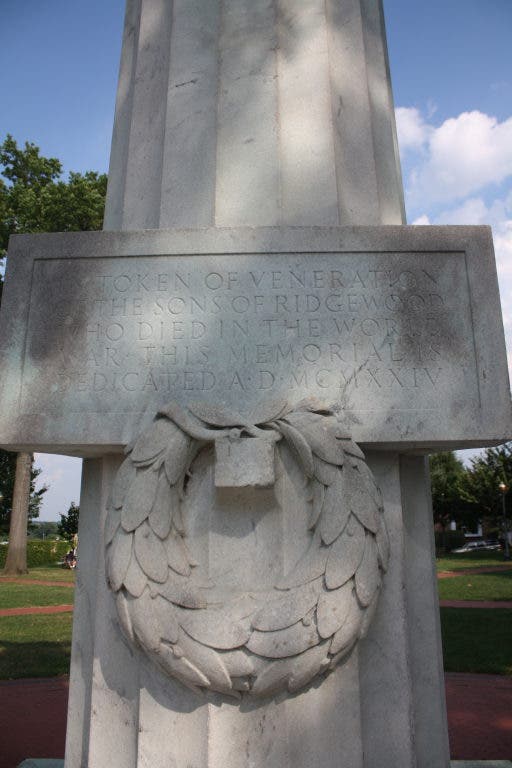
“The names of the servicemen who died are on the War Memorial in Van Neste Park. That was originally erected as a WWI memorial,” said Norris. “People thought that was going to be the last war.”
[Correction: The Wright Aeronautical Plant was mistakenly named "Wright-Paterson Air Force Base. The correction has been made.]