Community Corner
Marsh Plants and Mussels in the Hackensack Meadowlands
A local professor investigated how a mussel responded to an invasive plant species.
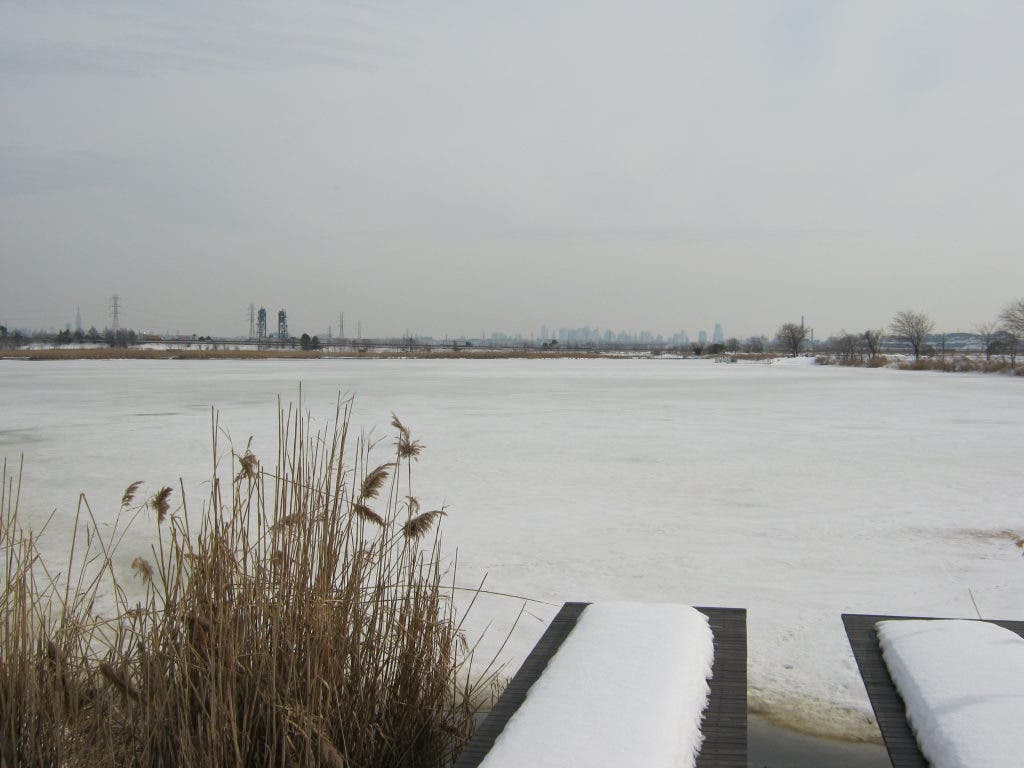
The Hackensack River is tidal south of the Oradell Dam. If you look at satellite images of the Hackensack River, you'll see that it is surrounded by development in Hackensack. Look farther south, and you'll see development give way to greenery on the banks of the Hackensack River.
Near the Meadowlands Complex in East Rutherford, the scenery becomes the Hackensack Meadowlands. Saw Mill Creek is one tributary of the Hackensack River in the Hackensack Meadowlands. It runs along the southern border of Lyndhurst.
Dr. Marion McClary Jr., a biology professor at Fairleigh Dickenson University, chose Saw Mill Creek as the location for his research on marsh plants and mussels.
Find out what's happening in River Dellfor free with the latest updates from Patch.
He selected two wetland plants for his study. The first, Spartina alterniflora, is native to the Hackensack Meadowlands. The other plant, Phragmites australis, arrived in the Hackensack Meadowlands more recently. Other researchers had documented how marshes change when P. australis colonizes a region. The P. australis alters the soil and water conditions of the ecosystem. Some plant and animal species suffer from the presence of P. australis while other species become more abundant after it colonies a marsh. Dr. McClary set out to compare how a mussel, Geukensia demissa faired near the native S. alterniflora and the invasive P. australis.
McClary investigated the G. demissa on four separate occasions. During each trip, he found the average number of G. demissa per square meter of S. alterniflora stands and the average number of G. demissa per square meter of P. australis stands. This process involved marking off rectangular plots called quadrats and counting the number of G. demissa within each quadrat.
Find out what's happening in River Dellfor free with the latest updates from Patch.
On each trip, Dr. McClary measured 4 quadrats that had the native S. alterniflora and 4 quadrat that had the invasive P. australis. Dr. McClary's results indicate that G. demissa does not suffer from the presence of P. australis. On three of the four occasions, G. demissa was slightly more abundant in the quadrats with P. australis, although the difference was not large enough to be significant.
On the remaining occasion, G. demissa was significantly more abundant in the quadrats with P. australis. Thanks to Dr. McClary's research, we now know that this mussel has weathered the introduction of P. australis rather well.