Politics & Government
Lawn Signs Meet Constitutional Law
Patch discovers just how constitutional the rules regulating political lawn signs are.

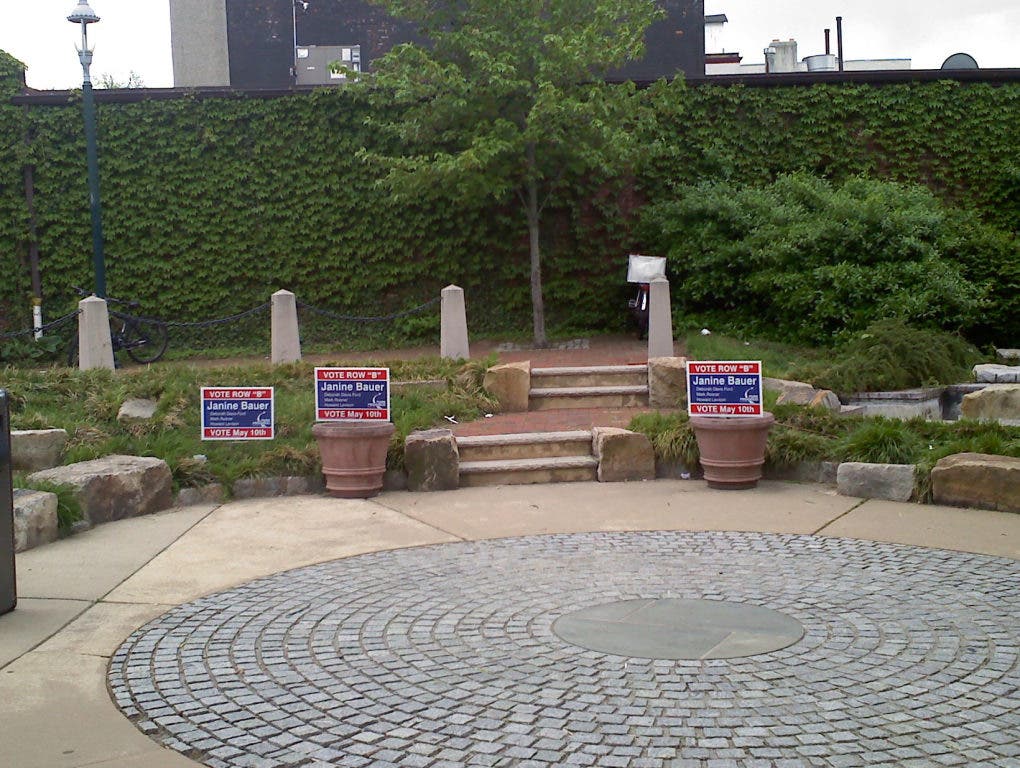
Since June 27, South Orange residents may have noticed a familiar ordinance on the agenda of every Board of Trustees (BOT) meeting. Ordinance 2011-11, which later became Ordinance 2011-12, has been either tabled or voted on in every meeting since that initial reading in June, failing to pass every time.
The ordinance amends Section 92-163B(1)(a) of the Code of the Township of South Orange Village to delete the requirement that only one political campaign sign be permitted in residential districts. It also repeals Section 92-162B(9)(c)[4] of the Code of the Township of South Orange Village which requires a notice of intention to display political signs and requires a payment of a fee of $25.
The ordinance became an issue in the 2011 election for Village President when the town tried to charge then-candidate Alex Torpey a fee. Torpey, after refusing to pay the fee, asked the clerk’s office to check with Village Counsel Steven Rother about the constitutionality of the fee. Rother confirmed that it was indeed unconstitutional and waived the fee.
Find out what's happening in South Orangefor free with the latest updates from Patch.
On June 13, Rother brought up the ordinances during a , stating that the town needed to repeal them in order to comply with the law of the country. This did not sit well with some trustees.
“One of the things I always liked about the registration, it’s a nominal fee, and this way someone’s accountable if there’s a problem,” Trustee Michael Goldberg said at the time. “This way if signs are left up for six weeks after an election or an event, you know who to go to; you know who’s responsible for it.”
Find out what's happening in South Orangefor free with the latest updates from Patch.
At the , the ordinance to repeal the fee, permit and sign limits was brought to a vote and was defeated 2-4 with Trustees Janine Bauer and Deborah Davis Ford being the only ayes. On July 11, it was reintroduced and tabled until July 27, only to be tabled again until September 12. At that meeting, it was defeated 2-3 with Trustees Michael Goldberg, Mark Rosner and Nancy Gould voting nay.
Recently, Patch contacted Thomas Healy, a professor at Seton Hall Law School, to ask him about the section of the code in question and whether it was constitutional. Healy, a professor at Seton Hall Law for eight years, teaches the first-year course in Constitutional Law at Seton Hall, in addition to upper-year electives in First Amendment, Federal Courts, and Criminal Procedure. He has been published in numerous publications and his articles tend to focus on matters of freedom of speech.
“The fee violates the First Amendment,” Healy wrote via e-mail. “Although cities may sometimes charge fees to defray reasonable costs incurred by the city, there are no costs to defray in this situation."
While the BOT generally agrees with striking the fee, it’s the accountability, or lack thereof, that troubles some of them. Healy explains why, despite the trustees concerns, they are blocked from requiring permits for candidates.
“The requirement that the candidate obtain a permit in order to display political lawn signs violates the First Amendment,” Healy wrote. “First of all, because this requirement only applies to campaign signs, it discriminates on the basis of content, which makes it presumptively unconstitutional. But even if it applied to all signs, it would infringe on the First Amendment rights of residents to display signs on their lawns. The Supreme Court has made clear that residential signs are an important part of the free marketplace of ideas and government cannot restrict their use without compelling reasons. I can see no compelling reasons that justify the requirement here.”
As for the amount of lawn signs allowed on residential property, this as well has been troublesome to some trustees. A fear was mentioned in previous meetings that residents will take advantage of being allowed to have as many political signs as possible on their lawn. As Healy explains, South Orange may limit on the number of signs, but prohiting a resident from posting just one is not allowed without a compelling reason.
“South Orange might be able to put an upper limit on how many signs can be displayed on a single lawn, but the number would have to be reasonable and justified by the city’s interest in avoiding excessive clutter,” wrote Healy. “A limit of one campaign sign per yard is definitely not reasonable. Nor is it justified by the city’s interest in maintaining the orderliness of its residential neighborhoods.”
Despite the rejection of the ordinance at the , Torpey, now the Village President, made it clear that South Orange would not be enforcing any ordinances that violate the constitution of the United States of America.
“This is to repeal a piece of our code that is unconstitutional,” Torpey said at the meeting, following the vote. “As the Chief Executive Officer of the Township of South Orange Village, I want to make clear that under my administration, there is not going to be enforcement of unconstitutional ordinances. I think we need to do this, we need to pass this. I don’t understand why we’re not passing this. It’s to repeal an unconstitutional piece of our code. People should not be concerned that the Village will be enforcing an unconstitutional piece of our code.”
The ordinance will now go back to the legal committee and trustees were advised to e-mail Village Counsel Rother with their concerns.
Get more local news delivered straight to your inbox. Sign up for free Patch newsletters and alerts.