Community Corner
Review: 'Windows to Heaven: Byzantine Icons' at the Walsh Gallery
Seton Hall's Walsh Gallery's latest exhibition features nearly 70 religious icons inspired by the Byzantine Church.


If you needed any more proof that good things can come in small packages, visit “Windows to Heaven,” an elegant, one-room exhibit of religious icons from the Byzantine, or Eastern, Rite of the Roman Catholic Church, currently on view at Seton Hall University. The nearly 70 objects assembled here, mostly painted images of biblical scenes, Jesus Christ, the Virgin Mary, angels and saints and their feast days, exude a contemplativeness and respite from everyday chaos that I have rarely found even in larger, more ornate, houses of worship.
Like the “stories” contained in the stained glass and statuary of the Latin, or Western, Rite of the Church, these richly colored icons are viewed as visual scriptures: teaching tools, as well as instruments of prayer, communication and veneration. But for the Byzantine faithful, the objects go one step further. They are considered windows into the divine world, a visual bridge from earthly, human concerns into heavenly ones. They are also profoundly beautiful.
I was surprised, but for some reason delighted, to learn that the creation of the icons involves not just applying paint to wood or enamel, but a process of fasting, prayer and ritualistic painting; in fact, they are said to be “written,” rather than painted. It made me smile to read that the opening, jaw-dropping piece, a sumptuous reproduction of Andrei Rublev’s "The Three Travelers," full of luminous golds and pinks, was written in the 15th century, in tempera on wood.
Find out what's happening in South Orangefor free with the latest updates from Patch.
Many other icons in the exhibit, which is curated by Sasha Makuka and Allison Stevens, graduate students in the museum professions department at Seton Hall, are paintings on wood as well, reproductions of 15th to 19th century originals in the Russian style. The figures’ elongated bodies, small, highly stylized hands and facial features, and the unusual flatness of the images give the paintings an other-worldly feel. Gold, representing the radiance of heaven, is a prominent color, as are red and blue, which symbolize a figure’s divinity and humanity, respectively. The paintings have no shadows, indicating the lack of darkness in heaven.
Another standout among the paintings, in addition to "The Three Travelers," is a version of "The Black Madonna of Czestochowa," one of the few Polish pieces in the exhibit. It’s much darker than the other icons, its background forest green, rather than the more common gold. Mary’s robe is a deep blue (humanity) and Jesus’s is a rich red (divinity); both are dotted with gold fleur de lys symbols that look like stars in the night sky. The original icon was slashed by attacking Hussites in the 1430s. In this 20th century reproduction, the offending slash marks are retained.
Find out what's happening in South Orangefor free with the latest updates from Patch.
Another notable item is a series of small papier mache and lacquer triptychs, from the personal collection of Seton Hall’s own Father James Spera, whose contributions can be found throughout the gallery. Trust me when I say that these are nothing like the papier mache you and I made in school, even if you went to art school.
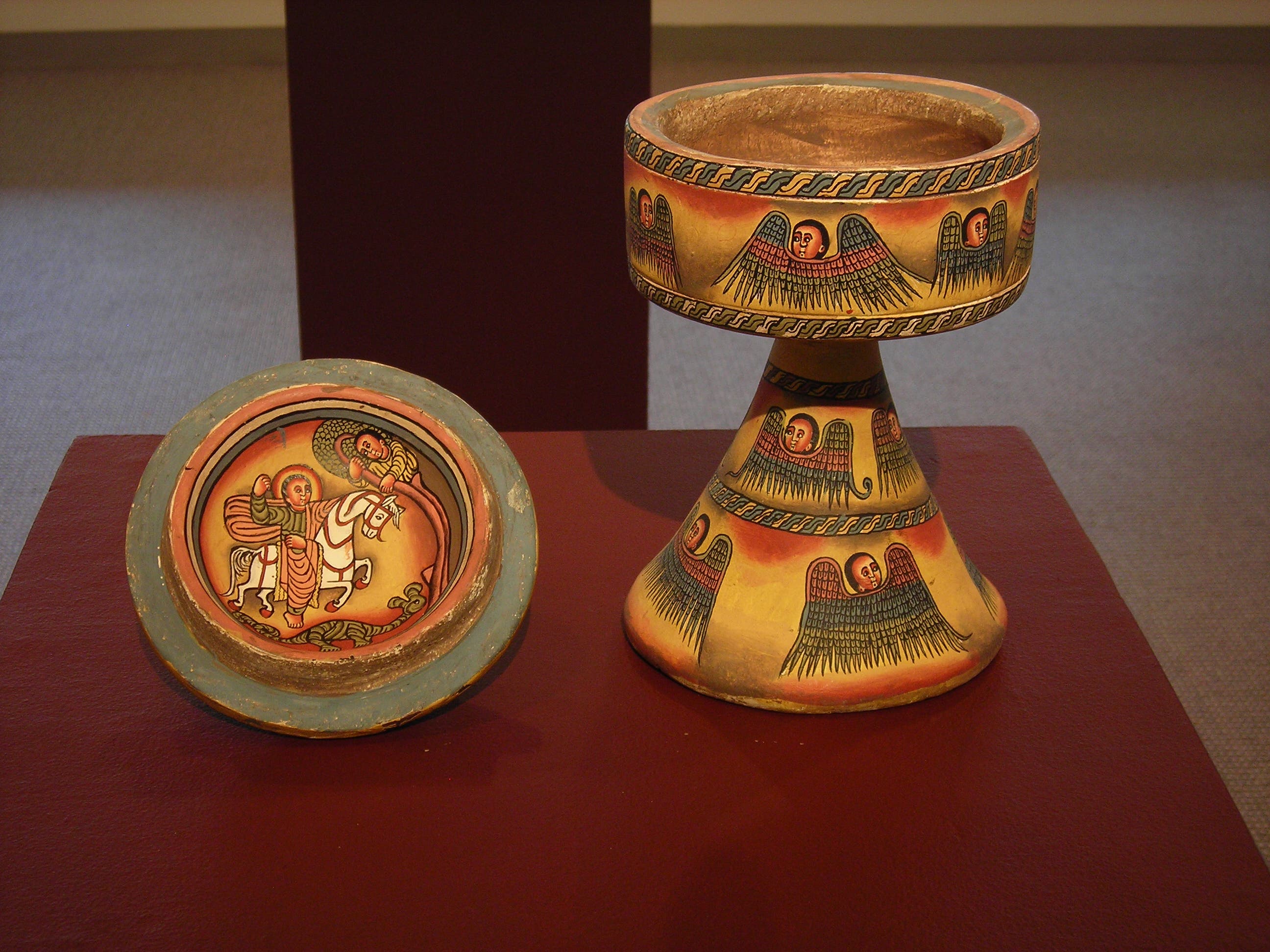
Also not to be missed are the Russian-style painted eggs, a chalice and bread plate with enamel icons of Mary and Jesus in pale blues and aquas, and a charming painted wooden chalice from Ethiopia, depicting the story of St. George and the dragon.
My favorite piece here, however, may be “Our Lady of the Sign,” a large framed icon written in 1970 in the Ukranian style. One of the only mosaics in the exhibit, its luminosity comes not from gilted paint, but from the reflection of light on hundreds of vibrant blue, red and gold tiles depicting Mary and Jesus. It’s as if behind the icon there was a window, rather than a wall, and the sun was streaming in through it, lighting up the room.
“Windows to Heaven” is on view at The Walsh Gallery, Seton Hall University, 400 South Orange Ave., through Oct. 16. Visiting hours are Monday through Friday, 10:30 a.m. to 4:30 p.m. (calling ahead is advised). A symposium, “Journey to the Holy Icon,” featuring Father Joseph Bertha, Ph.D., and organized by Dr. Marta Deyrup, will be held on Saturday, Oct. 10, from 10 a.m. to noon in The Walsh Gallery. For information on the symposium and to RSVP, call 973-275-2223. For questions regarding the exhibit, contact Jeanne Brasile at 973-275-2933.
![2,325 Students Earn Diplomas From Seton Hall University [WATCH]](https://patch.com/img/cdn20/users/22844250/20260519/032716/styles/patch_image/public/55278277363-6da6b3e950-o___19152531198.jpg)