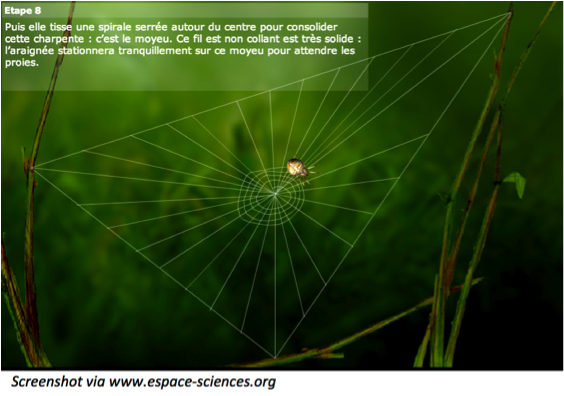
Not all of us love looking at real spiders up close. Thankfully, this cartoon video does a great job of showing how a spider builds a web, and with just a cute green drawing as the spider. It's pretty amazing to see how they build. If you've ever seen a real web, it has bigger and bigger rings of threads stretched across spokes that stick out from the center, like a bicycle wheel. What's amazing is the order in which the spider puts it in place. The spider first has to stretch the edge pieces; then it has to connect a thread from the middle of each back to the center, dividing each section into triangles. And since spiders can't fly, they have to walk to the middle of each strand, attach the silk, then walk all the way to the end, walk to the center, and reattach there. Now we see why spiders don't need to go to the gym for extra exercise.
Now here's today's math~
Wee ones: If a spider makes 4 threads that all touch to make a closed shape, what are all the shapes that could be?
Little kids: If a spider makes a triangle around the edge, then draws a thread from each corner to the center, how many threads did the spider make in total? (You can count them as separate pieces, even though they're probably one continuous silk.) Bonus: If the spider now connects the middle of each edge to the center also, how many triangles has the spider made - including the first big one?
Find out what's happening in Summitfor free with the latest updates from Patch.
Big kids: If the spider connects the tips of 2 9-inch long sticks in the air, it has to walk up the 9-inch stick, connect the thread, walk back down the stick, walk up the other 9-inch stick, and reconnect. At that point how far has the spider walked just to make that 1 side? Bonus: If the spider's web ends up having 48 inches of thread, and the spider had to walk double that distance to make the web, how far did the spider walk in total?
Find out what's happening in Summitfor free with the latest updates from Patch.
Answers:
Wee ones: Lots of choices to talk about: square, rectangle, diamond/rhombus, trapezoid, parallelogram...
Little kids: 6 threads: 3 around the edge, then 3 more from each of the 3 corners. Bonus: 7 in total: the big one, plus 6 little ones (each of the first 3 little triangles gets cut in half to make 2).
Big kids: 27 inches, since it has walked the stick length 3 times. Bonus: 96 inches of walking.