Schools
BOE Reorganizes, Members Outline Priorities
Raising GPA requirement for extra-curricular activities, new charter school are some of the items BOE members plan to review.
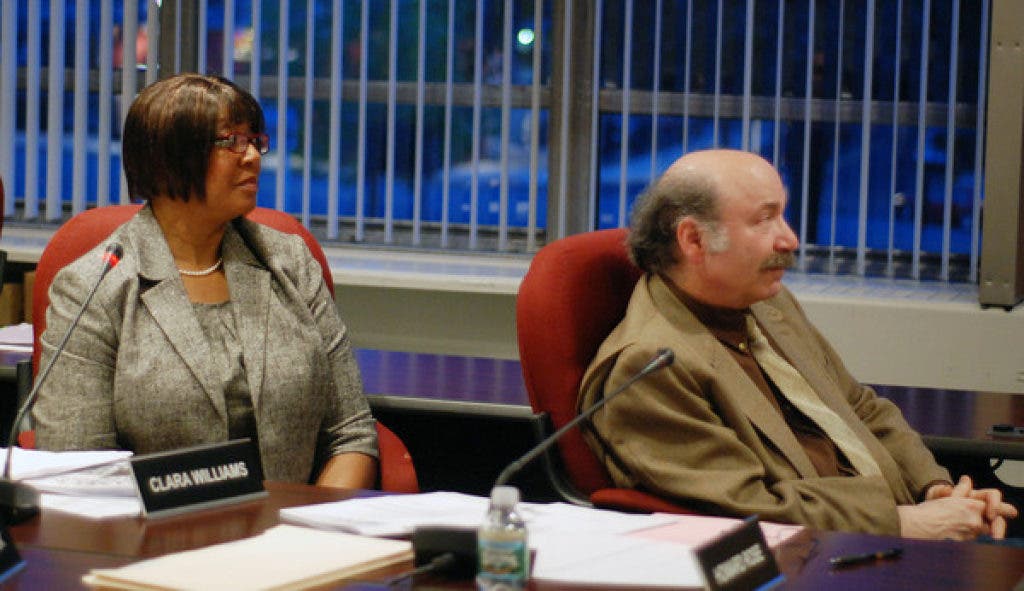
Two weeks after the Teaneck Board of Education , two new members are easing into their roles, while the remaining members who spoke with Patch said improving academic achievement continues to be their top priority.
On April 27, Voters also selected Howard Rose and Clara Williams to begin their first terms on the Board.
The budget passed with 2,903 votes, compared to 1,423 votes against it, according to the results.
Find out what's happening in Teaneckfor free with the latest updates from Patch.
Walser was sworn in last week as president of the BOE – a role he held for the 2010-2011 school year. Gervonn Rice also retained her position as vice president of the board.
The remaining five members on the board include trustees Henry Pruitt, Margot Fisher, Sebastian Rodriguez, Herbert Burack and David Diuguid. Burack declined to comment for the article, and Diuguid did not return messages seeking comment.
Find out what's happening in Teaneckfor free with the latest updates from Patch.
ROSE AND WILLIAMS
Beginning their first terms, Rose and Williams both said they were happy to be a part of the current board and found few surprises during their first BOE meeting as trustees.
“Information was exchanged and votes were taken,” said Rose. “I’ve been to many meetings as a resident, but there is a change when you take on the responsibilities of a trustee.”
Williams said the “synergy” of the prior board was one reason she wanted to run for a BOE seat.
“They’re all committed to the students of Teaneck,” she said. “I’ve observed how they work together and come to a consensus and move forward on matters.”
Williams said she’d like to begin working on increasing involvement, awareness and contact between the school district and the community. Rose said his priority is to listen and learn from the board and gain some perspective.
“When you become a trustee, there’s a learning process,” he said.
ACADEMIC ACHIEVEMENT
Pruitt said his priorities remain academic achievement and improving test scores, as well as attracting more parental and community involvement.
He said the board is in preliminary discussions on raising the current 2.0 GPA for participation in extra-curriculum activities. He said he wasn’t sure what the GPA would be raised to, but he said “kids need to be challenged a bit.”
He said that when the required GPA for participation in extra-curriculum activities was raised from 1.0 to 2.0, there was some grumbling that kids would miss opportunities. “But we didn’t lose anyone,” he said. “And interestingly, kids aren’t fighting the concept.”
Pruitt said it’s important that the community knows more about the resources and programs available to students, such as .
ACE offers high school students who are interested in careers in architecture, construction or engineering the chance to meet with professionals and work on a project under their supervision.
ACE students are scheduled to present their year-end projects at the start of the 8 p.m. BOE meeting tonight.
CHALLENGES FOR THE BOARD
Fisher said she was pleased the budget passed and that Walser returned to his seat as president, and she welcomed Williams and Rose in their new positions.
She said the board faces challenges on two fronts.
“We need to make up for the $6 million that was lost last year,” said Fisher, referring to the $6.1 million in cuts that had to be made after voters rejected the 2010-2011 school budget. “The budget that was approved doesn’t restore what’s been lost. So, we’re still behind where we were in 2008. It’s very challenging. Not only are we unable to restore what was lost last year, but we also had to make further cuts.”
She said the Board earlier this year had no option but to , which raised concerns among some community members and parents.
Fisher said she strongly opposed that decision because “I see the custodians as valuable members of our school community,” she said. Ultimately, workers agreed to concessions, which .
“Our second challenge is fighting the ethnic, racial and gender achievement gaps, as well as the special education achievement gap,” Fisher said. “We hired a new special education director last year, Maureen Edwards, who has been excellent. She finds savings through shared services, while at the same time strengthening the services our district currently has in place.”
Fishers said she hopes that outside school districts eventually will send their special education students to Teaneck because of improved services.
GOVERNMENT POLICIES
Rodriguez said in an emailed response that the BOE will continue to address educational gaps and issues that affect the district and will work alongside Superintendent Barbara Pinsak and school administrators to provide a quality education to students.
Rodriguez added that Gov. Chris Christie and his policies have done little to reduce educational costs and lower taxes “as he promised.”
“In the last two years, we lost over $7.6 million based on ‘political decisions’ by the governor,” Rodriguez said in an e-mail. “Unexpectedly, in 2010 he took away $6.2 million in state aid and reserves. This year, the governor approved a charter school that could cost the Teaneck school district $1.4 million despite the fact the school is not needed, and the majority of people in the community are opposed to it. His decisions have forced the district to eliminate 45 positions as well as many programs, eliminate courtesy busing for grades 1-4 and consider outsourcing custodians.”
Rodriguez said that Pinsak is the right type of leader to address the internal issues affecting the district. In regards to state policies, he said the board needs to press Trenton and Christie at a grassroots level.
“We need to develop proactive working relationships with our local legislators to strengthen our position in Trenton, find ways to educate the public about how Trenton/governor are affecting public education and increase community involvement (including our students) to demand that decisions affecting public education are made with the best interest of students, not politics,” he said.
FOLLOWING THROUGH ON INITIATIVES
Rice said she was pleased with the outcome of the BOE election and gave credit to anyone who would run for office.
“I look forward to working with the new members,” she said. “I’m pleased with their stances and that they will be adding to the direction that our board is currently taking.”
Rice said the board seeks to be more proactive in sharing with the community about the activities that are happening in the schools.
“We hope this year we can clearly define the opportunities that the talented members of our vast, rich community can be engaged with in our schools,” she said. “The board is set on a clear direction, and we anticipate great gains with our leadership and gains that our community will be proud of.”
Walser said the first BOE meeting after the election went well and that Rose and Williams contributed right away with opinions and ideas.
He said the board and central administrative office are working to address student achievement.
From standardized assessments for grades K-12 that are designed to identity underperforming students to more relationships with professionals and agencies in the community, Walser said the focus is checking in on students constantly throughout their academic careers and following through when underperformance is identified.
SHALOM ACADEMY AND CHARTER SCHOOLS
In regards to the Shalom Academy Charter School, which is a topic that was brought up at various BOE candidates’ forums by residents, Walser said he thinks what people in the community are concerned about is the siphoning of funds from the public schools to the charter schools. The district .
“My concern is with the process – how it’s vetted, assessed, how you do the funding, do you follow the rules? The vetting is questionable, and the funding is questionable,” Walser said.
Walser said the focus should be more on the process, the assessment and the funding – not the children and parents who will be a part of the new charter.
“They are our neighbors and our friends – we don’t want this to be divisive,” he said.
Walser said the issue of starting a lawsuit against Shalom Academy or joining in the legal challenge already filed by Englewood public school officials has come up a few times.
“We’re investigating where we can use our limited resources to handle this,” he said. “You have to have something to sue, you can’t sue for free.”
Walser said at this point, Shalom Academy still hasn’t let the board know where their school is located and where their students live. “We can’t even set up a bus route—there’s no address for where to pick students up or take them," he said. "We wouldn’t even know where to send the summons.”
While the school's charter application indicates it will be located on Williams Street in Englewood, questions have been raised about if the proposed site is still available. School founder Raphael Bachrach, of Englewood, has not responded to numerous requests for comment.