Arts & Entertainment
'Hot Rod Lincoln' Rolls into Library
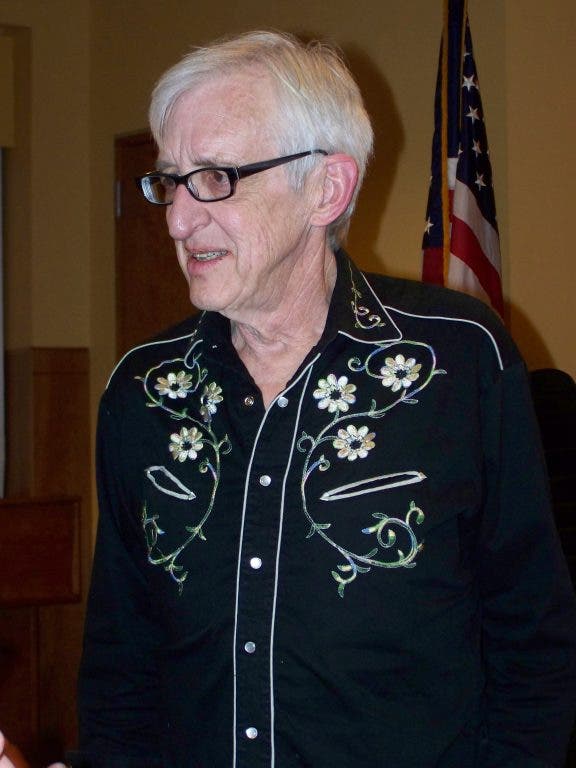
Bill Kirchen, co-founder of Commander Cody and His Lost Planet Airmen, perform to packed library hall


For decades, generations of people living in and around Toms River have bemoaned a familiar refrain. There’s nothing to do around here. It’s a cultural wasteland. At times, those unaccustomed to witnessing, or being part of, the great tide of humanity at some of the clubs on the other side of the Mathis bridge can feel that they have every reason to despair, especially in the dead of winter; however, those in the know are hip to a secret club that’s witness to some of the hippest musical acts to come through these parts.
That would be the library.
Last Thursday, those locals cool enough to be in the know saw Bill Kirchen play to a packed house in Mancini Hall at the Toms River branch of the Toms River library.
Find out what's happening in Toms Riverfor free with the latest updates from Patch.
Kirchen, the Titan of the Telecaster guitar, is justly famous for his guitar playing with Commander Cody and His Lost Planet Airmen, a band he co-founded in the late 1960s.
His unmistakable lead guitar playing on that group’s 1972 hit “Hot Rod Lincoln” is an apt introduction to his style of playing which has been called “dieselbilly”—a fusion of country, blues, rockabilly, western swing and boogie-woogie. Kirchen has since played with a veritable who’s who in music, including Nick Lowe, Elvis Costello, and Emmylou Harris.
Find out what's happening in Toms Riverfor free with the latest updates from Patch.
Kirchen charmed the audience like the polished professional he is. “I’m turning off my cell phone. I don’t care if I get a better offer, I’m staying with you guys,” he quipped from the stage.
With that, Kirchen swung into a little rockabilly swing number, “Bump Wood,” that epitomized his folksy charm: “When I wake up in the morning, then it's gonna be good/If I stick out my elbows and they don't bump wood.”
Kirchen elicited more laughs from the audience with a lengthy introduction to his song, “Talkin’ About Chicken,” where even seemingly mundane conversation can be construed as a sexual double entendre.
Kirchen then launched into “Hammer of the Honky-Tonk Gods,” a paean to his guitar of choice, the Fender Telecaster. “Born at the junction of form and function,” indeed; few guitar players are so closely associated with one guitar sound throughout their careers.
Local luthier, musician and guitar guy Paul Unkert, in the audience for the show, said, “I think he’s the greatest. He’s got the great Tele twang sound and we can’t get too much of that.”
Kirchen, backed by Jack O’Dell on vocals and drums and Maurice Cridlin on bass, swung into a couple of Bob Dylan covers. They were joined at one point by singer-songwriter Sarah Borges and guitar player Lyle Brewer, who had opened for Kirchen for a version of Dylan’s “Love Minus Zero/No Limit.” Kirchen then played another Dylan cover from the mid-1960s, “It Takes a Lot to Laugh, It Takes a Train to Cry,” which benefited greatly from Kirchen’s quiet singing and his delicate guitar solo played impossibly high on the guitar neck.
Kirchen told the story of how, as a teenager in 1964, he hitchhiked from Ann Arbor, Mich. to the Newport Folk Festival. “I saw all the people, Dylan, Mavis Staples and the Staples Singers, Son House, John Hurt. It ruined me for regular work. That’s why you find me busking at the public library.” And with that, he launched the band into a spirited “The Times, They Are a Changin’.”
Kirchen finished the evening with an extended version of his most well-known song, “Hot Rod Lincoln,” during which he soloed in the style of many prominent and familiar musicians in what was a mini-master class in guitar virtuosity.
After the show, a weary Kirchen seemed satisfied with how the show, his third at the library, went. “It was a blast,” he said. “It was a great thing, music in the library. I’ve been doing this a long time but I love doing it.”
There were scores of grateful music fans who were glad he did; the hall was packed to capacity.