Health & Fitness
Remembering America's Most Tragic Yet Sublime Day
Although 151 years ago today, the Battle Of Antietam remains our most tragic episode with more American lives lost on that one day than any other before or since. But the suffering was not in vain. From the ashes arose Emancipation and a better USA.



If you ask most Americans what was the bloodiest day in our history, you would most likely get either 9/11 or Pearl Harbor in reply. It would probably depend upon the age of the responder but it doesn’t matter for neither is correct.
In Western Maryland is a peacefully meandering creek called the Antietam. The scene is pastoral with rolling hills and farms dotted by occasional patches of woods. Nestled within these gentle ridges is the tiny hamlet of Sharpsburg. Stone monuments and bronze tablets dot the landscape. They seem strangely out of place here. Only some enormous event can explain their presence.
Find out what's happening in Westfieldfor free with the latest updates from Patch.
Almost by chance two great armies collided here. It was at the height of the Civil War. During the summer of 1862, Confederate General Robert E. Lee’s Army of Northern Virginia had fought and won a series of convincing victories first at Richmond and then 2nd Bull Run. Having driven the Northern invaders from his home state of Virginia, Lee’s army crossed into Northern territory for the first time. The Union Army of the Potomac under Maj. General George B. McClellan was out to confront and destroy them. On September 17, 1862 the two forces fought the Battle of Antietam to decide the issue. Their violent conflict shattered the quiet of Maryland ’s countryside. When the hot September sun finally set upon the devastated battlefield, some 23,000 Americans had fallen making this day the single worst act of mass killing of Americans in history. This single fact, with the heroism and suffering it implies, gives the markers and monuments their meaning. No longer do they presume upon the landscape, rather their mute inadequacy can only hint at the great event that happened here—and of its even greater consequences.
To comprehend just how terrible was the slaughter this day, we must consider that, though McClellan brought a host of 87,000 men to the battlefield to confront Lee’s mere 38,000 depleted ranks (from desertion or straggling), the Union commander only committed 50,000 of his men to battle. So the 23,000 losses in one day -- roughly 12,500 Union and 10,500 CSA -- represented over 25% casualties. (This was the same horrific attrition rate the 8th AF suffered in its disastrous raid on Schweinfurt in WW2). At the end of the day a Confederate diarist recorded that in the confusion and chaos their losses had been so severe that after the fighting subsided “half of Lee’s army was off searching for the other half.” But he was lucky to be alive.
The consequences of this battle were as monumental as the scale of the losses suffered. Although it is considered a tactical draw as Lee did hold the field—though barely by a thread—when merciful darkness finally brought an end to the fighting, it was clear his grievously wounded army would have to abandon any further invasion plans and limp back into Virginia. McClellan could claim a victory in that he ended Lee’s Northern ambitions and drove the aggressors from Union soil. But an abler general with his vast uncommitted reserves would have surely broken Lee’s army against the banks of the Potomac River at its back and ended the war.
Still the appearance of victory had far-reaching effects in the North’s favor. In July 1862 Lincoln, seeing the war in a higher moral and broader political vision than merely putting down an insurrection, was anxious to announce his preliminary Emancipation Proclamation. His astute Secretary of State Seward, however, dissuaded him from doing so while the Union armies were being trounced by the Rebels on the battlefields of both the Eastern and Western theaters, fearing it would appear to the world as “the last shriek on the retreat.” Antietam changed all that. It gave Lincoln the victorious platform from which to transform the war from a war against rebellion to a war against slavery—in short, declaring in a proclamation what the fighting had always been about...the vocal objections of some rogue historians notwithstanding. The preliminary Emancipation Proclamation was announced just five days after the battle, the full force of which would take effect on New Year’s Day 1863. Regardless of Lincoln’s motives which ranged from moral enlightenment to political opportunism, the beginning of the end of the great crime of slavery and that “new birth of freedom” about which he would speak a year later, can be traced back to that brutal September day. That the battle occurred on the 75th anniversary of the signing of the U.S. Constitution that brought North and South together as one nation – and also guaranteed their inevitable dissolution by preserving slavery – makes the date both one of those eerie coincidences of history and that much more significant.
Antietam for all practical purposes ended the once very real prospect of recognition by, and massive support from, Great Britain and France on the side of the Confederacy; these prospects were never so real as in the summer of 1862—a period that was arguably the greatest crisis in our history save perhaps the winter of 1776. But Lee’s elusive quest for a Southern version of Saratoga would go unfulfilled in the crucial September of 1862. All such hopes would be dashed completely upon the fields of Gettysburg nine months later.
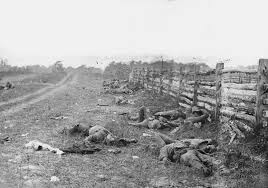
The battle also presented the first photographed images of the war’s true horror shot by Alexander Gardner who’d been sent by famed photographer Matthew Brady to catalogue the action in real time. Gardner followed the troops and photographed tragic sights unfiltered by a brutally honest camera lens. What Brady would eventually display in his Broadway studio a month later was a shock to the sheltered civilian populous whose only exposure to Civil War combat up until then had been romanticized newspaper lithographs. His exhibit was called simply: “The Dead Of Antietam.” The New York Times somberly wrote about Brady’s images: “Mr. Brady has done something to bring home to us the terrible reality and earnestness of war. If he has not brought bodies and laid them in our dooryards and along the streets, he has done something very like it.”
Find out what's happening in Westfieldfor free with the latest updates from Patch.
But the war continued. Although further disappointment awaited the Union cause at the blood-lettings of Fredericksburg and Chancellorsville, Antietam demonstrated to the Army of the Potomac, indeed Lincoln himself, that they could fight with mettle equal to that of their vaunted Southern opponents. The seeds of Gettysburg and beyond were sown on the fields of Sharpsburg . It would only take proper leadership at the very top for the Union army to eventually prevail. When asked by an elderly slave woman in Sharpsburg after the battle if he’d had a hard fight, an exhausted Rebel soldier replied: “Yes Aunty. The Yankees gave us the devil today. And they’ll give us hell tomorrow.”
But that tomorrow never came. Despite his army’s battered condition, Lee chose to remain on the smoldering field on the 18th, daring his opponent across the creek to renew the assault. But McClellan idled away the hours and eventually the day. He would allow Lee to escape that night back across the Potomac River to live to fight another day.
Lee’s senior general, James Longstreet, noted that at one point during the battle the situation for the Rebels was so precarious that during the thick of the fighting, with his lines in disarray and fresh battalions of blue troops just waiting for the order to move forward clearly visible on the bluffs east of the creek, he personally minded his staff’s horses so they could serve an artillery piece whose crew had been killed. The Southern soldier-historian and veteran of the battle, Porter Alexander, would write: “Lee’s army was ruined and the end of the Confederacy was in sight.” But it would not end that day. McClellan may have been the right man to organize his army after the summer defeats and restore its fighting spirit for “Little Mac” as he was affectionately known, was very popular among the Union rank and file. But he was the wrong man to take it into battle. McClellan, unbeknownst to Lee, had a copy of Lee’s plan of battle laying out in great detail his enemy’s dispositions, literally in his hands. (Incredibly the papers were found in an abandoned Rebel camp wrapped around some cigars!) But even this amazing intelligence coup was not enough to prompt the hyper-cautious general to move. Fearing defeat more than savoring victory, completely outclassed and very much intimidated by the brilliant Confederate commander who'd defiantly challenged him to fight it out, he never saw the opportunity to destroy the South’s principal army that was laid bare before him. Because of the hopelessly timid George McClellan, Antietam was the great missed opportunity to end the war.
In a way the sportsman in me likes the notion that the battle was a tie, so to speak. With such bravery and suffering exhibited by both sides, it would seem a shame that either army should lose such a desperate fight. The South's survival that day ultimately can be attributed to the exceptional skills of its high command: General Lee, and his two corps commanders, the aggressive “Stonewall” Jackson and the rock-steady Longstreet. Some say that Lee considered Antietam his finest battle, believing his men had shown their best against the worst odds. From a purely military standpoint, Lee certainly never should have fought there. But for his opponent being George McClellan he probably would not have. Despite being badly outnumbered and out gunned, Lee, perhaps displaying the first flashes of overconfidence that would be his undoing, simply believed he could whip McClellan and that was enough to offer battle. Yet once the fight was joined, he moved his units back and forth over the field like a chess master.
But Lee’s efforts there and elsewhere would not be enough to stave off the inevitable defeat that finally came to pass in April 1865. So long as Lincoln remained committed to the cause, which he was until his death, the South was never going to win the Civil War. That it did not end in September 1862 is a tragedy equal to the story of the Battle of Antietam itself considering the endless casualty lists of the subsequent two and a half years. But I like to think the legacy of generations of free men and women, whose chains first began to dissolve 151 years ago today, gives the 23,000 dead and wounded of Antietam sublime meaning after all.