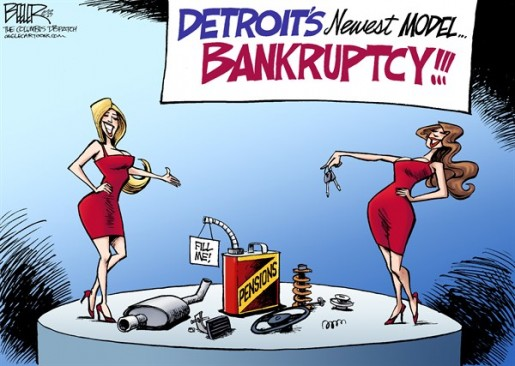
On July 18 2013, the city of Detroit officially filed for bankruptcy under Chapter 9. At $18 billion, this is the largest municipal bankruptcy in U.S. history.1 According to the current “proposal to creditors”2, the city’s pension plans have been chronically underfunded and the gap between the plan’s assets and liabilities now stands at approximately $3.5 billion. Additionally, the value of unfunded “other post-employment benefits” (OPEB) such as life insurance, health care, etc., now reaches $5.7 billion.There is thus a $9.2 billion gap between the total assets and the liabilities of Detroit’s pension and benefits system (see Table 1).
According to the restructuring plan, the city intends to write off the entirety of the $3.5 billion pension deficit and give the OPEB liabilities (which are basically not funded at all) the same treatment as bondholders – a 90% haircut. The net result is that pensioners could lose $8.6 billion of future benefits, or 41% of the value of all the benefits (pension plus OPEB) they were entitled to before the city’s bankruptcy filing. Obviously, such a large clawback will have a profound effect on the livelihoods of the pensioners. Doubtless, this will have repercussions that will also affect the economic activity of the communities in which they live. What still puzzles us is how predictable Detroit’s problems were and how little was done to fix them before it was too late.